

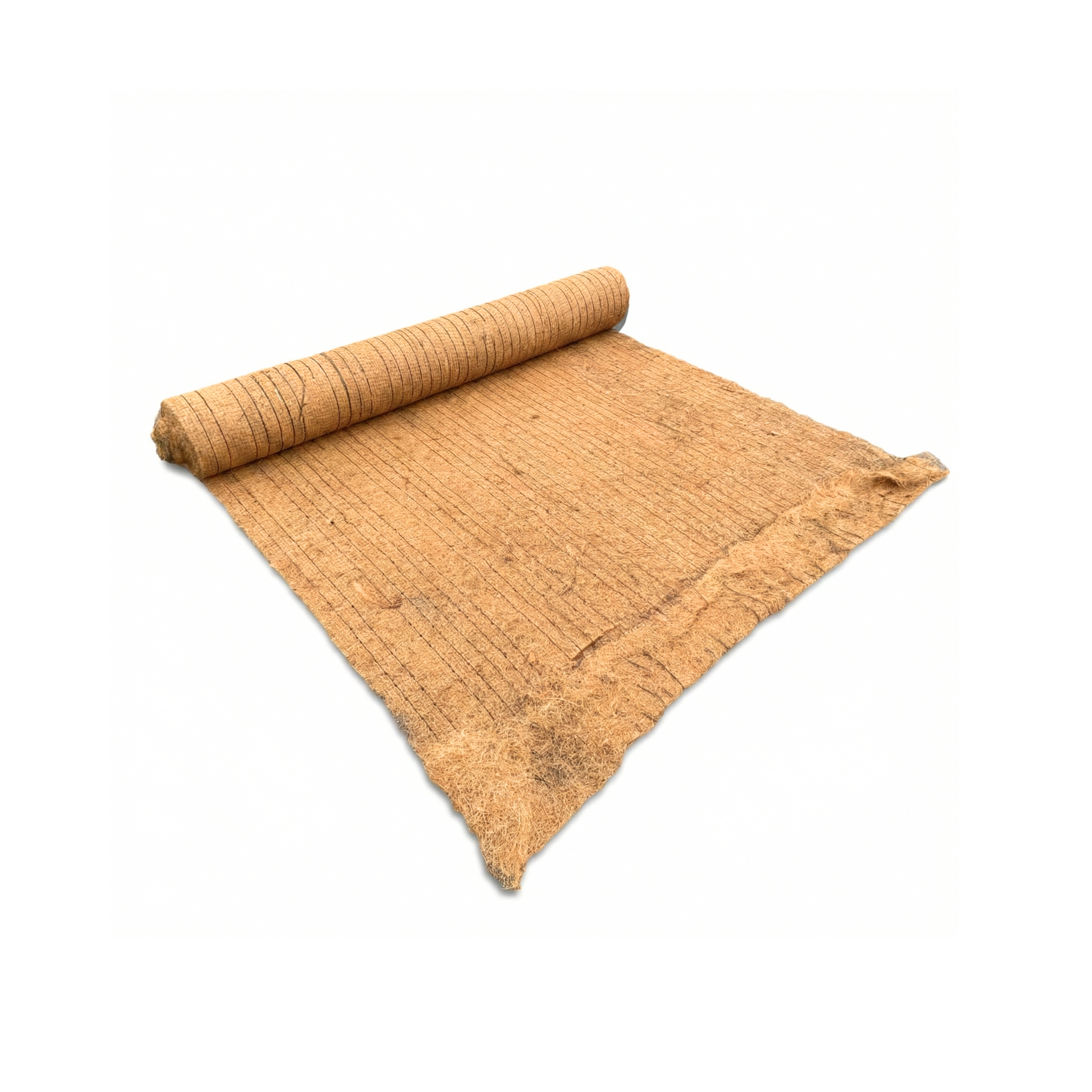
This guide covers the installation of the coir erosion-control blanket: surface preparation, excavation of the upper anchor trench, seeding before deployment, top-to-bottom unrolling, anchoring to the ground, overlap between rolls and closing with initial watering. Follow these steps to control erosion on slopes and allow vegetation to establish before the fiber biodegrades.
Product specifications
The coir erosion-control blanket is a 100% biodegradable organic blanket made of pressed coir fiber stitched onto natural nets. It works as an anti-erosion protective layer over bare soil: it cushions the impact of Caribbean rain, retains fine particles, conserves moisture to promote germination and breaks down adding organic matter to the soil. The Dodom range comes in a single standard configuration, sized for landscaping work, riverbank restoration and stabilization of residential or agricultural slopes.
| Specification | Coir erosion-control blanket 280 g/m² |
|---|---|
| SKU | 658443 |
| Material | Coir fiber with support net |
| Weight | 280 g/m² (8.3 oz/yd²) |
| Roll width | 2.5 m (8.2 ft) |
| Roll length | 40 m (131 ft) |
| Coverage per roll | 100 m² (1076 ft²) |
| Biodegradability | 100% natural |
Step-by-step instructions for use
The success of the erosion-control blanket depends almost entirely on the installation. If the blanket sits in full contact with the soil and is anchored without tension, the vegetation germinates underneath and grows through the fiber before it degrades. If there is a gap, water runs underneath and washes away the seed. Follow the strict order indicated below.
Prepare the surface
Remove loose stones, thick roots and plant debris from the slope or bank. Level depressions by filling them with soil from the site itself and compact lightly. The surface must be smooth: any gap under the blanket is an erosion path that water will exploit.
Excavate the upper anchor trench
At the crest of the slope, dig a trench 15 to 20 cm (6 to 8 in) deep and about 15 cm (6 in) wide, parallel to the slope. This trench will receive the upper edge of the erosion-control blanket and will be the key element that prevents water from slipping over the top of the roll.
Seed before covering
Spread the seed directly over the prepared ground, before placing the blanket. The erosion-control blanket works as a protective mulch: it lets light and moisture through but cushions the impact of the rain. Seeding underneath ensures direct contact of the seed with the soil and uniform germination.
Unroll the roll from top to bottom
Place the roll at the crest and unroll it following the slope, never parallel to it. Insert the first edge into the anchor trench. Let the blanket fall under its own weight without stretching it: it should rest on the ground like a sheet, in full contact with the soil across its entire surface.
Anchor the erosion-control blanket to the ground
Drive metal staples in a staggered pattern every 1 m (3.3 ft) in the body of the roll and every 50 cm (20 in) along the edges. In the upper trench, drive a dense row of staples, backfill with soil and compact. For steep slopes, replace the staples with metal rods fitted with an anchor cap every 80 cm (32 in).
Overlap adjacent rolls
When you reach the end of the first roll, start the next one overlapping 15 cm (6 in) over the previous one, always in the direction of water flow: the lower roll goes under the upper one. The same applies between side-by-side rolls: the one downstream always overlaps underneath. Reinforce the overlap line with an additional row of staples.
Close the lower edge and water
Dig a second trench at the foot of the slope, bury the lower edge and compact. Water the entire surface with a gentle spray: the first watering settles the fiber, improves contact with the soil and activates germination. Maintain light daily watering for the first 2 to 3 weeks.
In the Caribbean zone with intense tropical rain, install the erosion-control blanket with the smoother side facing down and the loose-fiber face facing up. That exposed face cushions the impact of large droplets better and retains more moisture for germination during the dry season.
Do not stretch the erosion-control blanket as if it were a tarp. If it is left taut in the air, water runs underneath, lifts the blanket and washes away seed and soil in a few hours. It must remain loose, in full contact with every irregularity of the ground. If you see a gap, add one more staple, do not stretch.
Complementary products
The erosion-control blanket does not hold itself in place: it needs anchoring to the ground and, in most projects, a seed under the fiber that is what truly fixes the soil once the blanket has degraded. These three complementary products cover both fronts and are the ones we recommend for a standard installation on a slope or bank.
The metal garden staple is the standard anchor for slopes and banks with a moderate gradient: quick to drive in and sufficient to hold the blanket under normal conditions. The anchor cap for metal rod is used when the slope exceeds 30% or the soil is very loose, since the rod penetrates deeper and the cap spreads the pressure over the fiber. The Bermuda grass seeds are the ground cover most resistant to the Caribbean sun and to foot traffic, ideal for establishing permanent cover before the erosion-control blanket breaks down.
Maintenance and care
The coir erosion-control blanket is a biodegradable product, so "maintenance" is really about ensuring that the vegetation establishes before the fiber breaks down. These are the critical guidelines:
- Intensive initial watering: for the first 2 to 3 weeks, water daily with a gentle spray. This is the period when the seed germinates under the fiber.
- Inspection after each heavy rain: check the anchor trenches and the overlaps in particular. If you find any detached area, add staples and backfill with soil. Do not wait for the damage to progress.
- Zero traffic for 60 days: no people or animals on the erosion-control blanket until you see visible germination. Foot traffic compacts the fiber against tender roots and kills the cover.
- Storage of leftover roll: keep it in a dry place, raised off the ground and covered. Coir fiber absorbs ambient moisture and, once wet, begins to break down even if it is not installed.
- Real service life on site: in the Caribbean climate the fiber degrades completely within 18 to 36 months, depending on exposure to sun and rain. The vegetative cover should be fully closed well before that deadline.
Frequently asked questions
How long does the coir erosion-control blanket take to biodegrade?
In the Dominican climate, with intense sun and frequent rains, the coir fiber degrades completely within 18 to 36 months. This is a longer period than for a straw or jute blanket, which gives you ample margin for the vegetation to establish and take over erosion control.
Up to what slope can I use the coir erosion-control blanket?
The 280 g/m² coir erosion-control blanket works well on slopes up to 1V:1.5H (around 33° or 67% gradient). Above that value, it is still valid, but you will need to switch the metal staples for rods with an anchor cap and reduce the spacing to 60 cm (24 in). On vertical or near-vertical slopes, the correct solution is a synthetic erosion-control mat, not a coir blanket.
Do I need to place a geotextile under the blanket?
In most cases, no. The blanket rests directly on the prepared soil and the fiber itself acts as a filter. Adding a nonwoven geotextile underneath is only recommended when the soil is very fine and the goal is to prevent loss of fine particles into a sensitive watercourse, or when seeding will be done over a substrate very different from the original one.
