

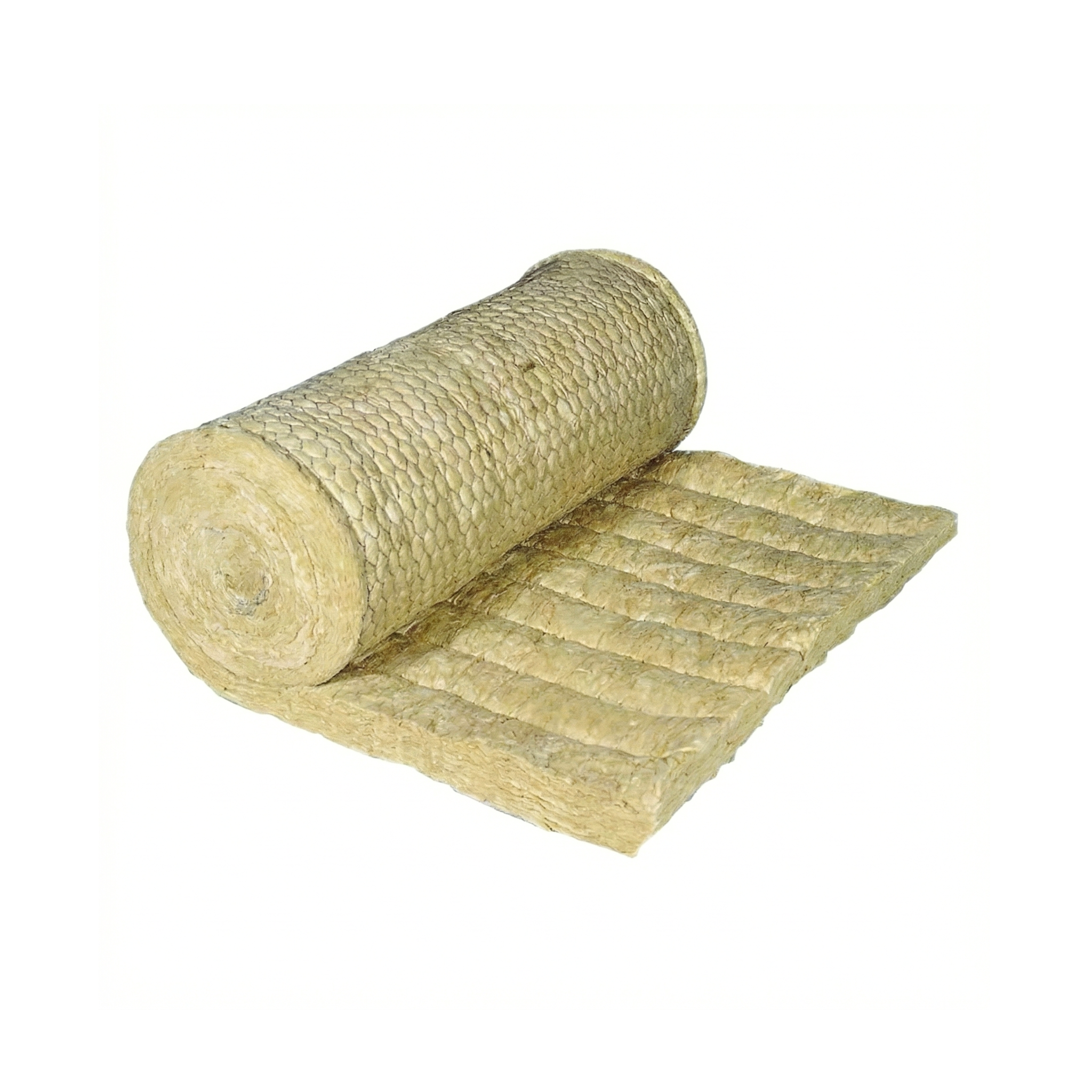
If you operate an industrial plant with steam pipes, hot water lines, boilers, furnaces, steam generators or cylindrical tanks where the insulation must conform to curved surfaces and maintain integrity under high temperature, the rock wool roll with sewn galvanized net is the standard industrial choice. This guide explains how to measure the material needed based on pipe diameter and length, how to wrap it with the correct orientation, how to fasten it with soft galvanized wire, and how to handle the protective outer cover depending on whether you are dealing with a hot fluid (metal jacket) or a cold fluid (vapor barrier with aluminum tape).
The netted roll is the right product for cylindrical and curved surfaces. For flat surfaces —drywall partitions, suspended ceilings, facades, firebreak separators— the choice is the semi-rigid rock wool panel, which installs between metal framing studs. Confuse the formats and you waste time: the panel does not conform to pipes and the roll does not fit between studs at 60 cm.
Product specifications
The netted roll is offered in a single variant calibrated for standard industrial insulation of pipes and thermal equipment. The following table gathers the complete technical specifications:
| Specification | Value |
|---|---|
| SKU | 432165 |
| Material | Volcanic rock wool with galvanized metal net sewn on one face |
| Density | 100 kg/m³ (6.24 pcf) |
| Thickness | 50 mm (2 in) |
| Roll dimensions | 0.6 m × 5 m (2 ft × 16.4 ft) |
| Area per roll | 3 m² |
| Thermal conductivity λ | ~0.040 W/m·K |
| Reaction to fire | A1 non-combustible |
| Melting point | Above 1000 °C |
| Recommended application | Pipes, boilers, furnaces, cylindrical tanks, curved ducts |
| Not suitable for | Flat drywall partitions (use the semi-rigid panel) |
The galvanized metal net sewn on one face performs three functions simultaneously: (1) it holds the wool, preventing it from coming loose when wrapping curved surfaces, (2) it provides a fastening platform for soft galvanized wire or metal strapping without the need for adhesives, and (3) it preserves the declared thickness of the insulation during continuous operation. The net always goes on the OUTSIDE (the side opposite the insulated equipment) and the wool on the INSIDE in contact with the pipe or boiler.
The semi-rigid panel is the sister choice when the surface is flat: drywall partition walls, suspended ceilings, sun-exposed facades and firebreak separators.
Step-by-step guide to using it
The following procedure covers the installation cycle of the netted roll in industrial insulation of pipes and thermal equipment.
Calculating the material needed
For pipes, calculate the insulated perimeter development: perimeter × length × overlap factor. The insulation perimeter is π × (pipe diameter + 2 × wool thickness) = π × (D_pipe + 100 mm). The recommended overlap factor is 1.10 for straight pipes and 1.15-1.20 for runs with elbows, tees and valves. Example: a 200 mm diameter pipe × 20 m with 50 mm of wool → π × 0.30 m × 20 m × 1.10 = 20.7 m² → 7 rolls (3 m² each) with usable surplus. For boilers or cylindrical tanks, add the cylindrical and flat surfaces of the heads, applying the same overlap.
Surface preparation and section-by-section planning
Clean the pipe or boiler of loose rust, dirt and debris. For pipes with surface moisture, let them dry completely before wrapping —moisture trapped under the wool accelerates corrosion of the insulated metal and degrades the insulation—. Plan the installation in SECTIONS, keeping flanges, valves, measuring instruments (thermometers, pressure gauges) and joints that require periodic maintenance accessible. Insulating continuously over these points forces you to cut the entire insulation when access is needed, multiplying the maintenance cost.
Wrapping the roll
Unroll the roll and bring it up to the pipe diameter with the galvanized net facing OUT and the wool in direct contact with the surface to be insulated. Pull the roll with moderate tension so the wool hugs the pipe without slack, but do NOT compress the material —see warning below—. Overlap a minimum of 5 cm at the longitudinal joint and 10 cm at transverse joints between sections. Close the longitudinal joint with the net from the outgoing end of the roll covering the net of the incoming end, so the joint stays protected and does not expose loose wool.
Fastening with soft galvanized wire
Secure the insulation with 1.0-1.5 mm ø soft galvanized wire wound at intervals of 20-30 cm on vertical pipes and 30-40 cm on horizontal pipes. The wire is wound around the perimeter over the galvanized net of the roll, fastened by twisting the ends with pliers. On runs where equipment vibration is high (near pumps, compressors), increase the fastening frequency to prevent progressive sliding of the insulation. On elbows, intensify additional anchors so the wool does not decompress on the inner side of the elbow.
For COLD pipes —chilled water from an HVAC chiller, liquefied gases, refrigerated brines— the vapor barrier on the outer face of the insulation is MANDATORY, not optional. Without a vapor barrier, ambient moisture migrates toward the cold pipe, condenses inside the wool and saturates it within a few months, rendering the insulation useless and promoting corrosion under insulation (CUI). The solution is to apply aluminum adhesive tape sealing all the longitudinal and transverse joints of the insulation on the outer face, with a minimum overlap of 5 cm. On hot pipes the vapor barrier does not apply (vapor migration is reversed) but an aluminum or galvanized outer jacket is advisable for mechanical and UV protection outdoors.
Finishing according to fluid type
For pipes or equipment with hot fluids (steam, hot water, thermal oil) in a protected interior, the galvanized net of the roll is an acceptable functional finish. Outdoors or in high-traffic personnel areas, install an outer metal jacket (aluminum or galvanized jacket of 0.5-0.8 mm) over the insulation, fastened with self-drilling screws in a downward direction so rainwater does not get in. For pipes with cold fluid, seal all joints with aluminum adhesive tape before installing the outer jacket, ensuring a continuous vapor barrier. Identify each section with labels for the fluid and flow direction according to plant code.
Do not insulate continuously over flanges, valves, instruments and joints that require periodic maintenance. When the time comes to tighten a flange, replace a thermometer or repair a valve, running into continuous insulation forces you to cut 1-2 meters of complete wrapping, reinstall afterward and redo the vapor barrier sealing with significant time and cost. The standard industrial practice is to insulate by straight SECTIONS, leaving flanges and valves with removable insulation in removable covers (insulation jackets) or accessible to remove the wrapping at a specific point without affecting the rest of the system. This planning is done before starting, with the plant's isometric drawing and the maintenance points marked.
Complementary products
To complement the netted rock wool roll in industrial insulation of pipes and thermal equipment, the following products cover the most common adjacent needs:
The rock wool panel is the sister product for flat surfaces (drywall, suspended ceilings, facades), where the netted roll does not apply. The aluminum adhesive tape is the natural tool to seal longitudinal and transverse joints of the insulation, essential in the vapor barrier for pipes with cold fluids. The polypropylene strapping serves to secure surplus rolls in storage (not for fastening the insulation onto the pipe, which is done with soft galvanized wire). The 3-runner plastic pallet is the internal transport base when the rolls arrive at the plant and must be distributed across the warehouse to the installation area.
Maintenance and care
The netted roll, correctly installed and protected with an outer jacket or aluminum adhesive tape in a vapor barrier, maintains performance throughout the entire service life of the insulated equipment, frequently decades. Periodic inspection should focus on: (a) outer finish (jacket or aluminum tape) without perforations from impacts, advanced surface oxidation or open joints; (b) elbow and valve areas where the soft-wire fastening can loosen due to vibration; (c) points where the outer galvanized net begins to rust outdoors in a salty coastal climate. When areas with failures appear (moisture under the insulation on a cold pipe, the sound of loose insulation tapping on a hot pipe with vibration), repair at that specific point by replacing the affected section.
For storage prior to installation, keep the rolls in a horizontal position on flat skids, in a covered area away from water. The rolls absorb moisture if stored out in the open even for a few days in a Caribbean climate; if a roll gets rained on, let it dry 48-72 hours in a ventilated area before installing. Inspect each roll before bringing it down to the job site to identify deformations, galvanized net damaged by impacts or wool loosened by accidental cuts in transport.
Frequently asked questions (FAQ)
How do I calculate how many rolls I need?
For pipes, calculate: (π × (pipe diameter + 2 × wool thickness)) × insulated length × overlap factor (1.10 for straight runs, 1.15-1.20 with elbows and valves). Divide by 3 m² per roll and round up. For a 200 mm × 20 m pipe with 50 mm wool: π × 0.30 × 20 × 1.10 = 20.7 m² → 7 rolls. For cylindrical tanks, add the cylindrical surface of the body plus the surface of the heads, applying the same overlap. In complex installations with many valves and flanges, raise the factor to 1.20-1.25 so you don't fall short and avoid ordering loose rolls with additional freight.
What outer jacket should I use in a Caribbean climate?
For pipes or equipment outdoors in a salty Caribbean climate (Punta Cana, La Romana, north coast), the aluminum jacket of 0.5-0.8 mm thickness is the standard option for its excellent resistance to marine corrosion and light weight. The galvanized jacket is an economical alternative for inland areas of the country without direct marine exposure. Fasten with self-drilling screws with a neoprene seal in a downward direction (upper side covers lower side) so rainwater runs off without getting in. In coastal areas with intense salt spray, aluminum lasts significantly longer than galvanized, which begins to rust after 2-3 years.
Is it suitable for a cold air-conditioning pipe?
Yes, but EXCLUSIVELY with a continuous vapor barrier sealed on the outer face of the insulation. Without a vapor barrier, ambient moisture migrates toward the cold pipe, condenses inside the wool and saturates it within a few months, rendering the insulation useless and promoting corrosion under insulation (CUI), one of the most costly problems in plants with refrigerated systems. The solution is to apply aluminum adhesive tape over the entire surface and joints of the insulation on the outer face, with a minimum overlap of 5 cm, BEFORE installing the outer jacket. For large HVAC chillers and industrial refrigerated lines, also consider alternative insulation specific to low temperature (elastomeric foam) on lines with reduced dimensions where the netted roll is excessive.
