

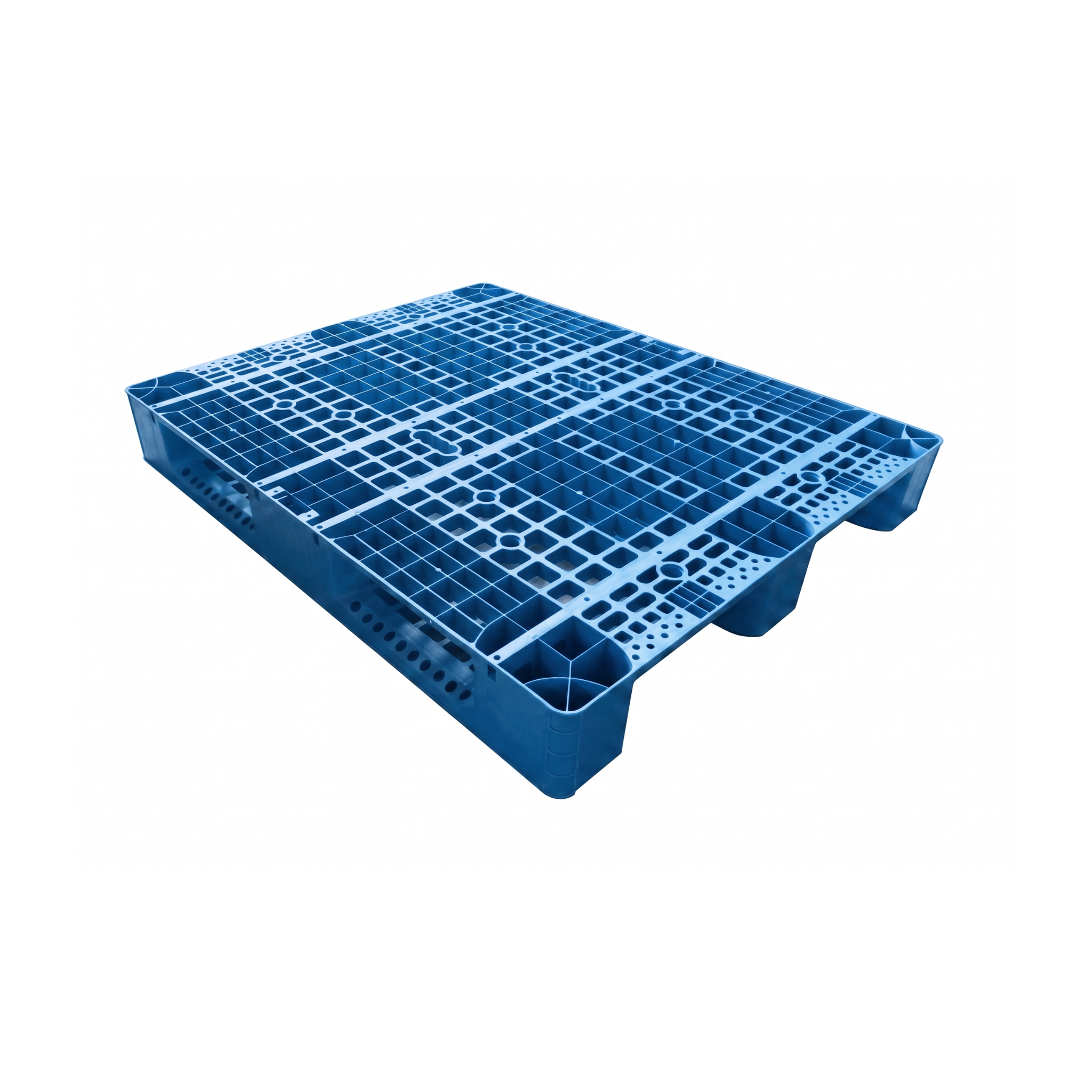
The 3-runner plastic pallet is available in two formats: American (120 × 100 cm) and European (120 × 80 cm), both in blue and manufactured from virgin plastic with high UV protection. Both are 4-way (fork entry on all four sides) and share a static load capacity of 4,000 kg, but they differ in dynamic capacity and racking load. The choice between American and European depends on your company's logistics system, your customers and your storage modulation.
🎯 Choose the variant in 10 seconds
- If your case is trade with the USA, 40′ containers or product sold by the full unit: go to the American variant (120 × 100 cm)
- If your case is trade with Europe, compact storage or European racking: go to the European variant (120 × 80 cm)
What to consider before choosing the variant
The two variants share construction (3 runners), material (virgin plastic), color (blue), entry type (4-way), weight (14.3 kg) and high UV protection. The choice is based on the logistics system and load capacities:
- Origin and destination logistics system: the American format (120 × 100 cm) is standard in the USA, Mexico, Central America and most Caribbean countries, including the Dominican Republic. The European format (120 × 80 cm) is the EUR/EPAL standard in the European Union. If you export or import, align with the destination's standard to optimize container loading.
- Container optimization: a 40′ (12.03 m) ocean container holds 20 American pallets on the floor or 25 European pallets. A 20′ (6.06 m) container holds 10 American or 11 European. If your cargo is already palletized on European pallets, keeping the format avoids costly re-stacking at the border.
- Rack storage: the American pallet has a higher racking load capacity (1,000 kg) than the European (800 kg). This matters in warehouses with selective racking where the pallet rests only on the beams. If the load exceeds 800 kg per pallet and goes into racking, prefer the American one.
- Dynamic load: in transport and forklift handling, the American supports up to 1,500 kg and the European up to 1,000 kg. For heavy goods such as beverages, cement bags or chemical products, weigh this difference. For light goods (textiles, cardboard, dry products), both variants are suitable.
- Box and product modulation: the width of the pallet conditions the modulation of the boxes you stack. Boxes designed in the 600 × 400 mm module fit perfectly on the European one (four boxes per level without overhang). Boxes in the American 24 × 16 in module (610 × 406 mm) stack better on the 120 × 100 format.
American variant (120 × 100 cm): the standard for the Americas and dynamic load
- Logistics standard in the Americas and Caribbean
- Larger usable surface: 1.20 m² per pallet
- Dynamic load 1,500 kg
- Racking load 1,000 kg
- Larger footprint in the warehouse
- Fewer pallets per ocean container
The American pallet is the logistics standard for companies operating in the USA, Mexico, Central America and the Caribbean, including the Dominican market. Its usable surface of 1.20 m² accommodates boxes in the American module and allows dynamic loads up to 1,500 kg, which makes it suitable for heavy goods such as beverages, construction materials or chemical products. The racking load capacity of 1,000 kg makes it compatible with most industrial racking installations.
European variant (120 × 80 cm): the compact one for Europe and dense storage
- Logistics standard in the European Union
- Optimizes pallets per ocean container
- Fits with 600 × 400 mm modular boxes
- Better use of space in European warehouses
- Dynamic load 1,000 kg (33% less than American)
- Racking load 800 kg
- Smaller usable surface: 0.96 m² per pallet
The European pallet is the standard for companies with trade flows toward the European Union or storage installations designed in the EUR module. Its smaller width allows you to optimize the number of pallets per ocean container and fits perfectly with boxes in the 600 × 400 mm module, very common in pharma, food and consumer goods. For companies with compact warehouses where cost per m² matters, the European format allows more SKUs in the same space.
Variant comparison table
The two variants share construction (3 runners), material, color, entry type and weight. The difference lies in the dimensions and, associated with that, in the dynamic and racking load capacity.
| Feature | American | European |
|---|---|---|
| Ideal use | Americas and Caribbean | Europe and dense storage |
| SKU | 562100 | 654231 |
| Dimensions (length × width) | 120 × 100 cm (48 × 40 in) | 120 × 80 cm (48 × 32 in) |
| Construction | 3 runners | 3 runners |
| Material | Virgin plastic | Virgin plastic |
| Color | Blue | Blue |
| Fork entries | 4-way | 4-way |
| Static load | 4,000 kg | 4,000 kg |
| Dynamic load | 1,500 kg | 1,000 kg |
| Racking load | 1,000 kg | 800 kg |
| Unit weight | 14.3 kg | 14.3 kg |
| UV protection | Yes (high) | Yes (high) |
| Usable surface | 1.20 m² | 0.96 m² |
Use case → recommended variant matrix
| If your case is… | Recommended variant |
|---|---|
| You export product to the USA, Mexico or Caribbean | → American |
| Heavy unit load (beverages, construction materials) | → American |
| Warehouse with racking and loads over 800 kg | → American |
| You export product to the European Union | → European |
| Warehouse with boxes in the 600 × 400 mm module | → European |
| Light or medium load in a compact warehouse | → European |
If your company operates with mixed customers, the most efficient approach is to standardize on the dominant format (American for the DR/USA market, European if you export mainly to the EU) and keep a reserve of the other format for customers who require it. Changing the pallet at the border or in the customer's warehouse is costly (labor, shrink-wrapping, risk of damaging the load). If you are unsure which format your customer requests, ask for written specification before palletizing the load.
Do not exceed the declared loads trusting that the pallet "looks sturdy." The static (4,000 kg), dynamic (1,500 / 1,000 kg) and racking (1,000 / 800 kg) load capacities are limits measured under test conditions; exceeding them drastically reduces service life and increases the risk of failure during handling. If your load exceeds the limits, consider higher-capacity models such as 9-runner or reinforced pallets.
Frequently asked questions
3 runners or 9 runners?
The 3-runner pallet (this product) has three longitudinal crossbars on the base, which makes it lighter and more economical. The 9-runner pallet has a 3 × 3 grid that provides greater stability and supports higher point loads. For goods in standard boxes and operation with a conventional forklift, 3 runners are sufficient. For loads with small or irregular bases, or when handled with a manual pallet truck, 9 runners offer better performance.
Is virgin plastic important?
Yes. Virgin plastic offers consistent and certified mechanical properties, whereas recycled plastic can show variability in strength and UV behavior. For applications with sanitary requirements (food, pharma) or exposure to the elements, virgin plastic is the standard choice and the one that complies with regulations. In addition, virgin plastic pallets have a more predictable service life and are safer for long-term racking use.
What advantages does plastic have over wood?
The plastic pallet does not require ISPM-15 phytosanitary treatment for international export, does not splinter, does not accumulate moisture or fungi, generates no waste, is lighter (14.3 kg vs 25–30 kg for a wooden pallet) and has a longer service life (5–10 years). It is the preferred option in the pharmaceutical, food and international logistics industries. The initial investment is higher than with wood, but the cost per use over time is usually lower.
