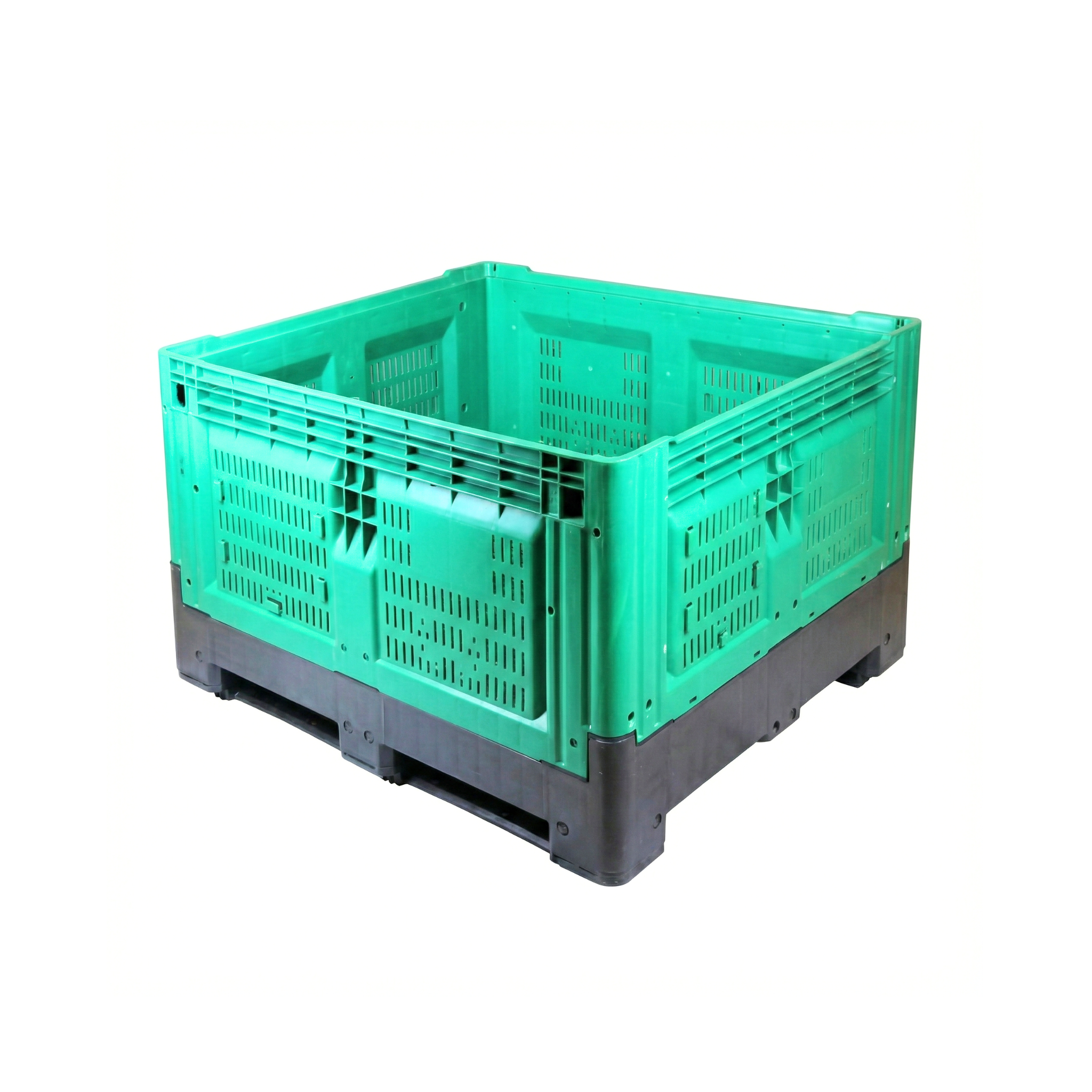
The collapsible plastic pallet box is offered in two components: the pallet box itself (the complete collapsible box with integrated pallet base) and the compatible lid that closes it from above. Both share an American format of 120 × 100 cm and a green and gray color combination, manufactured from virgin plastic with high UV protection. The difference is functional: the pallet box is the main container; the lid is the accessory that closes it and allows stacking. The choice comes down to whether your operation needs top closure, stacking, or protection against dust and handling.
🎯 Choose the variant in 10 seconds
- If your case is an open container for auto parts, bulk fruit, or frequently handled product: go to the collapsible pallet box
- If your case is to close the load, stack full boxes, or protect from dust and moisture: add the compatible lid
What to consider before choosing the variant
The pallet box and lid are not alternatives: they are complementary components. The question is not "which of the two," but whether your operation needs to close the box from above. These are the criteria for deciding:
- Type of merchandise: bulk merchandise (fruit, vegetables, auto parts, industrial components) is often transported open to facilitate manual loading and unloading. Product sensitive to dust, moisture, or light (electronics, processed food, chemicals) requires a lid for protection.
- Stacking of full boxes: without a lid, collapsible boxes cannot be stacked when full because the upper load would crush the contents inside. With a lid, 2–3 full boxes can be stacked depending on the capacity of each level and the weight of the load, which multiplies space utilization in the warehouse.
- Traceability and security: the lid allows the load to be sealed, makes tampering difficult, and reduces the risk of loss in transit. For valuable merchandise or shipments requiring access control to the contents, the lid is essential.
- Volume reduction when returning empty: the pallet box folds from 76 cm to 30 cm in height, reducing the volume to 40% when returned empty. The lid is independent and can be transported separately. This feature is key in a returnable logistics pool.
- Compatibility: the lid is specifically compatible with this model's collapsible pallet box. Its dimensions (1,210 × 1,010 mm) fit the upper edge of the unfolded pallet box. Do not use lids from other models without verifying dimensional compatibility.
Collapsible pallet box: the main container
- Capacity 597 L (158 gal)
- Static load 4,500 kg
- Dynamic load 1,500 kg
- Folded to 30 cm: optimizes empty return
- Ventilated sides: ideal for fruit
- Not stackable when full without a lid
- Contents exposed without a lid
The collapsible pallet box is a container with an integrated pallet base and folding sides that rise to form a box with a capacity of 597 L. Its ventilated sides allow internal air circulation, making it especially suitable for fruit, vegetables, and products that need ventilation or heat dissipation. When returned empty, the sides fold down, reducing the height to 30 cm, allowing three folded boxes to be loaded in the space that one unfolded box would occupy. It is the standard option in returnable logistics pools for auto parts, agri-food, and mass consumption.
Compatible lid: the accessory for closing and stacking
- Allows stacking of full boxes
- Protects against dust, moisture, and light
- Enables load sealing
- Low weight: 5 kg
- Firm fit on the top edge
- Additional cost over the pallet box
- Extra volume when transported separately
The lid is the compatible accessory that closes the top of the collapsible pallet box. Its dimensions (1,210 × 1,010 × 85 mm) fit exactly over the edge of the unfolded pallet box, forming a closed surface that allows three key uses: it protects the contents from dust, moisture, and direct light; it allows full boxes to be stacked because it distributes the weight of the upper load over the edges; and it facilitates sealing for merchandise with security requirements. Its weight of only 5 kg means minimal impact on the declared tare weight.
Comparative table of variants
The pallet box and lid are complementary components, not alternatives. Here are their characteristics to compare dimensions, weights, and function.
| Feature | Collapsible pallet box | Lid |
|---|---|---|
| Function | Main container | Closure and stacking |
| SKU | 373812 | 599111 |
| Dimensions unfolded | 120 × 100 × 76 cm | 1,210 × 1,010 × 85 mm |
| Dimensions folded | 120 × 100 × 30 cm | — |
| Internal volume | 597 L (158 gal) | — |
| Static load | 4,500 kg | — |
| Dynamic load | 1,500 kg | — |
| Unit weight | 42 kg | 5 kg (11 lb) |
| Material | Virgin plastic | Virgin plastic |
| Color | Green and gray | Gray |
| Ventilated sides | Yes | — |
| UV protection | Yes (high) | — |
Use case matrix → recommended variant
| If your case is… | Recommended components |
|---|---|
| Harvesting fruit or vegetables in the field | → Pallet box only |
| Auto parts or industrial components in a returnable pool | → Pallet box only |
| Finished product for warehouse stacking | → Pallet box + lid |
| Merchandise sensitive to dust, moisture, or light | → Pallet box + lid |
| Valuable cargo or sealed shipment | → Pallet box + lid |
| Multi-story warehouse on rack or block | → Pallet box + lid |
If your operation is mixed (part of the merchandise is transported open and part closed), purchase a proportion of lids equivalent to the percentage of loads that require closure. A typical proportion is 1 lid for every 2–3 pallet boxes, but adjust according to your flow. Lids are stored stacked separately from folded boxes and assembled when loading the pallet at the destination. This optimizes cost without saturating the warehouse with unused accessories.
Do not stack full pallet boxes without a lid. Although the plastic sides are rigid, they were designed to support the weight of the internal contents, not the concentrated load of another box resting on top. Stacking full boxes without a lid can deform the upper sides, lead to structural failure, and crush the contents. If you need to stack, always install the lid first; if you don't have a lid, limit storage to a single height.
Do you need a pallet box with or without a lid?
Tell us what product you will be transporting, if you need to stack full boxes, and if the merchandise is sensitive to dust or humidity. You will receive a recommendation on how many pallets and lids to order, and how to combine them in your operation.
Frequently Asked Questions
How does it fold and unfold?
The sides of the pallet box are hinged to the base. To unfold, lift each side in order (first the longer ones, then the shorter ones) until they engage in their vertical position using a snap and hinge mechanism. To fold, release the latches and lower the sides towards the inside of the base. One person can perform the operation in less than a minute without the need for tools.
How many folded boxes fit in the space of one unfolded box?
An unfolded box is 76 cm high. When folded, it reduces to 30 cm, although two stacked folded boxes use approximately 60 cm, which is what an unfolded one would occupy with some margin. In logistics practice, 5-6 folded boxes are usually stacked to the same height as 2 unfolded boxes, drastically reducing the cost of empty return transport.
Which industries commonly use it?
It is very common in agribusiness (harvesting and transporting fruits and vegetables), automotive (auto parts in a returnable pool between supplier and assembly plant), fishing (transporting catches from port to processing plant), chemical industry (bulk for powdered products), and mass consumption (internal inventory movement in large warehouses). In each case, the ventilated sides, the 597 L capacity, and the ability to fold for return are decisive advantages compared to other formats.