

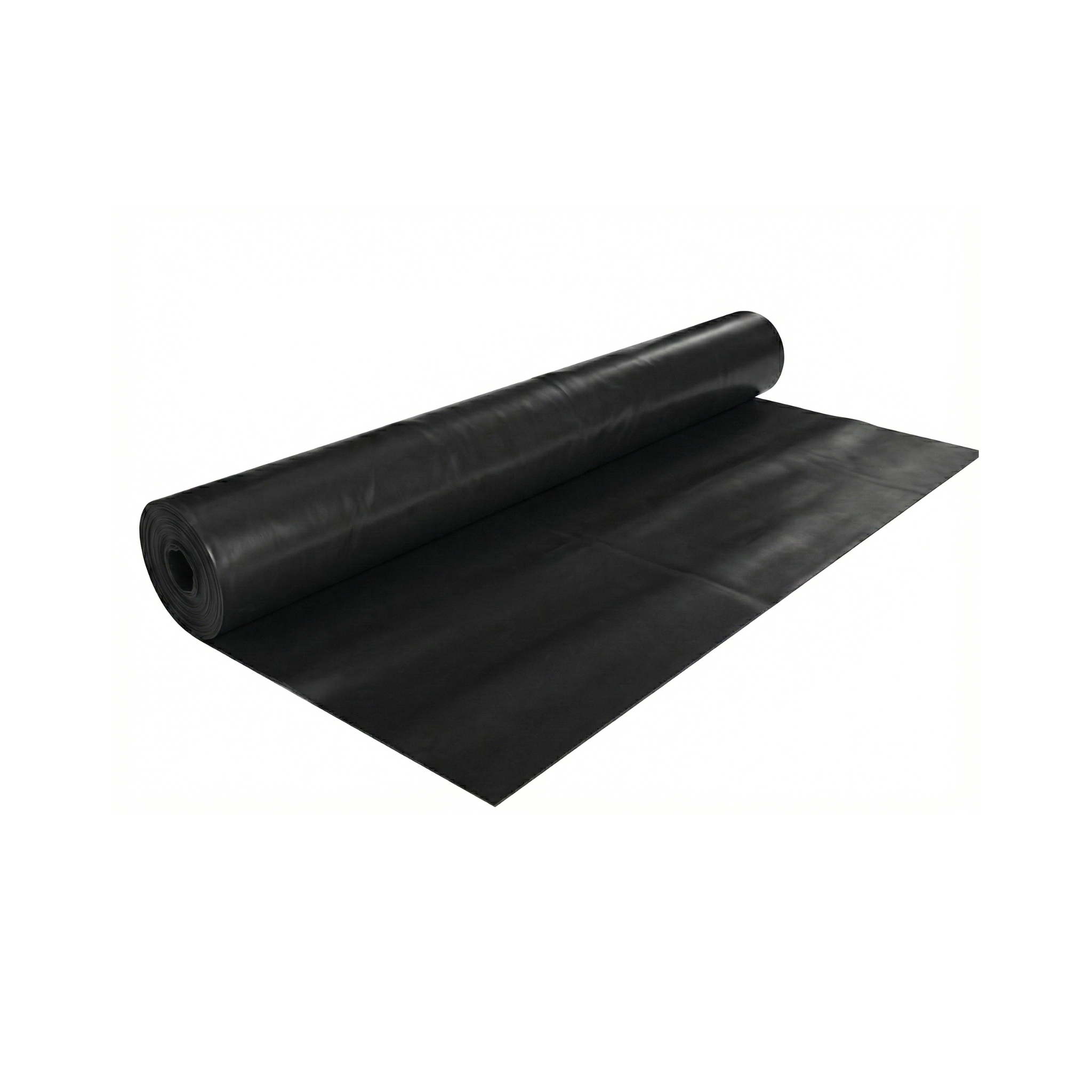
HDPE geomembrane is offered in six different gauges, from 0.1 mm (Gauge 400) to 2 mm (Gauge 8000). Choosing the wrong thickness can mean overpaying for an oversized project or, worse, the liner failing prematurely. This comparison guide helps you decide which gauge fits your project, whether it is a vapor barrier under a concrete slab or a large agricultural reservoir.
🎯 Choose your variant in 10 seconds
- If your case is a temporary construction cover or protection of stacked material: go to the 0.1 mm variant (Gauge 400)
- If your case is a vapor barrier under a concrete slab or lightweight cover: go to the 0.2 mm variant (Gauge 800)
- If your case is a small garden pond or closed water tank: go to the 0.5 mm variant (Gauge 2000)
- If your case is an agricultural pond or irrigation channel: go to the 1 mm variant (Gauge 4000)
- If your case is an artificial lake or industrial reservoir: go to the 1.5 mm variant (Gauge 6000)
- If your case is chemical containment, a landfill, or critical sealing: go to the 2 mm variant (Gauge 8000)
What to consider before choosing the variant
The geomembrane comes in two roll sizes: the lighter gauges (0.1 and 0.2 mm) in rolls of 2 m × 50 m (100 m² per roll) and the heavier ones (0.5, 1, 1.5, and 2 mm) in industrial rolls of 5.8 m × 100 m (580 m² per roll). This implies enormous differences in weight and handling. These are the criteria that carry the most weight in the decision:
- Final application: a vapor barrier under a floor (where the liner is protected and under no tension) is very different from an open pond exposed to sun and water movement.
- Depth and hydrostatic pressure: the greater the water column above, the higher the pressure and resistance required. A 1 m pond demands less than a 5 m reservoir.
- UV exposure and expected service life: while all variants include high UV protection, thicker gauges withstand more years of exposure to the Dominican sun without degrading.
- Superficie a cubrir y logística: cubrir 50 m² lo resuelve un rollo ligero que usted puede mover con 2 personas. Cubrir 2000 m² requiere rollos industriales, grúa y personal capacitado. Also consult our HDPE geomembrane usage guide to understand installation logistics.
- Puncture risk: if the soil contains stones or sharp objects that cannot be fully removed, move up one gauge or add geotextile.
0.1 mm variant (Gauge 400): the ultra-light liner for temporary use
- The most economical option in the catalogue
- Ultra-light 9.4 kg roll: one person can deploy it
- Covers 100 m² per roll (2 m × 50 m)
- Easy to cut with a blade and join with butyl tape
- Minimum thickness: cannot support a permanent water column
- No certified values for tensile strength, tear, or puncture resistance
- Limited service life when exposed to sun
- Not suitable for hot-wedge welding
Gauge 400 is the thinnest liner in the range and is used exclusively for temporary covers: protecting stacked material on construction sites, covering excavations during the rainy season, or isolating surfaces that will not receive water pressure. Do not use it for ponds or permanent vapor barriers: for those applications move up to Gauge 800 or higher.
0.2 mm variant (Gauge 800): the lightweight liner for vapor barriers
- Cost-effective and widely used in civil construction
- Light 18.8 kg roll: 2-person deployment
- Covers 100 m² per roll (2 m × 50 m): ideal for small projects
- Suitable for joining with butyl tape (no welder required)
- Not suitable for ponds or pressurized containment
- Lower mechanical resistance than thicker gauges
- Shorter exposed service life than 1 mm and above
Gauge 800 is the most accessible option in the structural segment and the most widely used as a vapor barrier under concrete floors, foundation insulation, and temporary civil construction covers. It performs well as long as the liner is mechanically protected and does not have to bear direct water column pressure. If your project is a pond or reservoir, you need to move up in gauge.
0.5 mm variant (Gauge 2000): the entry point to industrial format
- First gauge in industrial roll format (5.8 m × 100 m)
- Tensile strength at break 10 N/mm
- Tear resistance 69 N
- Covers 580 m² per roll: fewer seams per project
- Roll weight 272.6 kg: requires 4–6 people or mechanical means
- Lower resistance than the 1 mm agricultural standard
- Not recommended for water columns greater than 1.5 m
- No certified puncture resistance data
Gauge 2000 is the entry point to the industrial roll and the choice for ornamental garden ponds, closed water storage tanks (covered from the sun), small shallow agricultural ponds, and civil works where the liner is buried or protected. If your pond will be exposed to sun or exceeds 1.5 m in depth, move up to Gauge 4000.
1 mm variant (Gauge 4000): the standard for ponds and channels
- Tensile strength at break 27 N/mm
- Tear resistance 125 N and puncture resistance 320 N
- Industrial roll of 580 m² (5.8 m × 100 m)
- Optimal balance between cost and durability
- Roll weight 545.2 kg: forklift required
- Joining requires professional welder (not tape)
- Insufficient for landfills or aggressive chemicals
Gauge 4000 is the most popular variant in the range and the benchmark for the agricultural sector in the Dominican Republic. It comfortably covers the majority of cases: irrigation pits, channels, tilapia and shrimp ponds, medium-sized reservoirs, and open cisterns. It offers the best balance of mechanical resistance and cost per installed m².
1.5 mm variant (Gauge 6000): the heavy-duty liner for large reservoirs
- Tensile strength at break 40 N/mm
- Tear resistance 187 N and puncture resistance 480 N
- Longer service life exposed to the Dominican sun
- International standard for large hydraulic projects
- Roll weight 817.8 kg: crane or excavator required
- Higher cost per m² compared to Gauge 4000
- Requires trained personnel for hot-wedge welding
Gauge 6000 is the standard thickness when the project exceeds 2 m of water column depth or when a service life of 20 or more years exposed to the elements is required. It is used in mining reservoirs, large ornamental lakes, and most industrial-scale aquaculture projects.
2 mm variant (Gauge 8000): the maximum for critical applications
- Maximum tensile strength at break 53 N/mm
- Tear resistance 249 N and puncture resistance 640 N
- Longest exposed service life in the range
- Ideal for industrial fluids and heavy static loads
- The most expensive in the range
- Industrial handling mandatory (crane)
- Oversized for most agricultural applications
Gauge 8000 is the specification used for municipal landfills, secondary containment of fuel tanks, aggressive chemical storage facilities, and projects regulated under strict environmental standards. If your project does not fall into these categories, Gauge 6000 or 4000 is likely more appropriate and cost-effective.
Variant comparison table
All variants share the same material (HDPE), the same smooth black finish, and the same high UV protection. The differences lie in the thickness, roll format, roll weight, and mechanical properties.
| Characteristic | 0.1 mm Cal. 400 |
0.2 mm Cal. 800 |
0.5 mm Cal. 2000 |
1 mm Cal. 4000 |
1.5 mm Cal. 6000 |
2 mm Cal. 8000 |
|---|---|---|---|---|---|---|
| Ideal use | Temporary cover | Vapor barrier | Garden ponds | Channels and aquaculture | Large reservoirs | Landfills and chemicals |
| Thickness (mil) | 4 mil | 8 mil | 20 mil | 40 mil | 59 mil | 79 mil |
| Roll format | 2 m × 50 m | 2 m × 50 m | 5.8 m × 100 m | 5.8 m × 100 m | 5.8 m × 100 m | 5.8 m × 100 m |
| Coverage per roll | 100 m² | 100 m² | 580 m² | 580 m² | 580 m² | 580 m² |
| Tensile strength (yield point) | — | — | 10 N/mm | 15 N/mm | 22 N/mm | 29 N/mm |
| Tensile strength (break) | — | — | 10 N/mm | 27 N/mm | 40 N/mm | 53 N/mm |
| Tear resistance | — | — | 69 N | 125 N | 187 N | 249 N |
| Puncture resistance | — | — | — | 320 N | 480 N | 640 N |
| Roll weight | 9.4 kg | 18.8 kg | 272.6 kg | 545.2 kg | 817.8 kg | — |
| Handling | 1 person | 2 people | 4–6 people | Forklift | Crane | Crane |
| Joining method | Butyl tape | Tape / hot air | Professional welding | Hot wedge | Hot wedge | Hot wedge |
Use case matrix → recommended variant
| If your case is... | Recommended variant |
|---|---|
| Temporary construction cover or protection of stacked material | → 0.1 mm (Calibre 400) |
| Vapor barrier under residential slab or warehouse floor | → 0.2 mm (Calibre 800) |
| Small garden pond or closed water tank | → 0.5 mm (Calibre 2000) |
| Agricultural pit, irrigation channel, tilapia pond up to 2 m | → 1 mm (Calibre 4000) |
| Artificial lake, industrial reservoir, or impoundment deeper than 2 m | → 1.5 mm (Calibre 6000) |
| Secondary fuel containment or municipal landfill | → 2 mm (Calibre 8000) |
Quick rule of thumb for agricultural projects: for every meter of water column depth, move up one gauge level. Up to 1 m use 0.5 mm, up to 2 m use the 1 mm standard, up to 3 m use 1.5 mm, and reserve 2 mm for cases exceeding 3 m or chemical applications. This rule prevents you from paying for an oversized gauge.
Do not purchase Gauge 400 or 800 thinking you can use them as a "budget liner" for a permanent pond. Although the initial purchase may seem attractive, the thickness is insufficient to support a water column, long-term direct UV exposure, and sediment weight. For any application that permanently contains water, start from Gauge 2000.
Still unsure which gauge fits your project?
Tell us the area to cover, the water depth if applicable, the type of fluid, and whether it will be exposed to sun. You will receive a technical recommendation for the exact gauge and the square meters you need to purchase.
Frequently asked questions
Can I join variants of different gauges in the same project?
Technically possible but not recommended. The thickness difference creates mechanical stress at the joint and reduces long-term watertightness. If you need localized reinforcement (for example, at a high-stress corner), use a patch of the same primary gauge instead of moving up in thickness. For applications with a water column, always use a uniform gauge throughout.
How do I know how many rolls I need to purchase?
Calculate the area to cover in square meters, add 10% for overlaps and perimeter anchoring, and divide by the coverage per roll for your chosen variant: 100 m² per roll for Gauges 400 and 800, and 580 m² per roll for Gauges 2000, 4000, 6000, and 8000. For example, a 500 m² pond with 10% extra (550 m²) is covered by 1 industrial roll of Gauge 4000.
Why is the same product sold in such different roll sizes (2 m × 50 m vs. 5.8 m × 100 m)?
Because each roll responds to a different use case. The 2 m × 50 m rolls are the manufacturing standard for thin gauges (0.1 and 0.2 mm), designed for small projects and manual deployment. The industrial 5.8 m × 100 m rolls optimize large-scale installation: fewer seams per square meter covered and therefore fewer critical failure points. That is why all gauges from 0.5 mm onward are manufactured in this second format.
