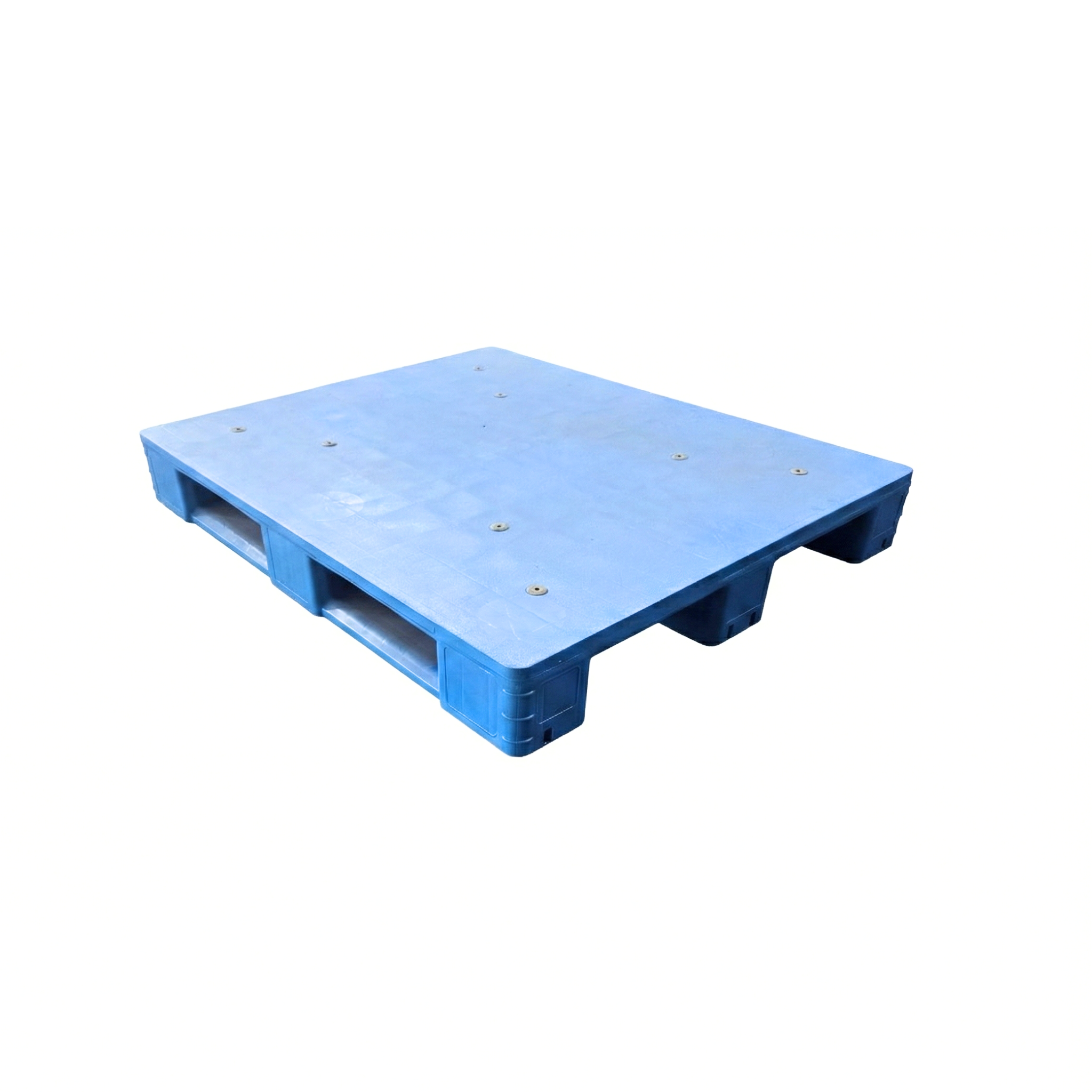
The hygienic plastic pallet is offered in two formats: American (120 × 100 cm) and European (120 × 80 cm), both 15 cm high and blue. They are made of virgin HDPE/PP plastic, with a closed surface and a washable design suitable for industries with sanitary requirements. They share a static capacity of 6,000 kg, 4-way entry, and robust construction, but differ in dimensions, dynamic capacity, rack load, and weight. The choice between formats depends on the destination market and your company's logistical modularity.
🎯 Choose the variant in 10 seconds
- If your case is pharma, food, or chemical with destination to the USA or the Caribbean: go to the American variant (120 × 100 cm)
- If your case is pharma, food, or chemical with destination to the EU or compact warehouse: go to the European variant (120 × 80 cm)
What to consider before choosing the variant
The two variants share a hygienic design (closed, washable, and disinfectable surface), HDPE/PP material, blue color, height (15 cm), and 4-way entry. The difference lies in format, capacities, and weight. These are the criteria for making the right choice:
- Sanitary requirements: The hygienic design (no gaps where dirt accumulates) makes it suitable for pharmaceutical, food, meat, dairy, and chemical industries. The HDPE/PP surface withstands high-pressure washing with industrial detergents and disinfectants, and resists repeated impacts without cracking.
- Logistical system: The American format (120 × 100 cm) is standard in the USA, Mexico, Central America, the Caribbean, and the Dominican Republic. The European format (120 × 80 cm) is the EUR/EPAL standard in the EU. If you export or import sanitary products, aligning the format with the destination avoids re-stacking and cross-contamination.
- Load capacity: Both share 6,000 kg static capacity, but the American one supports 1,800 kg dynamic (vs 1,500 kg for the European) and 1,500 kg in rack (vs 1,250 kg). For liquid goods, bags of chemical products, or heavy boxes, the American offers a greater safety margin.
- Weight of the empty pallet: The American weighs 23.8 kg and the European 21.6 kg. This information is important for the declared tare in exports and for sizing manual handling when moving an empty pallet.
- Traceability and cleanliness: Being a closed surface, washing is quick and effective. For processes with HACCP, GMP, or ISO 22000 regulations, this format facilitates compliance compared to wooden pallets (which do not allow high-pressure washing) or open plastic pallets (where dirt can get trapped in internal gaps).
American variant (120 × 100 cm): the standard for the American sanitary industry
- Logistical standard in USA and Caribbean
- Larger usable surface: 1.20 m² per pallet
- Dynamic load 1,800 kg
- Rack load 1,500 kg
- High UV protection
- More occupied warehouse space
- Higher unit weight: 23.8 kg
- Fewer pallets per container
The American hygienic pallet is the standard choice for industries with strict sanitary requirements operating towards the USA, Mexico, Central America, and the Caribbean. Its closed surface allows washing and disinfection between batches, its dynamic capacity of 1,800 kg covers heavy loads such as chemical drums, bags of powdered milk, partial IBCs, or processed meat boxes. The usable surface of 1.20 m² accommodates boxes in American module and simplifies the modulation of sanitary packaging.
European variant (120 × 80 cm): the compact for the European sanitary industry
- Logistical standard in the European Union
- Optimizes pallets per sea container
- Fits with 600 × 400 mm modular boxes
- Lower unit weight: 21.6 kg
- Dynamic load 1,500 kg (17% less than American)
- Rack load 1,250 kg
- Smaller usable surface: 0.96 m² per pallet
The European hygienic pallet is the standard choice for companies exporting sanitary products to the European Union or with storage facilities designed in EUR module. Its narrower width allows optimizing the number of pallets per sea container and fits perfectly with 600 × 400 mm modular boxes common in pharma, food, and consumer goods. The lower unit weight (21.6 kg vs 23.8 kg) facilitates handling when empty and slightly reduces the declared tare weight in exports.
Comparative table of variants
The two variants share type (hygienic), material, color, height, entries, and static capacity. The difference lies in dimensions, dynamic capacity, rack load, and unit weight.
| Feature | American | European |
|---|---|---|
| Ideal use | Sanitary America | Sanitary Europe |
| SKU | 096453 | 650567 |
| Type | Hygienic | Hygienic |
| Dimensions | 120 × 100 × 15 cm | 120 × 80 × 15 cm |
| Material | Virgin plastic (HDPE/PP) | Virgin plastic (HDPE/PP) |
| Color | Blue | Blue |
| Entries | 4-way | 4-way |
| Static load | 6,000 kg (13,230 lb) | 6,000 kg (13,230 lb) |
| Dynamic load | 1,800 kg (4,000 lb) | 1,500 kg (3,300 lb) |
| Rack load | 1,500 kg (3,300 lb) | 1,250 kg (2,755 lb) |
| Unit weight | 23.8 kg (52.5 lb) | 21.6 kg (47.6 lb) |
| UV protection | Yes (high) | Yes (high) |
| Usable surface | 1.20 m² | 0.96 m² |
Use case matrix → recommended variant
| If your case is… | Recommended variant |
|---|---|
| Pharmaceutical industry with destination USA or Caribbean | → American |
| Heavy dairy, meat, or fish product | → American |
| Warehouse with racks and loads greater than 1,250 kg | → American |
| Export of sanitary products to the European Union | → European |
| Standard 600 × 400 mm boxes in pharma or food | → European |
| Cold room or cleanroom with compact warehouse | → European |
Document specific cleaning protocols for your hygienic pallets and rotate the fleet every 12–18 months for inspection. After high-pressure washing with an alkaline detergent or authorized disinfectant in your industry, air dry in a vertical position before storing to avoid residual moisture. Keep a photographic record of each pallet's condition (number of uses, accumulated impacts, surface integrity) to remove it from service before cracks or splinters appear that compromise sanitary traceability.
Do not mix hygienic pallets with standard pallets (3 or 9 open runners) in the same sanitary rotation. Although visually they are the same blue color, open pallets cannot be pressure washed with the same effectiveness and can contaminate sensitive products. Mark each hygienic pallet with a unique identifier and maintain separate traceability of each unit in your management system.
American or European hygienic pallet?
Tell us your industry (pharma, food, chemical, meat, dairy), applicable regulations, average weight per load unit, and destination market. You will receive a format recommendation and the initial quantity based on estimated rotation.
Frequently asked questions
What makes a pallet "hygienic"?
Hygienic design is characterized by a closed surface (no gaps where dirt can accumulate), smooth edges without deep grooves, and monoblock or injection-molded construction. This allows for pressure washing with alkaline detergents or industrial disinfectants, quick drying, and sanitary traceability. HDPE/PP material does not absorb liquids, does not generate odors, does not accumulate bacteria, and withstands repeated cleaning-drying cycles without degradation.
Can it go directly into cold storage or freezing?
Yes. HDPE/PP plastic maintains its mechanical properties within typical cold storage and freezing temperature ranges. For deep-freezing conditions (below -25 °C), please consult the technical data sheet of your specific pallet or batch, as some formulations have a wider operating range than others.
Hygienic or 3-runner: when does the extra cost justify it?
A hygienic pallet justifies its extra cost over a 3-runner pallet when your industry has specific sanitary requirements (HACCP, GMP, ISO 22000), when the product comes into direct contact with the pallet, when it is washed between batches, or when it is used in cold storage. For dry storage of non-sensitive consumer goods, the 3-runner pallet remains more economical and suitable.