

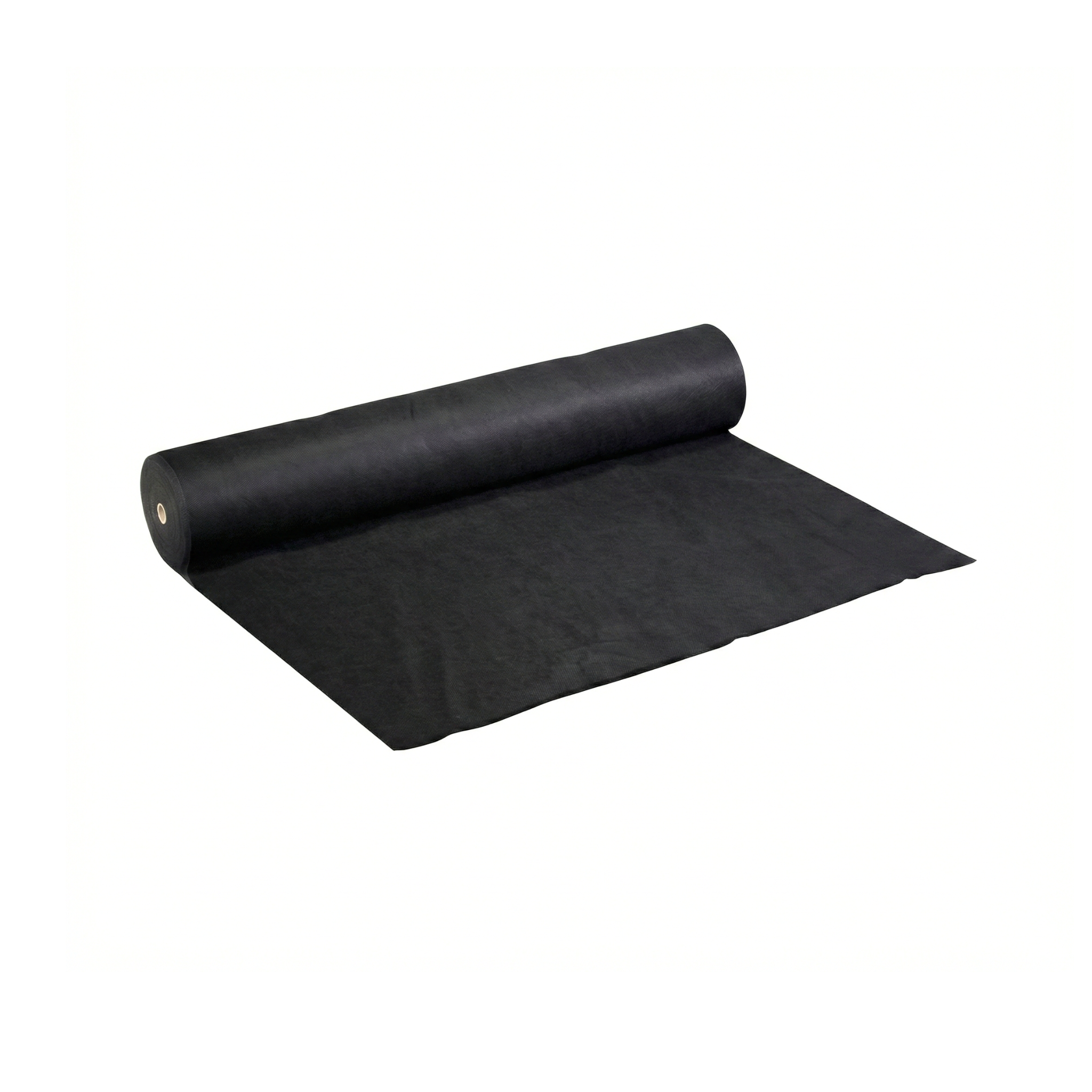
The non-woven polypropylene (PP) geotextile comes in three grammages: 100, 200, and 400 g/m², all in black. Choosing the wrong one can mean overpaying for over-specified reinforcement, or having the sheet fail under the first puncture load. This comparison helps you decide which grammage fits your project: garden layer separation, drainage and geomembrane protection, or reinforcement under medium-traffic roads.
🎯 Choose your variant in 10 seconds
- If your case is gardening, landscaping, or separation under decorative gravel: go to 100 g/m² variant
- If your case is drainage, geomembrane protection, or light road construction: go to 200 g/m² variant
- If your case is medium-traffic roads, reinforcement, or rocky soils: go to 400 g/m² variant
What to consider before choosing a variant
All three variants share the same material (PP filament), color (black), UV retention (≥ 80%), and format in rolls of 5.95 m × 100 m (595 m² per roll). The differences lie in grammage, thickness, and mechanical strength. These are the key criteria:
- Primary function: separation and filtration call for light grammages; protection under HDPE geomembrane and reinforcement under load call for medium or heavy grammages.
- Load above the geotextile: the higher the static or dynamic load, the greater the tensile strength and CBR required. Pedestrian traffic: 100 g/m²; light vehicle traffic: 200 g/m²; medium traffic: 400 g/m².
- Soil type: sandy, clean soils accept low grammages; rocky soils require a higher grammage. CBR puncture resistance (1.1 / 2.3 / 4.2 kN) is the critical figure when the geotextile goes under a geomembrane.
- Sun exposure: all three retain at least 80% of their strength after UV exposure. Even so, do not leave the geotextile uncovered longer than necessary.
- Complete system: geotextile is frequently combined with nodular drainage sheet, PE geocell, or geomembrane. Consider the whole system before settling on a grammage.
Variant 100 g/m²: the lightweight option for gardening and separation
- The lightest and most economical in the range
- Thickness ≥ 1.0 mm: unobtrusive under gravel or soil
- O95 opening 0.07–0.3 mm: filters fines without clogging
- UV retention ≥ 80% for brief exposed periods
- CBR 1.1 kN: not suitable for geomembrane protection
- Tensile 7 kN/m: insufficient under vehicle traffic
The 100 g/m² grammage acts as a separation layer between two materials that must not mix: soil and decorative gravel, substrate and subbase, etc. It also works as a filter in small residential drains to prevent fines from clogging the pipe. It is not designed to bear vehicle traffic or to protect a geomembrane in rocky soils.
Variant 200 g/m²: the standard for drainage and protection
- Tensile 15 kN/m: more than double the 100 g/m²
- CBR 2.3 kN: suitable under geomembrane on prepared soils
- Thickness ≥ 1.9 mm: effective protection against small stones
- Grab 0.8 kN: withstands point loads during installation
- Insufficient for heavy vehicle traffic
- On unscreened soils, consider moving up to 400 g/m²
The 200 g/m² grammage is the most widely used reference in light civil construction. It works as protection under geomembrane in small to medium ponds and reservoirs, as a drainage layer in landscaped gardens, and as separation under pedestrian walkways and light-traffic roads. If your project includes an HDPE geomembrane, this grammage is a reasonable starting point unless the soil has many stones or sharp edges.
Variant 400 g/m²: the heavy-duty option for reinforcement and demanding civil works
- Tensile 30 kN/m: four times the 100 g/m²
- CBR 4.2 kN: ideal under geomembrane in demanding applications
- Thickness ≥ 3.5 mm: reinforced protection against sharp edges
- Grab 1.7 kN: highest in the range
- The most expensive per m² in the range
- Over-specified for gardening or residential drains
- Heavier handling (bulkier roll)
The 400 g/m² grammage is the specification for projects where puncture risk or mechanical stress is high: geomembrane protection in municipal landfills, subbase reinforcement on secondary roads, separation in civil works with rocky soils. If your project does not fall into these categories, the 200 g/m² is likely more appropriate and economical.
Variant comparison table
All three variants share material (PP filament), color, elongation (60–100%), UV retention (≥ 80%), equivalent opening, and format. Differences are concentrated in grammage, thickness, and mechanical strength.
| Feature | 100 g/m² | 200 g/m² | 400 g/m² |
|---|---|---|---|
| Ideal use | Gardening and separation | Drainage and protection | Reinforcement and civil works |
| SKU | 534623 | 623451 | 654237 |
| Material | PP filament | PP filament | PP filament |
| Thickness | ≥ 1.0 mm | ≥ 1.9 mm | ≥ 3.5 mm |
| Tensile strength | ≥ 7 kN/m | ≥ 15 kN/m | ≥ 30 kN/m |
| Grab strength | ≥ 0.4 kN | ≥ 0.8 kN | ≥ 1.7 kN |
| Tear resistance | ≥ 0.21 kN | 0.4 kN | 0.75 kN |
| CBR puncture | ≥ 1.1 kN | ≥ 2.3 kN | ≥ 4.2 kN |
| Elongation | 60–100% | 60–100% | 60–100% |
| O95 opening | 0.07–0.3 mm | 0.07–0.3 mm | 0.07–0.3 mm |
| UV retention | ≥ 80% | ≥ 80% | ≥ 80% |
| Color | Black | Black | Black |
| Format | 5.95 m × 100 m | 5.95 m × 100 m | 5.95 m × 100 m |
Use-case matrix → recommended variant
| If your case is… | Recommended variant |
|---|---|
| Separation under decorative gravel or patio tiles | → 100 g/m² |
| Filtration in residential drains or landscaped gardens | → 100 g/m² |
| Geomembrane protection in a small to medium pond or reservoir | → 200 g/m² |
| Drainage in gardens and light pedestrian road construction | → 200 g/m² |
| Medium-traffic roads or rocky soils | → 400 g/m² |
| Geomembrane protection in a landfill or industrial reservoir | → 400 g/m² |
When choosing between two grammages, use the CBR puncture resistance as your guide rather than the grammage itself. The difference between 2.3 kN (200 g/m²) and 4.2 kN (400 g/m²) is nearly double: in rocky or unscreened soils, that extra reserve is what prevents a stone from perforating the upper geomembrane after years of service. The right grammage is paid for once; a perforated geomembrane is paid for every time it needs repair.
Do not use 100 g/m² as protection under a geomembrane, no matter how economical it may be. The CBR breaking strength of 1.1 kN is not enough to resist medium-sized stones under hydrostatic pressure, and a single perforation compromises the entire waterproofing layer. For geomembrane protection, always start with 200 g/m² and move up to 400 g/m² if the soil is not fully screened.
Frequently asked questions
PP or PET: which non-woven geotextile should I choose?
Polypropylene (this product) offers better chemical resistance against acids and alkalis and is generally more economical. PET (polyester) has higher creep resistance under sustained load and performs better at high temperatures. For drainage and geomembrane protection in Dominican civil construction, both work well at the same grammage; PP is the standard option and PET is the upgrade for critical reinforcement applications.
How much overlap should I leave between rolls?
For drainage and filtration applications, a minimum overlap of 30 cm sewn or heat-fused is required. For separation under gravel or in gardening, 15–20 cm is sufficient. If going under a geomembrane, maintain 30 cm and avoid wrinkles: high points at the overlap concentrate stress on the upper sheet and are a frequent cause of perforations.
When should I use woven instead of non-woven?
Use non-woven (this product) when the primary function is drainage, filtration, or protection; it lets water pass and absorbs puncture loads. Use woven PP geotextile when the primary need is separation and reinforcement under medium or heavy traffic loads: it offers higher tensile strength for a similar density, but lower filtration capacity.
