

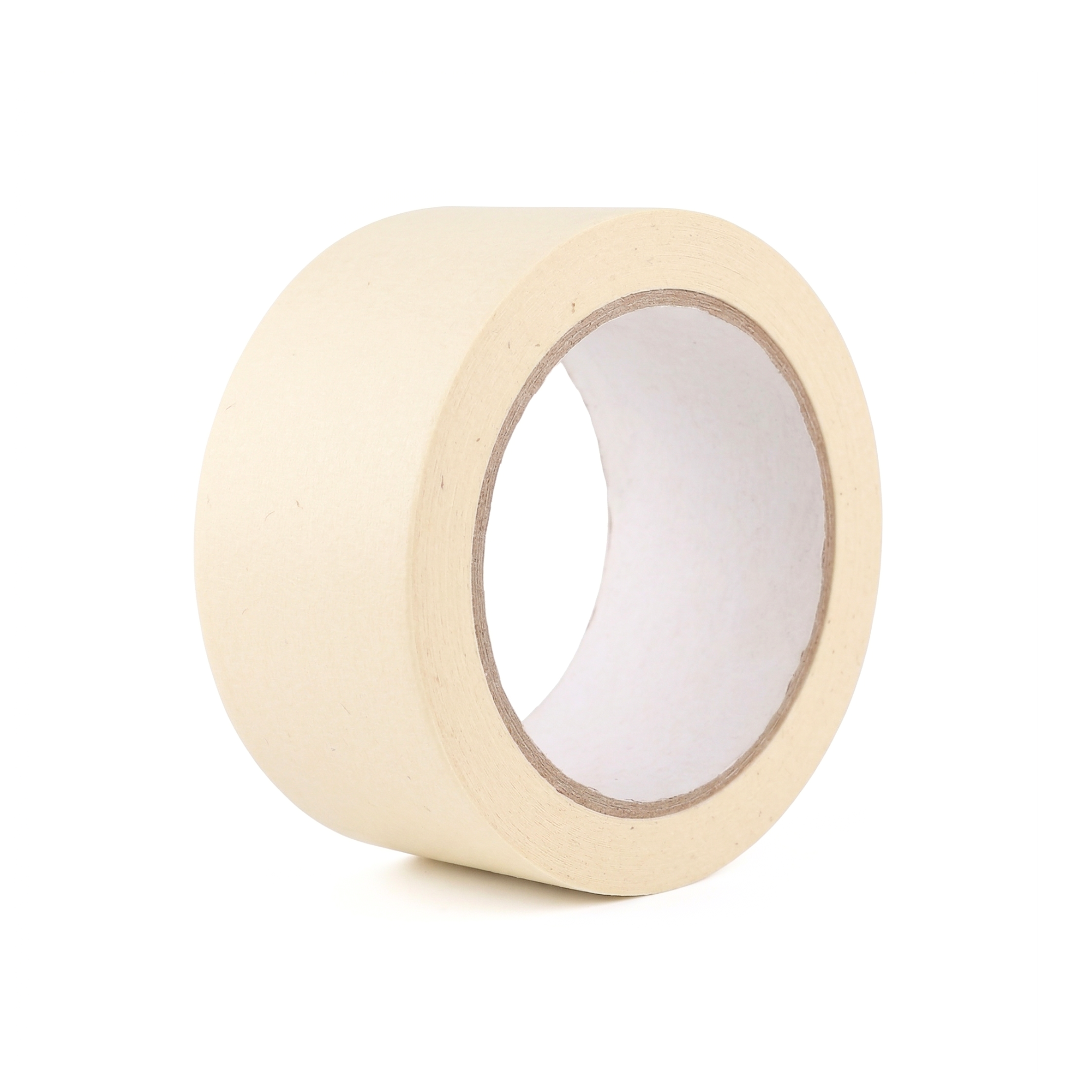
Paper tape is available in three widths: 25 mm (1 in) in a case of 18 rolls, 50 mm (2 in) in a case of 9 rolls, and 72 mm (3 in) in a case of 6 rolls. All come in 55 m (60 yd) rolls. Paper tape (also known as masking tape, bodywork tape or painter's tape) stands apart from plastic tapes because it can be applied and removed without damaging the surface, which makes it indispensable for masking in paint jobs, temporary marking and light closing. The choice between the three widths depends on the job: fine lines and details, standard masking, or wide and fast coverage.
🎯 Choose your variant in 10 seconds
- If your case is fine masking, lines and details in painting: go to the 25 mm (1 in) width
- If your case is standard masking, temporary marking or general use: go to the 50 mm (2 in) width
- If your case is wide coverage, masking large surfaces or temporary closing: go to the 72 mm (3 in) width
What to consider before choosing a variant
All three variants share the same material (adhesive paper tape) and length per roll (55 m). The difference lies in the width and the number of rolls per case. These are the criteria for choosing well:
- Type of job: the width should match the surface you are going to mask or cover. For fine details and precise lines (baseboards, window frames, contours) a 25 mm width allows precise lines and curves. For medium surfaces (doors, wall-to-ceiling edges, frames) 50 mm speeds up the work. For large surfaces (floors, large windows, covering big areas with protective plastic) 72 mm reduces the number of strips needed.
- Key characteristic of paper tape: the adhesive paper material allows the tape to be removed without damaging the surface once the job is done. This is its advantage over plastic tapes such as clear PP, which are designed for permanent or long-lasting sealing.
- Typical applications: interior and exterior painting (masking areas that must not get stained), construction and repair (temporary marking of measurements), the automotive industry (bodywork masking), light packaging (temporary closing of bags or boxes that will be reopened), office use (temporary labeling, attaching papers to a board).
- Total volume per case: 25 mm × 18 rolls = 990 m per case; 50 mm × 9 rolls = 495 m per case; 72 mm × 6 rolls = 330 m per case. The total footage decreases as the width increases, because each wider roll uses more material and volume per unit.
- What paper tape does NOT do: it is not suitable for permanently sealing boxes for transport, does not bear significant weight, does not withstand prolonged exposure to moisture or UV radiation, and is not transparent. For permanent box sealing, use PP tape.
25 mm (1 in) variant: the thin one for details and precise lines
- Allows fine lines and curves
- Case of 18 rolls: high yield
- 990 m in total per case
- Ideal for carpentry details
- Not enough for large surfaces
- Slower work due to less coverage
The 25 mm width is the choice for jobs that demand precision: masking contours in artistic painting, marking fine lines on floors or walls, temporarily sealing narrow joints in carpentry and detail projects. Its width makes it possible to follow curves and tight angles without wrinkling, something wider tapes cannot do. The 18-roll case yields 990 m in total and covers operations that combine many small detail jobs.
50 mm (2 in) variant: the standard for general use
- Balance between coverage and precision
- Market-standard width
- Case of 9 rolls: 495 m in total
- Ideal for interior and exterior painting
- Too wide for fine details
- Slow for large surfaces
The 50 mm width is the most versatile option and the most widely used for general applications. It covers medium surfaces efficiently while adapting well to gentle curves. It is the typical format demanded by professional painters, construction workers marking measurements and office staff for temporary labeling. The 9-roll case covers medium projects and provides 495 m in total.
72 mm (3 in) variant: the wide one for large surfaces and fast coverage
- Fast coverage of large surfaces
- Fewer passes for wide areas
- Suitable for securing protective plastic
- Case of 6 rolls
- Not suitable for tight curves
- Oversized for details
- Only 330 m in total per case
The 72 mm width speeds up work on large surfaces: covering floors during a full room paint job, securing protective plastic against dust, masking large windows when painting facades or temporarily sealing large-format boxes during a move. A single pass covers three times as much as the 25 mm tape, which reduces preparation time. The 6-roll case is sized for one-off large-scale projects that need coverage without excess inventory.
Variant comparison table
All three variants are the same material (adhesive paper) and the same length per roll (55 m). The difference lies in the width and the case format.
| Feature | 25 mm (1 in) | 50 mm (2 in) | 72 mm (3 in) |
|---|---|---|---|
| Ideal use | Details and fine lines | Standard general use | Large surfaces |
| SKU | 643243 | 256213 | 945632 |
| Width | 25 mm (1 in) | 50 mm (2 in) | 72 mm (3 in) |
| Length per roll | 55 m (60 yd) | 55 m (60 yd) | 55 m (60 yd) |
| Format | Case of 18 rolls | Case of 9 rolls | Case of 6 rolls |
| Total meters per case | 990 m | 495 m | 330 m |
| Material | Adhesive paper | Adhesive paper | Adhesive paper |
| Thickness | — | — | — |
| Adhesion | — | — | — |
Use case → recommended variant matrix
| If your case is… | Recommended variant |
|---|---|
| Artistic painting with fine lines or curves | → 25 mm (1 in) |
| Carpentry details and narrow joints | → 25 mm (1 in) |
| Interior painting of rooms and offices | → 50 mm (2 in) |
| Temporary marking on job sites and construction | → 50 mm (2 in) |
| Standard bodywork or automotive application | → 50 mm (2 in) |
| Covering floors when painting rooms | → 72 mm (3 in) |
| Securing protective plastic against dust on site | → 72 mm (3 in) |
| Masking large windows or facades when painting | → 72 mm (3 in) |
Remove paper tape before the paint is fully dry to keep the adhesive from hardening onto the surface. The ideal moment is when the paint is no longer wet to the touch but still flexible (1–2 hours after applying the last coat, depending on the paint type). To remove it, pull at a 45° angle toward the painted side, not straight back. If you work with several widths at once (a typical room painting project), plan your inventory by combining: 50 mm for wide areas and baseboards, 25 mm for details and contours.
Do not use paper tape to permanently seal boxes for transport. Paper tape adhesive is designed for clean removal, which means it loses adhesion over time, with moisture or with friction. A box sealed with paper tape can open during handling, putting the goods at risk. To seal boxes for transport, use PP adhesive tape, which is designed specifically for that purpose.
Frequently asked questions
How long can it stay applied before removal?
The recommended dwell time depends on the manufacturer and the conditions (temperature, humidity, sun exposure). As a general guide, remove the tape within 24–72 hours after application to ensure clean removal. If you leave it longer, the adhesive can transfer to the surface and make removal difficult. For paint jobs, the ideal is to remove it when the paint is no longer wet but still flexible.
Does it work on damp surfaces or outdoors?
Paper tape is designed for dry, clean surfaces. On damp or wet surfaces, the adhesive does not bond properly and the tape can peel off. Under prolonged exposure to rain or intense sun, the paper degrades and the adhesive loses effectiveness. For outdoor jobs, plan to apply and remove the tape within the same day in dry conditions.
Paper or plastic for sealing boxes?
For permanently sealing boxes for transport, always use polypropylene (PP) tape: it is stronger, does not peel off with moisture and bears weight. Paper tape is only for temporary closing (same-day moves, short-term storage, marking and masking), not for shipments or long transport.
