

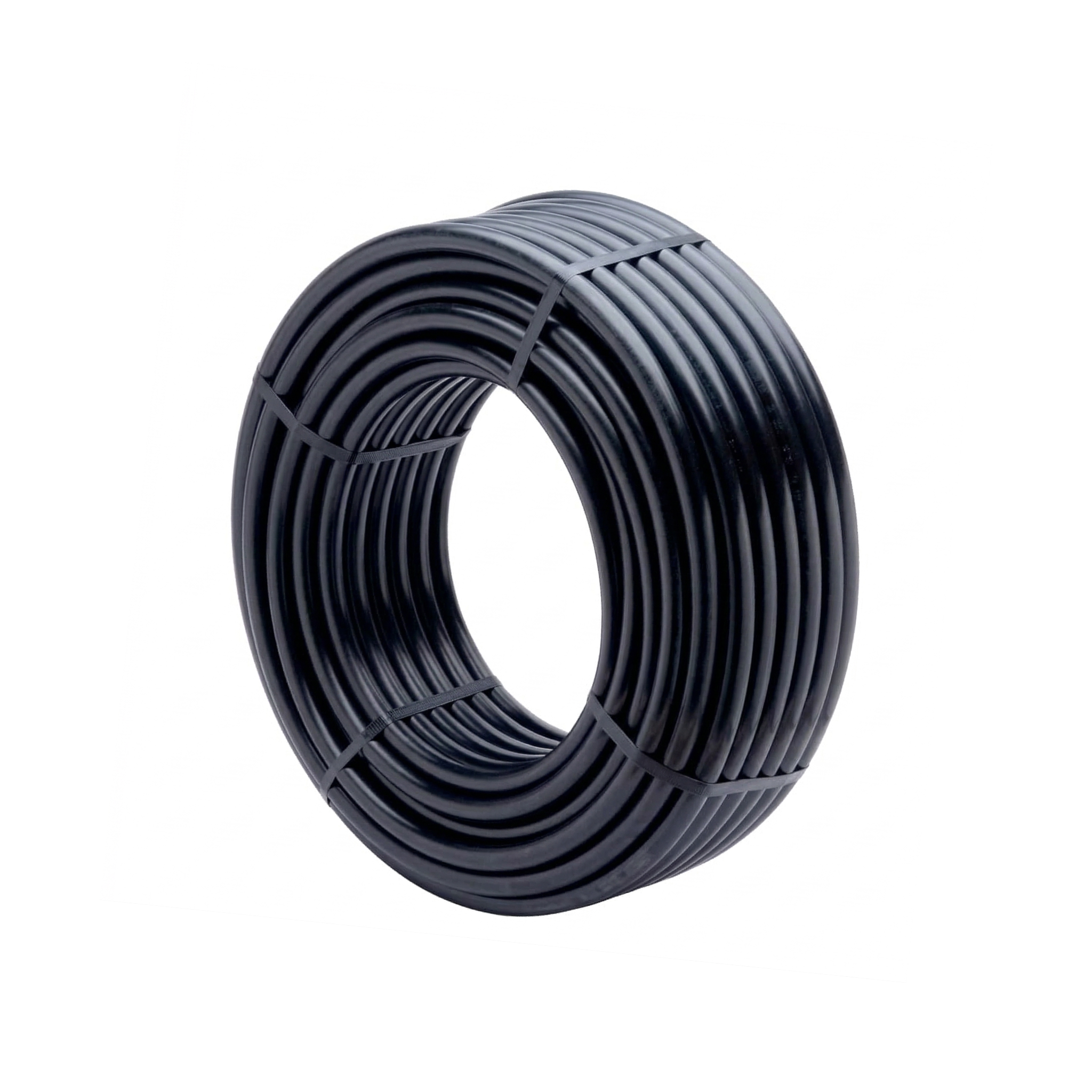
The pressure-compensating drip irrigation hose comes in two configurations that differ only in the spacing between emitters: 30 cm and 50 cm, both in 500 m rolls with a 16 mm diameter, 1.0 mm wall thickness (Gauge 4000) and a nominal flow rate of 1.6 L/h. The key feature that sets it apart from the standard hose is the pressure-compensating emitter: it maintains a constant flow rate across a wide range of pressures, which provides uniformity on sloped terrain or very long lateral runs. The choice between 30 and 50 cm defines the number of emitters and the total flow rate of the system.
🎯 Choose the variant in 10 seconds
- If your case is vegetables or row crops with plants every 30–40 cm on a slope: go to the 30 cm emitter spacing configuration
- If your case is fruit trees, ornamentals or very long lateral runs in plots with elevation change: go to the 50 cm emitter spacing configuration
What to consider before choosing the variant
The two variants share material, diameter (16 mm), wall thickness (1.0 mm), nominal flow rate (1.6 L/h), working pressure (3.0 bar) and roll format (500 m). The difference lies only in the emitter spacing and, as a result of that, in the number of emitters and the total flow rate. These are the criteria for choosing well:
- When pressure-compensating is the right choice: in plots with elevation change (slopes greater than 2%), very long lateral runs or systems that experience pressure variations from group pumping. The pressure-compensating emitter maintains a constant flow rate despite changes in local pressure, ensuring uniform discharge along the entire lateral.
- Crop spacing: in vegetables with plants every 30 cm (tomato, pepper) the 30 cm option places an emitter next to each plant. In fruit trees, young banana plantings or ornamentals with plants every 50–100 cm, the 50 cm option distributes better without over-supplying.
- Total system flow rate: the 30 cm roll has 1,666 emitters and releases approximately 2,666 L/h; the 50 cm roll has 1,000 emitters and releases 1,600 L/h. If your pump is limited, the 50 cm option lets you expand the irrigated area per shift.
- Capacity for long laterals: the pressure-compensating property allows significantly longer lateral runs than the standard hose at the same pressure. For long plots, lines with elevation change or greenhouses with extensive aisles, this property is the main reason to choose pressure-compensating.
- Filtration and maintenance: the pressure-compensating emitter is more sensitive to particles than the simple turbulent-labyrinth emitter, because it incorporates a flexible membrane. Adequate head-unit filtration (at least 120 mesh, 130 micron) is essential to preserve the service life of the system.
30 cm emitter spacing configuration: the close-spaced option for vegetables on slopes
- 1,666 emitters per roll: uniform coverage
- Identical flow rate at the top and bottom of the lateral
- 1 mm wall: durable for permanent use
- Compensates for system pressure variations
- High total flow rate: ≈2,666 L/h per roll
- Oversized for widely spaced fruit trees
- Greater sensitivity to fines: 120 mesh filter mandatory
The 30 cm configuration is the standard option for row vegetables when the terrain has elevation change or when uniformity is critical: tomato, pepper, eggplant, cabbage. Where a standard hose would leave the end emitters discharging less due to pressure loss, the pressure-compensating one maintains an even 1.6 L/h from the first to the last emitter, regardless of whether the lateral climbs up a hill or runs down a slope. It is the choice for farms with irregular topography, where the standard hose would create under- or over-irrigation zones.
50 cm emitter spacing configuration: the wide-spaced option for fruit trees and long laterals
- Lower total flow rate: ≈1,600 L/h per roll
- Allows very long lateral runs without losing uniformity
- Ideal for large plots with elevation change
- Reduces pumping demand
- Insufficient for tightly spaced row vegetables
- Risk of dry zones if the crop is dense
The 50 cm configuration is the option for widely spaced plantings in plots with slopes or long laterals: young bananas, papayas, citrus in plantation, ornamentals in linear beds, palms. Its 1,000 emitters lower the total water demand to 1,600 L/h, which allows large areas to be fed with a single main line and a moderate head unit. Combined with pressure compensation, it is the most efficient choice for extensive farms with variable topography.
Variant comparison table
The two variants share all construction and emitter characteristics. The difference lies only in the spacing and, therefore, in the number of emitters and the total flow rate of the system.
| Characteristic | 30 cm between emitters | 50 cm between emitters |
|---|---|---|
| Ideal use | Vegetables on slopes | Fruit trees and long laterals |
| SKU | 967456 | 945623 |
| Emitter type | Pressure-compensating | Pressure-compensating |
| Diameter | 16 mm (5/8 in) | 16 mm (5/8 in) |
| Wall thickness | 1.0 mm (Gauge 4000) | 1.0 mm (Gauge 4000) |
| Distance between emitters | 30 cm (12 in) | 50 cm (20 in) |
| Nominal flow rate | 1.6 L/h (0.42 gph) | 1.6 L/h (0.42 gph) |
| Emitters per roll | 1,666 | 1,000 |
| Total roll flow rate (estimated) | ≈2,666 L/h | ≈1,600 L/h |
| Working pressure | 3.0 bar (43.5 psi) | 3.0 bar (43.5 psi) |
| Roll length | 500 m (1640 ft) | 500 m (1640 ft) |
Use case → recommended variant matrix
| If your case is… | Recommended variant |
|---|---|
| Tomato or pepper in a plot with a slope | → 30 cm |
| Row vegetables with critical uniformity | → 30 cm |
| System with group pumping and pressure variations | → 30 cm |
| Bananas, papayas, citrus in plantation with a slope | → 50 cm |
| Long aisles in a fruit orchard or palm grove | → 50 cm |
| Ornamental beds in an elongated plot | → 50 cm |
Pressure-compensating hose justifies its price in three specific situations: plots with a slope or elevation change greater than 2%, lateral runs exceeding the maximum length of the standard hose, and systems with group pumping where several lines share a head unit and pressure varies as shifts are activated. If your plot is flat, the laterals are short and you have a single pumping group, the standard hose delivers similar results for less cost. Pay for the pressure-compensating one only when the geometry or hydraulics of your system justify it.
Do not install pressure-compensating hose with pressure below the emitter's activation threshold. These emitters need a minimum pressure to begin regulating the flow rate; below that pressure they discharge little or nothing. If your system operates at low pressure from gravity or a low-head well, check the operating range with the manufacturer and, if necessary, install an auxiliary pump. Without sufficient pressure, pressure compensation does not activate and the system performs worse than a standard hose.
Frequently asked questions
What real advantage does the pressure-compensating hose have over the standard one?
The pressure-compensating hose maintains a constant flow rate despite pressure variations along the lateral or the system. In a standard hose, the end emitters discharge less due to accumulated pressure loss. The pressure-compensating hose eliminates that difference, which translates into superior uniformity and, in high-value crops, into higher yield through irrigation uniformity.
Can I combine standard and pressure-compensating hose in the same plot?
Yes, it is a common practice when the farm has flat zones and zones with elevation change. Use the standard hose in flat sectors with short laterals (more economical) and the pressure-compensating hose in sectors with a slope or long laterals (critical uniformity). The two can share a filtration head unit and valves as long as the operating pressures of each sector are respected and regulators are used at the entrance of each zone if the general pressure is high.
Does it require a special filter?
Yes, just as the standard hose requires at least 120 mesh (130 micron) screen, but the pressure-compensating emitter is somewhat more sensitive due to its internal flexible membrane. With well water high in fines, it is advisable to combine a screen filter with a sand filter in the head unit. Keeping the filter clean prevents the membrane from getting dirty and extends the service life of the system.
