

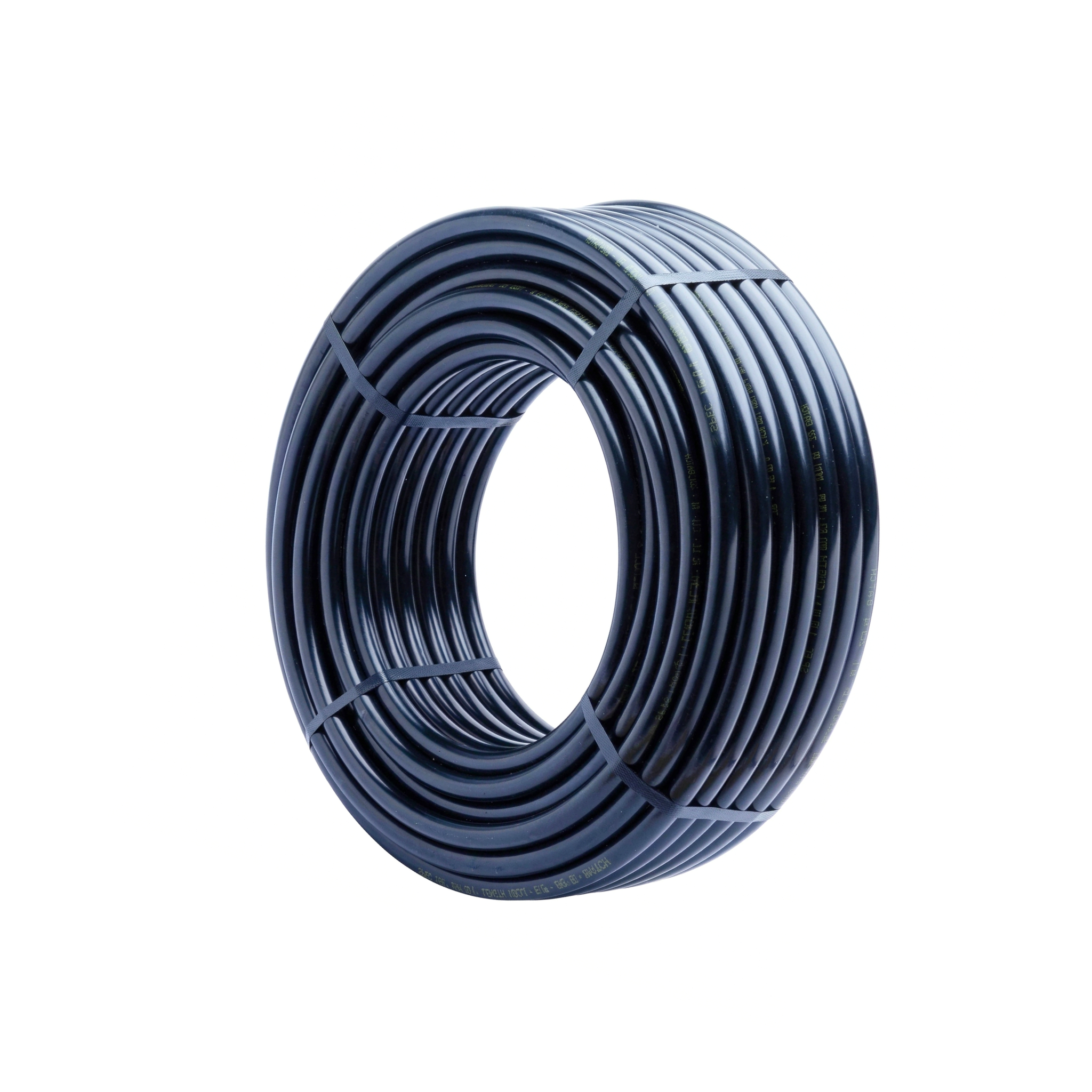
The standard drip irrigation hose is offered in two configurations that differ only in the spacing between emitters: 30 cm and 50 cm, both in 500 m rolls with a 16 mm diameter, 1.0 mm wall thickness (Gauge 4000) and an emitter flow rate of 1.6 L/h at 1 bar. The 1 mm wall sets it apart from the drip tape at 0.3 mm: the hose is designed for semi-permanent or permanent use, with greater mechanical strength and service life. The choice between 30 and 50 cm defines the total system flow rate and the maximum run length.
🎯 Choose the variant in 10 seconds
- If your case is vegetables, row crops with plants every 30–40 cm: go to the 30 cm emitter spacing configuration
- If your case is fruit trees, ornamentals in rows or spaced crops (50 cm or more): go to the 50 cm emitter spacing configuration
What to consider before choosing the variant
Both variants share diameter (16 mm), wall thickness (1.0 mm), emitter flow rate (1.6 L/h), number of outlets (2 per emitter), coefficient of variation (Cv < 5 %), emission uniformity (EU < 0.5) and standard (ISO 9261:2004). The difference lies only in the spacing and in how it affects the system flow rate:
- Crop spacing: in vegetables with plants every 30 cm (tomato, pepper, cabbage, melons in rows), the 30 cm option places an emitter next to each plant. In fruit trees or more widely spaced crops (40–60 cm between plants: young banana plants, papaya, ornamental plants in rows), the 50 cm option distributes better without over-supplying.
- Total system flow rate: the 30 cm roll releases 2,665 L/h over its 500 m; the 50 cm roll releases 1,600 L/h. If the water supply or pump is limited, the 50 cm option reduces demand and allows you to expand the irrigated area per cycle.
- Maximum run length: on flat terrain and at 1 bar, the 30 cm option holds up to 97 m per line; the 50 cm option up to 134 m. For elongated plots (long aisles in fruit orchards, rows of palm trees), the 50 cm option reduces the number of laterals and connections to the main line.
- Hose versus tape: the 1 mm wall makes this hose more resistant to trampling, impacts and aging than a 0.3 mm tape. It is the option for systems that you want to keep year after year on the ground, without rolling it up each season.
- Anti-clogging capacity: the emitter with two outlets and an internal labyrinth reduces the risk of clogging, but just as with tape, proper filtration at the head is essential to maintain uniformity and service life.
30 cm emitter spacing configuration: the close one for vegetables in rows
- 1,666 emitters per roll: uniform coverage
- Ideal for vegetables in rows
- 1 mm wall: durable for semi-permanent use
- Cv < 5 % ensures high uniformity
- High total flow rate: 2,665 L/h per roll
- Shorter maximum lateral: 97 m on flat ground
- Oversized for fruit trees
The 30 cm configuration is the standard option for vegetables in rows with plants every 30–40 cm: tomato, pepper, eggplant, cabbage, melon or watermelon plantings in rows. Its density of 1,666 emitters per roll ensures that each plant receives water without dry intermediate zones. Compared to tape, the 1 mm wall makes it suitable for systems that are kept on the surface season after season, especially in plots with light traffic between lines.
50 cm emitter spacing configuration: the spaced one for fruit trees and ornamentals
- Lower total flow rate: 1,600 L/h per roll
- Longer maximum lateral: 134 m on flat ground
- Allows elongated plots with fewer laterals
- Ideal when pumping is limited
- Insufficient for tightly spaced vegetables in rows
- Risk of dry zones if the crop does not match the spacing
The 50 cm configuration is the preferred option for spaced crops or when long laterals are needed: young banana plants, papaya, citrus plantings in rows, ornamentals in linear beds, palm tree plantings. Its 1,000 emitters per roll lower the water demand to 1,600 L/h, which allows you to irrigate much more area with the same pump. The maximum length of 134 m per line makes it the natural choice for long plots or extensive aisles in fruit orchards.
Variant comparison table
Both variants share all construction and emitter characteristics. The difference lies only in the spacing and, therefore, in the total flow of the roll and the maximum lateral length.
| Characteristic | 30 cm between emitters | 50 cm between emitters |
|---|---|---|
| Ideal use | Vegetables in rows | Fruit trees and ornamentals |
| SKU | 888852 | 443627 |
| Diameter | 16 mm (5/8 in) | 16 mm (5/8 in) |
| Wall thickness | 1.0 mm (Gauge 4000) | 1.0 mm (Gauge 4000) |
| Distance between emitters | 30 cm (12 in) | 50 cm (20 in) |
| Flow rate per emitter (@ 1 bar) | 1.6 L/h (0.42 gph) | 1.6 L/h (0.42 gph) |
| Emitters per roll | 1,666 | 1,000 |
| Total roll flow rate | 2,665 L/h (704 gph) | 1,600 L/h (423 gph) |
| Maximum run length (flat) | 97 m (318 ft) | 134 m (440 ft) |
| Outlets per emitter | 2 | 2 |
| Coefficient of variation (Cv) | < 5 % | < 5 % |
| Emission uniformity (EU) | < 0.5 | < 0.5 |
| Roll length | 500 m (1640 ft) | 500 m (1640 ft) |
| Working pressure | 1 bar (14.5 psi) | 1 bar (14.5 psi) |
| Production standard | ISO 9261:2004 | ISO 9261:2004 |
Use case → recommended variant matrix
| If your case is… | Recommended variant |
|---|---|
| Tomato or pepper with plants every 30–40 cm | → 30 cm |
| Eggplant, cabbage, romaine lettuce in rows | → 30 cm |
| Melon, watermelon, zucchini in a continuous row | → 30 cm |
| Young banana plants, papaya, citrus in plantation | → 50 cm |
| Beds of ornamentals or palm trees in rows | → 50 cm |
| Limited pumping or long aisles in the orchard | → 50 cm |
When in doubt between hose and tape, let the expected service life of the system and the presence of traffic in the plot guide you. The gauge 120 tape (0.3 mm) is economical and sufficient for one vegetable season, but it is easily damaged by trampling or rubbing against machinery. The 1 mm hose (this product) is the choice for systems lasting more than one season, fruit tree plantations or crops where personnel and machinery move close to the irrigation. The cost difference pays for itself by avoiding replacement and repairs every cycle.
Do not exceed the maximum run lengths indicated (97 m for 30 cm, 134 m for 50 cm on flat terrain at 1 bar). Beyond that distance, the pressure drops at the end of the lateral and the flow rate of the last emitters is reduced, generating poor uniformity. For longer plots, feed the line from the center (with two laterals toward both ends), or switch to a pressure-compensating hose, which maintains a constant flow rate on lines twice as long.
Frequently asked questions
Hose or tape: when do I choose each one?
Use drip tape (0.3 mm wall, gauge 120) for single-season crops and a tight budget: annual vegetables, short cycles. Use drip hose (this product, 1 mm wall) for semi-permanent or permanent systems: fruit trees, perennial plantations, systems that you want to keep for more than one cycle. The hose better resists trampling, rubbing against machinery and aging in the sun.
Standard or pressure-compensating for my plot?
Use standard (this product) on flat plots or those with minimal slopes, where the pressure remains uniform along the lateral. Use a pressure-compensating hose on sloped terrain, very long laterals or when you need an identical flow rate at the first and last emitter regardless of the local pressure. The pressure-compensating one is the technical upgrade when uniformity is critical.
