

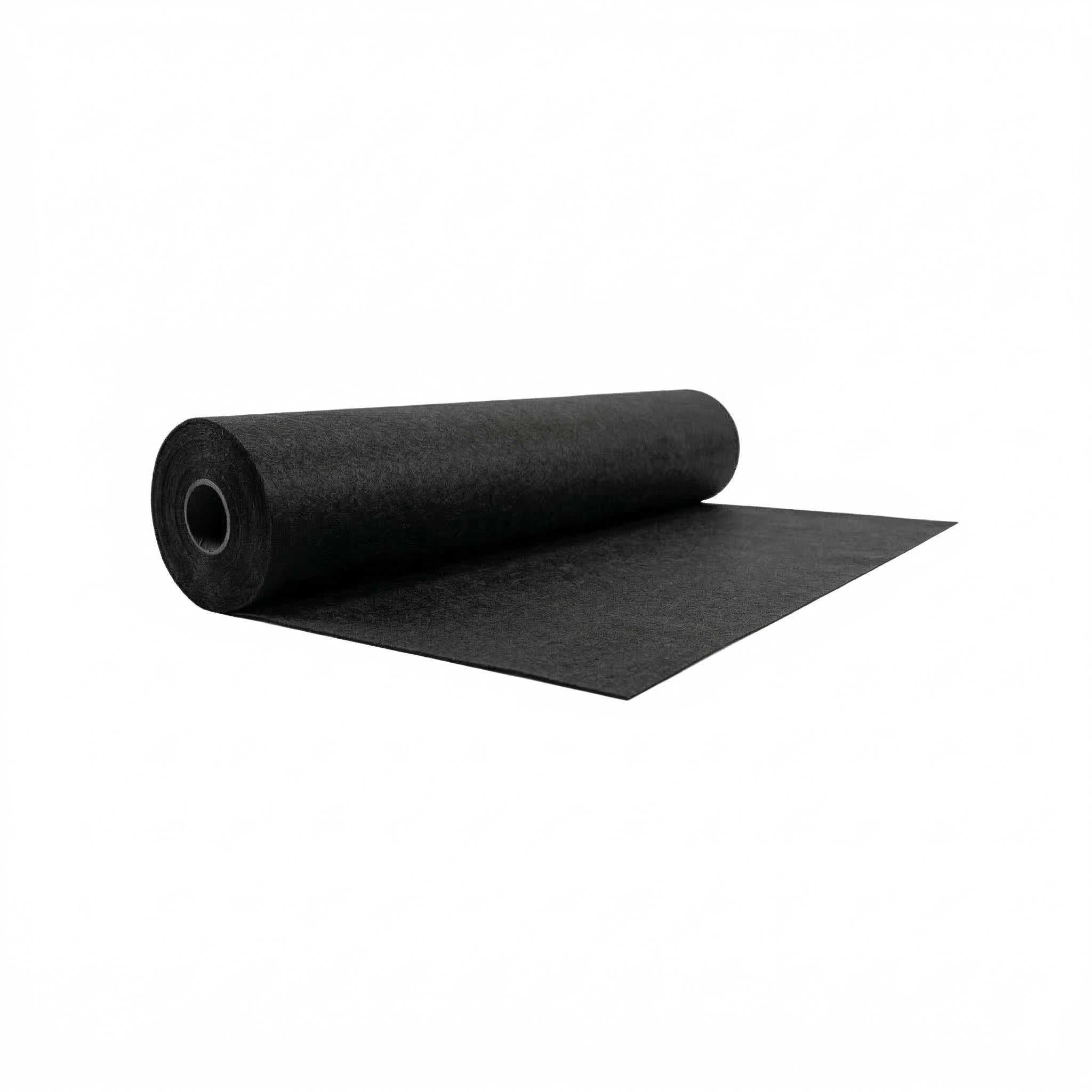
The woven polypropylene (PP) geotextile is offered in two tensile strengths: 40 kN/m and 80 kN/m. Unlike non-woven geotextile (selected by grammage), woven geotextile is specified directly by its tensile strength, because its primary function is separation and reinforcement under load. This comparison helps you decide which option fits your project: secondary road construction with medium traffic, or embankment construction and heavy structural reinforcement.
🎯 Choose your variant in 10 seconds
- If your case is subbase stabilization, rural access roads, or secondary roads: go to 40 kN/m variant
- If your case is embankment reinforcement, soft soils, or heavy structural loads: go to 80 kN/m variant
What to consider before choosing a variant
Both variants share the same material (woven PP), the same elongation at break (< 15%), the same UV resistance (≥ 85%), the same O90 pore size (0.3–0.8 mm), and the same format: rolls of 5.2 m × 100 m (520 m² per roll). The decision comes down to the structural load the geotextile must withstand:
- Structural function: woven geotextile is for separation and reinforcement under load. If you only need drainage, filtration, or geomembrane protection, use non-woven PP or non-woven PET.
- Traffic load: light to medium traffic roads work with 40 kN/m; heavy traffic roads, embankments with concentrated loads, or soil-reinforced retaining walls require 80 kN/m.
- Bearing capacity of the subgrade: low CBR of the underlying soil (< 3) requires greater reinforcement. On soft, saturated, or highly deformable soils, always use the 80 kN/m variant.
- Fill thickness above: thin fills over soft soils transmit more stress to the geotextile. The greater the direct load on the sheet, the higher the tensile requirement.
- Overlaps and splices: for structural reinforcement, the recommended minimum overlap is 50 cm perpendicular to the load direction. Take advantage of the 5.2 m roll width to minimize joints.
Variant 40 kN/m: the standard for secondary road construction
- Strength 41 kN/m in MD and CD: balanced in both directions
- Elongation < 15%: minimal deformation under load
- UV resistance ≥ 85%: tolerates moderate site exposure
- Best cost-to-strength ratio for standard road construction
- Insufficient for high embankments on soft soils
- Not recommended under heavy traffic or concentrated loads
The 40 kN/m is the reference for secondary road construction: rural roads, property access drives, outdoor parking lots, and urban roads with light to medium traffic. Its primary function is to separate the subbase from the subgrade (preventing material mixing) while providing lateral reinforcement. For soils with a reasonable CBR and standard fill depths, this strength covers the majority of projects.
Variant 80 kN/m: the heavy-duty option for structural reinforcement
- Strength 80 kN/m in MD and CD: double the standard variant
- Suitable for embankments over saturated or low-CBR soils
- Reduces differential settlement in civil works
- Same elongation < 15% and UV resistance ≥ 85%
- Higher cost per m² than the 40 kN/m
- Over-specified for standard secondary road construction
The 80 kN/m is the specification for projects where soil deformation is high or structural load demands extra reinforcement: embankments over soft or saturated soils, soil-reinforced earth walls, heavy-load storage platforms, and access roads to high-tonnage construction sites. If your project does not fall into these categories, the 40 kN/m is usually sufficient and more economical.
Variant comparison table
Both variants share all functional properties (pore size, flow rate, elongation, UV resistance) and differ only in ultimate strength. The choice comes down to a single structural question: what load must the geotextile bear?
| Feature | 40 kN/m | 80 kN/m |
|---|---|---|
| Ideal use | Secondary road construction | Embankments and heavy reinforcement |
| SKU | 527427 | 654134 |
| Material | Woven PP | Woven PP |
| Ultimate strength MD | 41 kN/m | 80 kN/m |
| Ultimate strength CD | 41 kN/m | 80 kN/m |
| Elongation | < 15 % | < 15 % |
| UV resistance | ≥ 85 % | ≥ 85 % |
| O90 pore size | 0.3–0.8 mm | 0.3–0.8 mm |
| Water flow rate | 10–180 L/m²/s | 10–180 L/m²/s |
| Format | 5.2 m × 100 m | 5.2 m × 100 m |
Use-case matrix → recommended variant
| If your case is… | Recommended variant |
|---|---|
| Subbase stabilization on a rural road or property access drive | → 40 kN/m |
| Outdoor parking lot or urban road with light to medium traffic | → 40 kN/m |
| Embankment over soft or saturated soil | → 80 kN/m |
| Soil-reinforced earth wall or reinforced slope | → 80 kN/m |
| Heavy-load storage platform or access road to high-tonnage construction site | → 80 kN/m |
If you combine woven geotextile with a biaxial geogrid, install the woven geotextile first as a separation and filtration layer, then place the geogrid on top as a discrete reinforcement layer. Each product does what it does best. If you install only the geogrid without the geotextile underneath, fine soil particles migrate up and clog the openings, causing a loss of bearing capacity within months.
Do not use woven geotextile as protection under a geomembrane or as a filter in primary drainage. The woven structure has regular openings that allow fines to pass but does not absorb stone puncture loads as effectively as non-woven geotextile. For drainage and geomembrane protection, use non-woven geotextile. Woven geotextile is exclusively for separation and load-bearing reinforcement.
Frequently asked questions
Woven or non-woven: which should I choose?
Use woven geotextile (this product) when the primary function is layer separation and reinforcement under load, especially in road construction and civil works. Use non-woven when the primary function is drainage, filtration, or geomembrane protection. The simple rule: if it bears structural load, use woven; if it manages water or protects another sheet, use non-woven.
What overlap should I leave between rolls for reinforcement applications?
For reinforcement under load, a minimum of 50 cm in the direction perpendicular to the principal stress, and 30 cm in the parallel direction. For subbase separation on secondary roads without critical tensile demand, 30 cm is sufficient. Take advantage of the roll width (5.2 m) to minimize longitudinal joints in the principal load direction.
Should it be combined with a geogrid?
It depends on the project. For standard secondary roads, the woven geotextile alone is sufficient. In very soft soils or where reducing subbase thickness is required, combining the woven geotextile (separator) with a geogrid (discrete reinforcement) is beneficial: the geogrid adds additional tensile capacity to the system while the geotextile prevents contamination of the aggregate by fines from the underlying soil.
