

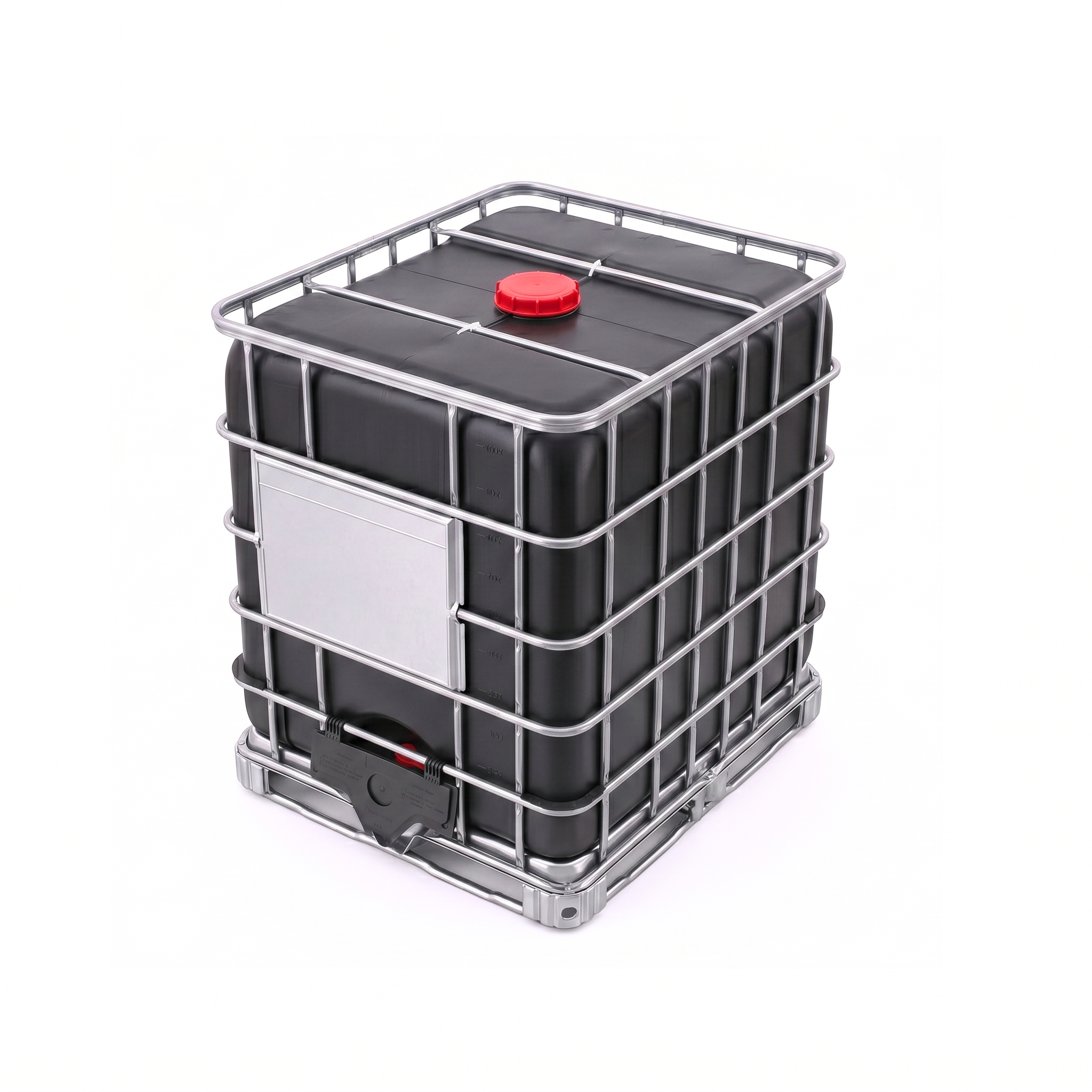
If you need to store water outdoors under direct sunlight without algae growth, contain liquid fertilizers, agrochemicals or light-sensitive liquids that degrade with light, or manage fuels, oils and industrial chemicals under UN regulation in yards and outdoor areas, the 1000 L CARGOBO Black IBC container with galvanized cage and UN approval is the tool calibrated for those scenarios. This guide explains how to verify that the UN approval covers the specific liquid you are going to contain, how to confirm the chemical compatibility of HDPE with the product, how to fill and discharge correctly, and how to handle the container with a forklift on site and in the plant without compromising the structural integrity of the tank.
The IBC economically replaces multiple 200 L drums with unified logistics handling, a 4-way palletized base for access from any side, and a bottom valve for controlled discharge. For dry bulk solids instead of liquids, step away from the IBC and consider the big bags with valve that offer similar capacity for grains, solid fertilizers and granular materials with their own discharge system.
Product specifications
The Black IBC container is offered as a single variant calibrated for industrial, agricultural and logistics use of liquids outdoors. The following table sets out the complete technical specifications:
| Specification | Value |
|---|---|
| SKU | 975769 |
| Tank | Opaque black virgin HDPE (carbon black) |
| Cage | Tubular galvanized steel |
| Base | Integrated palletized base with 4 ways for forks |
| Capacity | 1000 L (265 gal) |
| Dimensions | 120 × 100 × 115 cm (48 × 40 × 45 in) |
| Filling opening | Top cap with standard thread and vent |
| Discharge valve | Bottom valve with standard thread (compatible with garden hoses and industrial lines) |
| Approval | UN approval, categories II and III for hazardous substances |
| Condition | New (not reconditioned) |
| Suitable for | Water outdoors, irrigation, liquid fertilizers, light-sensitive liquids, HDPE-compatible chemicals, regulated fuels |
The UN marking printed or embossed on the container encodes the packaging type (31HA1 for rigid composite IBC), the packing group (X = all classes I, II, III; Y = classes II and III; Z = III only), maximum liquid density, test pressure, year of manufacture and country. Verify that the UN marking of the IBC covers the class of the specific liquid you are going to contain — an IBC with Y approval does NOT work for class I and an IBC with Z approval does NOT work for class II or I. The UN marking has a validity date through periodic reinspection; verify that it is current before first use with a hazardous substance.
For dry bulk solids in a volume similar to the IBC, the big bags with loading valve and flat bottom are the alternative choice: grains, solid fertilizers and granular materials are handled better in a flexible than in a rigid container.
Step by step to use it
The following procedure covers the full IBC cycle: approval verification, filling, logistics handling and discharge.
Verification of approval and chemical compatibility
Before first use with a hazardous substance, read the UN marking on the container and confirm that it covers the UN class of the liquid (I, II or III according to the product's MSDS safety data sheet). For construction water, irrigation or non-hazardous rainwater, approval is not legally required — but confirming the chemical compatibility of HDPE with the liquid does matter. HDPE is compatible with most diluted acids, bases, common oils, fertilizers and common fuels, but some aggressive organic solvents (ketones, pure aromatic hydrocarbons, halogenated compounds) degrade it progressively. Consult the manufacturer's chemical compatibility table or the product's MSDS before loading non-routine liquids.
Filling through the top cap
Place the IBC in a vertical position on a firm, level surface. Open the top cap and fill by gravity (hose, funnel) or pumping, filling up to 95% of the maximum usable volume — leave a 5% margin for thermal expansion to account for Caribbean temperature variations that can expand the liquid and compromise the cap. Since the tank is opaque and does not let you see the contents, monitor filling through the top opening or keep a record of the loaded volume. For hazardous chemicals, label the container with the substance name, UN class and loading date in accordance with your operation's safety protocol. Close the cap with moderate torque — over-tightening compromises the flat seal and deforms the filling neck. For hazardous chemicals, place the IBC on a spill containment pallet with retention calibrated to 110% of the volume.
Handling with a forklift or pallet truck
ALWAYS handle the IBC in a vertical position — tilting it when full causes liquid displacement with a moment of force that can tip it over or exceed the load capacity of the forklift. Insert the forks into any of the four sides of the integrated pallet of the base, all the way in, with the cage resting against the forklift backrest. Standard dynamic capacity of an IBC full of water: 1000 kg, plus the tare weight of the container (~60 kg). Make sure your forklift or pallet truck supports that weight. Move at a slow speed, avoiding sudden braking, sharp turns at speed and steep ramps — the inertia generated by 1000 L of liquid is significant. Do NOT stack full IBCs: for horizontal stacking, use heavy-duty racking with individual compartments.
The Black IBC is the choice when the water or liquid is going to be in full sun: the opaque tank with carbon black blocks light, so algae do not grow inside and you do not need to cover or paint it as a translucent tank requires. In exchange, you will not be able to see the level from the outside: mark a scale on a dipstick, monitor through the top opening, or install a flow meter on the discharge line if you dose with precision. And although carbon black gives greater resistance to UV radiation than a clear tank, the galvanized cage still suffers from the salt corrosion of the Caribbean: in coastal areas, protect it all the same. If you need to see the liquid level at a glance, consider the Translucent White IBC container.
Discharge through the bottom valve
Position the IBC on a support of sufficient height (platform, metal stand) so that the bottom valve is above the receiving container or the hose connection. Connect the hose or line to the standard thread of the valve. Before opening, slightly open the top cap to allow air entry — without venting, the liquid comes out in discontinuous spurts and can create a vacuum that deforms the tank. Open the valve gradually to avoid spillage from excessive speed, controlling the flow rate with the partial opening. Close the valve completely when finished and verify that there is no residual dripping. In operations with hazardous chemicals, the procedure must be recorded in a logbook with the quantity discharged, date and responsible operator in accordance with the plant's protocol.
Cleaning and reuse
If the contents of the IBC are going to change from one liquid to another between cycles, wash thoroughly: repeated rinsing with pressurized water through the top cap, rotating the IBC to drag out residues, and discharge through the bottom valve until the water comes out clean. For chemicals with persistent residue, use a neutral detergent or the product specified by the safety data sheet of the previous liquid. CRITICAL: never switch from one chemical to another without verifying the compatibility of the residues of the first with the second — mixing residues of acids with bases, oxidizers with flammables or antagonistic products can generate hazardous reactions. After washing, let it air-dry with the top cap and valve open in a ventilated area before the next cycle.
Do not use IBCs without a current UN marking for hazardous substances (fuels, classified chemicals, hazardous waste), nor IBCs with an expired approval past the reinspection date. The UN marking is not decorative: it is a legal and technical requirement that certifies that the container passed impact, hydraulic pressure and leak-tightness tests calibrated for that class of substances. An IBC without a UN marking or with an expired marking loaded with a UN chemical is illegal for transport and, more importantly, does not offer a guarantee of integrity under accident: if the container fails during an impact, rollover or fire, the regulatory, environmental and human consequences can be serious. For non-hazardous substances (water, rainwater, irrigation) the container without a current marking remains useful, but for regulated chemicals always verify the approval before first use.
Complementary products
To complement the Black IBC container in liquid storage and logistics, the following products cover the most common adjacent needs:
The spill containment plastic pallet is the natural complement when the IBC contains regulated chemicals or liquids with environmental risk: the retention sump calibrated to 110% of the volume contains any spill from a leak, valve failure or rollover, preventing soil contamination and regulatory fines. The big bag with loading valve and flat bottom is the alternative choice when the material to be stored is dry bulk solid (grains, solid fertilizers, fine gravel) in a comparable volume. The 3-skid plastic pallet serves as an internal transport base when the IBC is discharged onto the plant floor and needs to be moved on conventional pallets. The box pallet with valve is an alternative for NON-hazardous liquids in a smaller volume (~700 L) when UN approval is not required.
Maintenance and care
Inspect the IBC periodically for cracks or dents in the HDPE (especially in fork impact areas), incipient corrosion on the galvanized cage (especially on feet and welds), a valve with residual dripping or a degraded seal, and a top cap with an aged seal. The black tank with carbon black resists UV radiation better than a translucent tank, which makes it ideal for prolonged solar exposure; even so, the galvanized cage in a salty Caribbean climate lasts significantly less than in a dry continental climate. In coastal areas (Punta Cana, La Romana, north coast) consider an additional coating of exterior metal paint every 2-3 years to extend the cage's service life. If the cage shows advanced structural corrosion, remove the IBC from service even if the HDPE tank is intact: the cage is a fundamental part of the integrity of the assembly under impact.
For prolonged storage of the fleet of empty IBCs, keep the units with the caps and valves closed to prevent the entry of dust, rain and wildlife. Keep a record of the fleet by unit with serial number, historical contents, date of last cleaning and date of next reinspection for hazardous substances. Traceability by unit is required in regulatory audits of UN class substances and in ISO quality certifications of industrial plants.
Frequently asked questions (FAQ)
What UN class is the IBC's and what liquids does it cover?
The IBC has UN approval for packing groups II and III (Y designation in the UN marking). Group II covers liquids of medium hazard (most common fuels, diluted acids, common bases, hazardous liquid fertilizers) and group III covers liquids of low hazard (lubricating oils, regulated non-hazardous aqueous solutions, liquids compatible with HDPE in general). Group I (liquids of high hazard: concentrated acids, concentrated bases, highly toxic chemicals) is NOT covered by this IBC and requires specific X approval. Always verify the UN class of the specific liquid you are going to contain — the information is in the product's MSDS safety data sheet — before first use.
How do I monitor the level if the tank is opaque?
The black tank does not let you see the contents from the outside. To monitor the level: open the top cap and measure with a graduated dipstick, keep a record of what is loaded and discharged, or install a flow meter on the filling or discharge line. If visual monitoring of the level at a glance is a priority in your operation (dosing, inventory, replenishment), the suitable variant is the Translucent White IBC container, whose translucent tank lets you see the liquid without opening the cap.
How long does a Black IBC last in the Caribbean outdoors?
The black tank with carbon black is better prepared than a clear tank for direct sun: the pigmentation adds resistance to UV radiation and blocks light, preventing the growth of algae in stored water. With professional handling — maintenance of the cage against salt corrosion, washing between liquid changes and careful handling with a forklift — it offers many years of service. The most likely failure point in a coastal climate is not the tank but the galvanized cage: protect it with exterior metal paint in salty areas and remove the unit from service if structural corrosion advances.
