

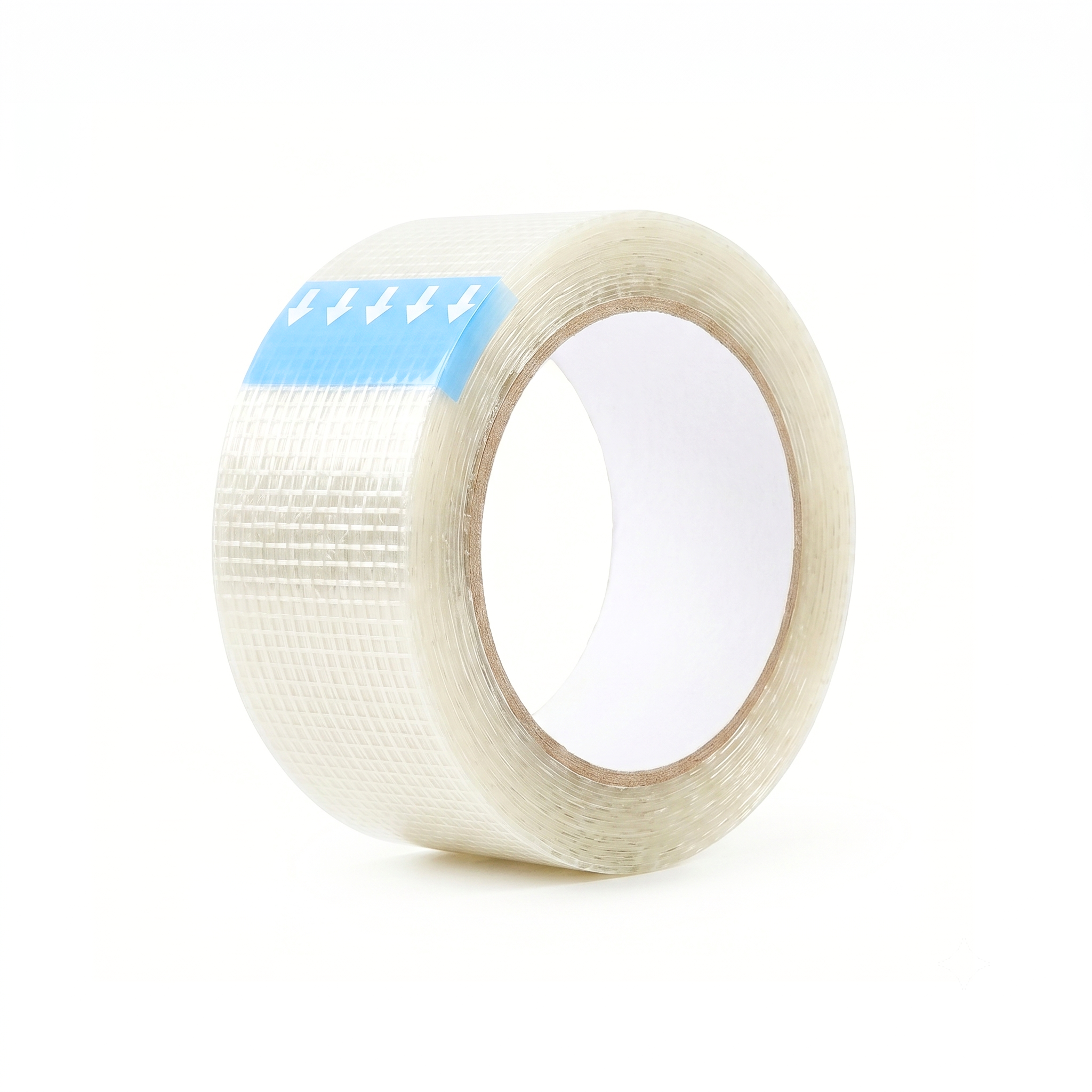
This guide covers the application of filament tape: choosing the width according to the load, surface preparation, applying with firm tension, anchoring the ends in bundles, and cutting with a tool. Follow these steps to reinforce heavy boxes and unitize packages with strapping strength, without needing a tensioner, seal, or buckle.
Product Specifications
The tape combines BOPP film, longitudinal fiberglass filaments, and high-tack hot melt adhesive, manufactured by Fortemo in three widths with 50 m per roll. The table below shows the three available variants:
| Specification | 18 mm × 50 m | 25 mm × 50 m | 48 mm × 50 m |
|---|---|---|---|
| SKU | 610820 | 610821 | 610822 |
| Tape width | 18 mm (3/4 in) | 25 mm (1 in) | 48 mm (2 in) |
| Length per roll | 50 m (55 yd) | 50 m (55 yd) | 50 m (55 yd) |
| Film material | BOPP with fiberglass filaments | BOPP with fiberglass filaments | BOPP with fiberglass filaments |
| Adhesive | Hot melt | Hot melt | Hot melt |
| Tensile strength | ≥ 250 N/cm | ≥ 250 N/cm | ≥ 250 N/cm |
| Elongation | < 5 % | < 5 % | < 5 % |
| Rolls per box | 48 rolls | 36 rolls | 24 rolls |
| Brand | Fortemo | Fortemo | Fortemo |
Step-by-step guide to using it
The procedure covers the two main uses of the tape: reinforcing heavy boxes and bundling tubes, profiles, and packages. In both cases, the key is the same: clean surface, firm tension during application, and well-anchored ends, because the filaments only work if the tape is taut and adhered along its entire length.
Choose the width according to the load
The 18 mm width covers light bundles (thin rods, medium boxes, immobilizing lids and drawers); the 25 mm width is the balance for grouping tubes and reinforcing heavy export boxes; the 48 mm width is for very heavy bottoms, coils, and bulky packages where maximum grip surface is desired. The wider the tape, the more filaments work per pass.
Prepare the surface and plan the path
Clean dust, grease, and moisture from the adhesion area: the hot melt adheres instantly, but only on a clean surface. For boxes, decide where the reinforcement sections will go (corners, bottom, flap joint); for bundles, calculate the full wrap around the assembly with 10-15 cm of overlap on the tape itself.
Apply with firm tension and press along the entire length
Pull the roll with sustained tension while pressing the tape with your palm: with less than 5% elongation, whatever you tension during application is what remains working, without the bundle loosening afterwards. Pass your palm along the entire applied section so that the hot melt makes full contact, especially on edges and changes of plane.
To immobilize movable parts (appliance doors, furniture drawers), finish the end with a 2-3 cm dry tab by folding the tape back on itself: at the destination, it can be located and removed without tools and without scratching the edge with a fingernail. The holding force is not lost by this finish.
For bundles, close the wrap by overlapping tape on tape
Complete the wrap around the assembly and finish by adhering the end onto the tape itself, not onto the product: tape on tape is the strongest anchor for the system. For heavy boxes, combine longitudinal sections under the bottom with perpendicular reinforcements at the corners, which is where the cardboard yields first.
Cut with scissors or a knife, never by pulling
Fiberglass filaments cannot be torn by hand: always cut with scissors, a knife, or the blade of a dispenser, at an angle to leave a starting tab. Trying to tear it will only fray the film edge and can hurt your fingers with the threads.
Complementary Products
Filament tape bridges the gap between conventional packaging tape and strapping systems with tools. These complementary products mark the two extremes of that range and protect the load when bundling:
Polypropylene (PP) strapping is the next step when bundling scales up to full pallets or loads requiring mechanical tension with a tool. Plastic edge protectors for strapping protect the edges of the package when strapping tightens delicate corners, with tape or strapping. Transparent PP tape solves the standard sealing of boxes that do not require structural reinforcement.
Maintenance and Care
Filament tape remains stable for years with three warehouse rules, which also protect its declared strength and adhesive tack:
- Storage between 10 °C and 30 °C: closed boxes in their original packaging, away from direct sunlight. UV radiation degrades the hot melt adhesive and makes the film brittle before the filaments.
- FIFO rotation: use older rolls first so that no batch ages at the back of the shelf losing initial stickiness.
- Handling an open roll: leave the tab folded and the roll standing on its edge. Lying flat on the shelf, the adhesive sticks to the surface, and when peeled off, it pulls the first layer with its filaments.
Do not use filament tape as a substitute for strapping on heavy palletized loads under sustained tension, much less for lifting or hanging packages: the tape reinforces and groups, but it does not replace the mechanical tension of a PET strap closed with a tool. Also, do not try to tear it by hand: the filaments will not yield, and pulling can injure your fingers.
Frequently Asked Questions
How many bundles can be made from a 50 m roll?
It depends on the perimeter of the assembly. As a reference, a bundle of tubes with a 40 cm perimeter, with a full wrap and overlap, consumes about 0.6 m per tie: one roll yields about 80 simple ties, or 40 bundles with double ties at the ends, the usual configuration for long tubes and profiles.
Does container heat unstick the tape?
The high-tack hot melt adhesive is formulated to maintain the bond under tension at typical transit and warehouse temperatures in the DR. The critical point is not heat but application: clean, dry surface, and firm pressure along the entire length. A tie that fails was almost always applied on dust or without pressing the final overlap.
Can it be used to hang or hoist packages?
No. The resistance of ≥ 250 N/cm is declared for reinforcement and unitization, not for hoisting suspended loads, where a failure implies risk to people. To lift or suspend packages, use slings and rigging certified for hoisting; the filament tape is for keeping the package bundled and firm.
