

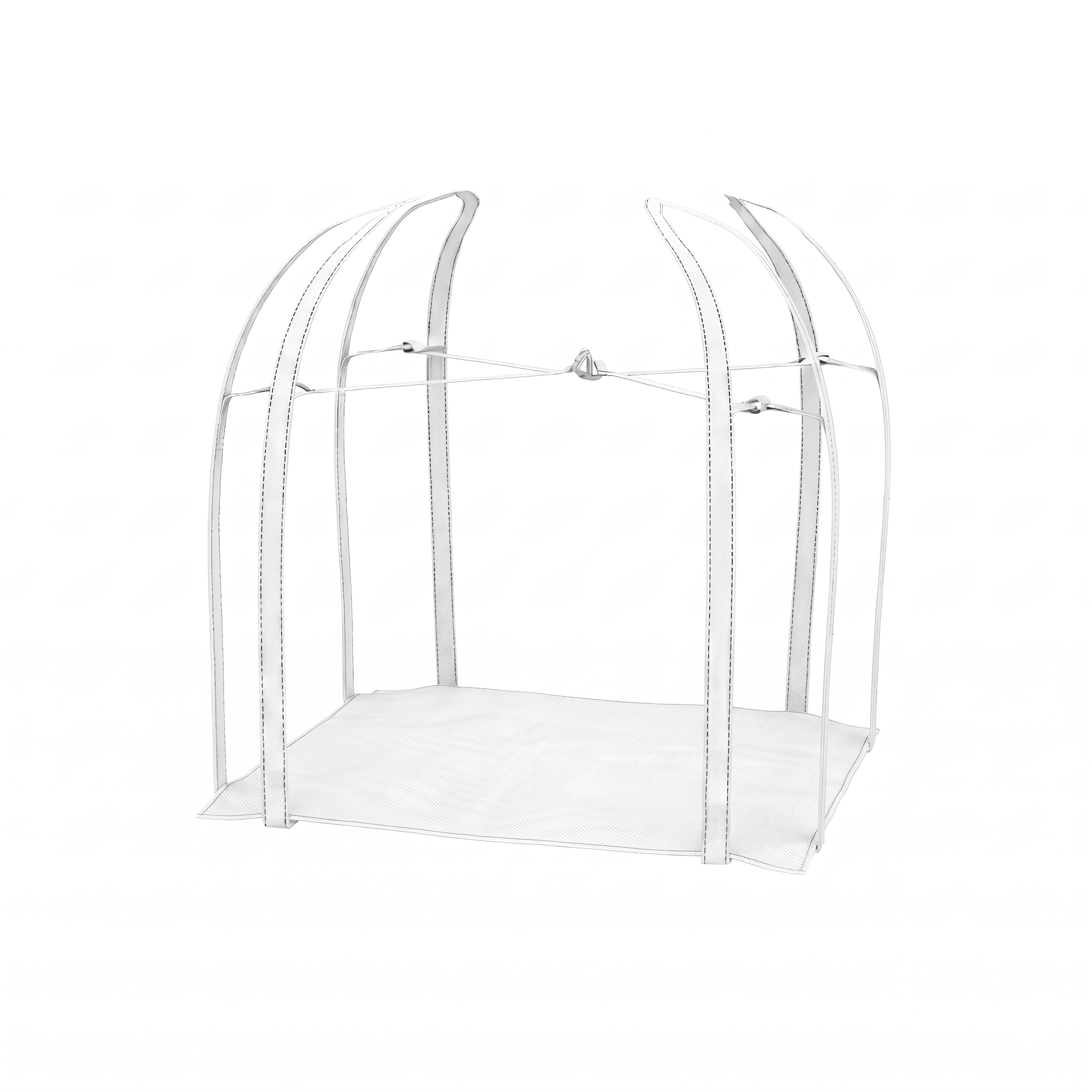
This guide covers the safe use of the polypropylene sling (soft pallet): pre-use inspection, building the load, lifting by all four points, transport by forklift or crane, and storage. The sling is a lifting device; follow the recommended sequence to move bags safely and get the most out of its service life.
Product specifications
The polypropylene sling is a textile pallet made of virgin white woven fabric with four reinforced lifting points, designed as a light, hygienic alternative to the wooden pallet. It is supplied in packs of 30 units. Confirm the dimensions and the working load limit before use.
| Specification | Value |
|---|---|
| Material | Virgin polypropylene (PP), 160 g/m² woven fabric |
| Color | White |
| Base | 120 × 120 cm (48 × 48 in) |
| Usable height | 160 cm (63 in) |
| Lifting points | 4 polypropylene webbing lifting loops, 7 cm wide, with 145 cm auxiliary ears |
| Working load limit (WLL) | 1,500 kg (3,300 lb) |
| Safety factor | 5:1 |
| Packaging | Pack of 30 slings |
Using your polypropylene sling step by step
Follow these five steps in order. Do not improvise with the load or the attachment points: a sling used correctly is safe; one used incorrectly can fail suddenly.
Inspect the sling before each use
Check the fabric, the seams and the four loops for cuts, burns, broken threads or heavy sun fading. A sling with visible damage to a strap or seam must be taken out of service: it is not repairable.
Build the load centered
Spread the sling open on firm ground and stack the bags in crosswise layers, distributing the weight evenly. Do not exceed the 1,500 kg working load limit or the 160 cm usable height: a load that is too tall or off-center becomes unstable when lifted.
Prepare the four lifting points
Gather the four loops and ears toward the center of the load and check that none is twisted or trapped under the bags. The 145 cm auxiliary ears must remain free to receive the forklift or crane hook.
Lift by all four points at once
Hook the four loops onto the forklift forks or the crane hook and lift vertically and smoothly, without jerking. Never lift from one, two or three points: it unbalances the load and concentrates all the stress on a few seams.
Transport, stack and secure
Move the load at low speed, without dragging the sling along the floor or running it over sharp edges. For high stacking or long transport, wrap the unit with stretch film, which locks the bags in place and keeps them from shifting.
For sea export, the sling avoids the ISPM-15 phytosanitary treatment that wooden pallets do require, weighs a fraction as much and frees up container space. In practice, that lowers the freight cost per unit and speeds up customs inspection.
Complementary products
To get the most out of the sling, these products round out the bag palletizing and transport operation:
The polypropylene raffia bag is the typical load palletized on the sling. The big bag is the alternative when moving bulk product instead of individual bags. And stretch film locks and protects the assembled unit so the bags do not shift during transport.
Maintenance and care
Store slings clean and dry, under cover and out of direct sunlight: UV radiation degrades polypropylene over time and is the most common cause of strength loss in a textile pallet. Before reusing a sling, repeat the inspection of seams and loops; if in doubt about its condition, withdraw it.
For cleaning, wash the fabric with water and mild soap and let it dry in the shade. Avoid solvents, acids and prolonged contact with hot surfaces. Do not mark or pierce the fabric to identify the load: any cut reduces the strength at the point where it is made.
Never exceed the 1,500 kg working load limit or use the sling to lift people. Never lift it from fewer than its four points either: uneven loading concentrates the stress on a single seam and can cause the load to fail suddenly.
Frequently asked questions
How much weight can the sling hold?
Its working load limit (WLL) is 1,500 kg, with a 5:1 safety factor. That factor is a manufacturing margin, not an authorization to exceed the WLL: always work below 1,500 kg.
Is it suitable for exporting goods by sea?
Yes. It is an alternative to the wooden pallet that does not require ISPM-15 phytosanitary treatment, weighs far less and makes better use of container space, which lowers the freight cost per unit.
Is the sling reusable?
Yes, as long as it passes the pre-use inspection: no cuts in straps or seams, no burns and no evident sun degradation. If there is any damage to a lifting point, take it out of service; it is not repairable.
