

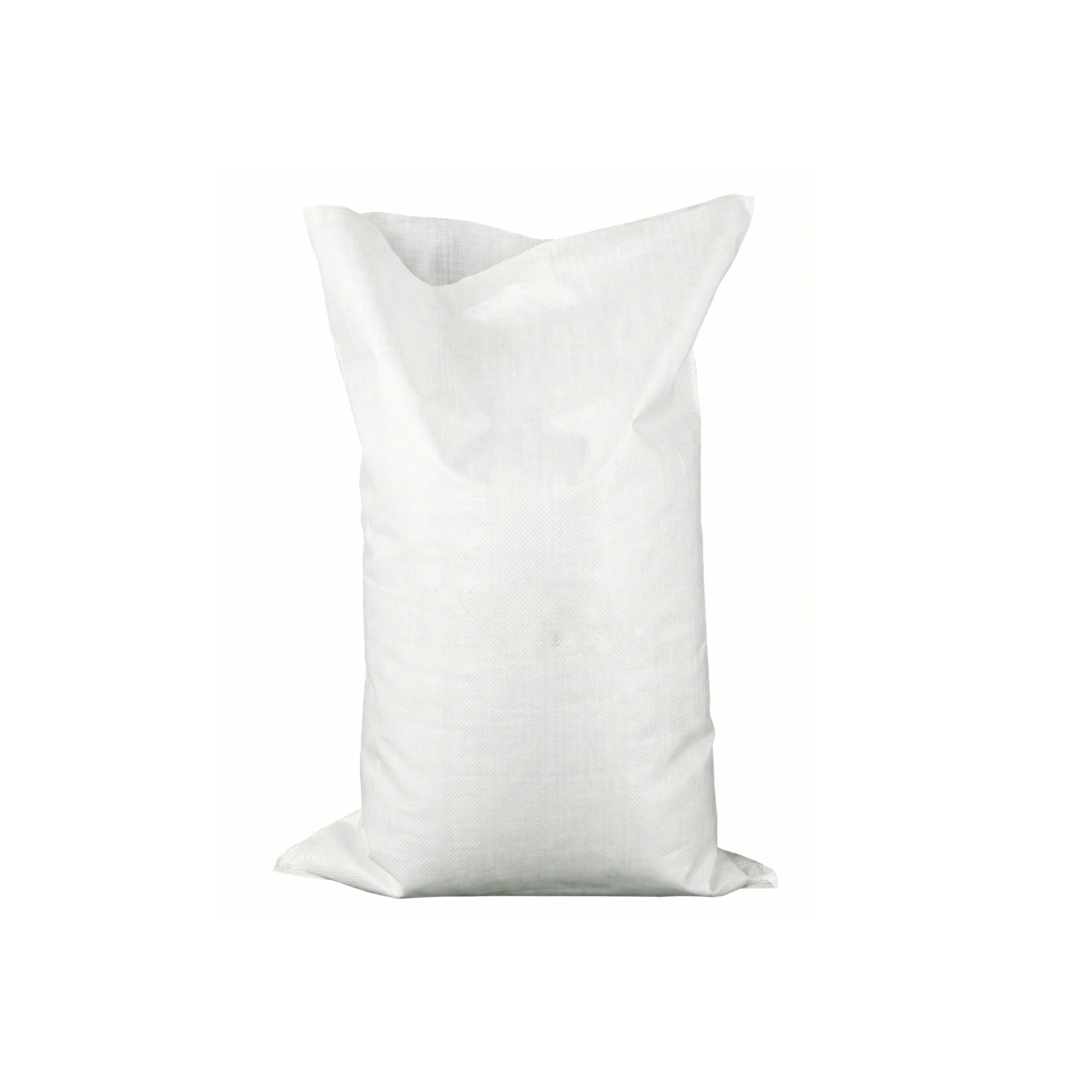
This guide covers the use of the polypropylene raffia bag: choosing laminated or unlaminated depending on the product, using the correct size for the actual weight, filling by weight with a funnel or nozzle, closing with an industrial chain stitch 401 seam and stacking on a pallet in a pyramid or column. Follow these steps to pack grains, flours, aggregates or dry materials with an economical, durable and reusable bag.
Product specifications
The polypropylene raffia bag is made with high-tenacity virgin PP tape (1,000–1,200 denier), 12 × 12 threads/in mesh weave, weight calibrated by size (95 to 125 g/m²) and compliant with ISO 23560:2015. The laminated version adds a BOPP film of ≈20 g/m² on the inner face as a moisture and dust barrier; the unlaminated version is breathable and more economical.
| Capacity | Dimensions | Denier (PP tape) | Weight | Unlaminated SKU | Laminated SKU | Packaging |
|---|---|---|---|---|---|---|
| 4.5 kg (10 lb) | 33 × 50 cm (13 × 20 in) | 1,000 D | 95 g/m² | 100610 | 100620 | 500 bags |
| 11.3 kg (25 lb) | 46 × 76 cm (18 × 30 in) | 1,000 D | 95 g/m² | 113654 | 754554 | 250 bags |
| 22.7 kg (50 lb) | 56 × 91 cm (22 × 36 in) | 1,000 D | 105 g/m² | 324453 | 754211 | 250 bags |
| 45.4 kg (100 lb) | 74 × 114 cm (29 × 45 in) | 1,100 D | 120 g/m² | 654783 | 764111 | 100 bags |
| 56.7 kg (125 lb) | 56 × 97 cm (22 × 38 in) | 1,200 D | 125 g/m² | 487326 | 562478 | 100 bags |
Step-by-step use
The procedure applies to all variants. The key differences between laminated and unlaminated appear in steps 1 (choice) and 5 (storage); the rest of the workflow is identical.
Choose laminated or unlaminated depending on the product
The inner finish changes how the bag behaves with moisture and the product. This is the first and most important decision.
- If you have the laminated variant: it is designed for fine grains (flour, sugar, salt), hygroscopic fertilizers, products sensitive to moisture or prolonged sun exposure. The inner BOPP barrier blocks dust, moisture and odors.
- If you have the unlaminated variant: it is designed for coarse grains (rice, beans, corn, roasted coffee for the local market), rubble, aggregates and products that tolerate or need some breathability during storage.
Use the correct size for the actual weight
Each format has weight calibrated to its nominal load: the 100 lb bag uses 1,100 denier tape and 120 g/m²; the 25 lb one uses 1,000 denier and 95 g/m². Filling a 25 lb bag with a 50 lb load breaks it; it is not a saving, it is a loss.
Fill by weight using a funnel or nozzle
Place the bag under the filling funnel or on a scale with a nozzle. Load up to the nominal weight, leaving 7–10 cm free at the mouth for the stitching. Gently shake the bag at half load to settle the product without compacting it too much.
Close with an industrial chain stitch 401 seam
Use a portable sewing machine with PP multifilament thread of 1,200–2,000 denier, 7–10 stitches per inch, chain stitch class 401 seam. Fold the mouth of the bag once over itself before sewing to reinforce the edge. At the end, check that the seam does not come undone by gently pulling on the end of the thread.
If you do not have a portable sewing machine available, tie the mouth with soft galvanized wire or plastic load ties. It is less professional than stitching but holds the weight for occasional uses. For repetitive operations, the investment in a bag closer pays for itself in a few weeks.
Stack on a pallet in a pyramid or column
Stack the bags in a pyramid pattern (layers alternated at 90°) for maximum stability or in a straight column if the goods are to be dispatched soon. The anti-slip additive built into the bag allows stacking more than 5 layers without slippage. Secure the stack with stretch wrap (both laminated and unlaminated accept either).
- If you have the laminated variant: it tolerates longer storage in the sun and in high-humidity environments (≥80 %) without the goods getting damp. Stacking can reach the structural limit of the bag.
- If you have the unlaminated variant: avoid prolonged storage in damp outdoor conditions. If the product is to be stored for more than 6 months, consider switching to the laminated one or covering the pallet with a waterproof tarp.
Do not use the PP raffia bag for green coffee or cocoa beans intended for export. The international standard for those products is the jute bag (IJO, ICO, ICCO standards); using PP raffia for export means rejection by the buyer at destination.
Complementary products
To close the bags professionally and move palletized goods, these accessories complete the workflow. The portable sewing machine is practically mandatory if you handle more than 50 bags a week.
For large volumes and intensive palletizing, also consider the machine stretch wrap and, if you handle bulk goods, the big bags in the corresponding category.
Maintenance and care
Unused packs are kept in a dry place, without direct contact with concrete floors (use a pallet or shelving) and away from direct sunlight. The bag's UV-HALS stabilization protects against ≥12 months in the Caribbean sun in the unlaminated version (≥1,600 h QUV) and ≥24 months in the laminated one (≥3,000 h QUV), but storing them indoors extends their service life well beyond those values. Do not reuse bags that have carried rubble, aggregates or chemical products to pack food.
How many times can I reuse a raffia bag?
Depending on the product and the handling, unlaminated bags withstand 2–4 cycles in normal agricultural use, and laminated ones up to 5–6 cycles when used for dry grains. Inspect before each reuse: discard bags with frayed tape, undone seams or deep scratches in the weave.
Frequently asked questions (FAQ)
What is the real difference between laminated and unlaminated?
The laminated one incorporates a BOPP film (≈20 g/m², 18–25 µm) on the inner face of the bag that acts as a barrier against moisture, dust and odors. Functionally it protects the product more, extends the service life of the packaging under sun and water, and allows packing hygroscopic products. The unlaminated one is breathable, cheaper and sufficient for coarse grains and dry materials that tolerate or need some breathing.
Is it suitable for food contact?
Yes. The resin complies with FDA 21 CFR 177.1520 for indirect contact with dry food (cereals, legumes, sugar, flour, salt). Both the laminated and the unlaminated version share this compliance. For green coffee and cocoa intended for export, however, the standard requires a jute bag.
Can I use the 25 lb bag to pack 50 lb of rice if I tie it tightly?
It is not recommended. Each format is calibrated for its nominal load: the 25 lb bag uses 1,000 denier tape and 95 g/m², and the seam is sized to support 11.3 kg. Overloading to 50 lb forces the seam beyond the ASTM D1683 limit and multiplies the risk of breakage on the first lift. Use the 50 lb bag (1,000 D, 105 g/m²) or the 100 lb one if you handle more weight.
