

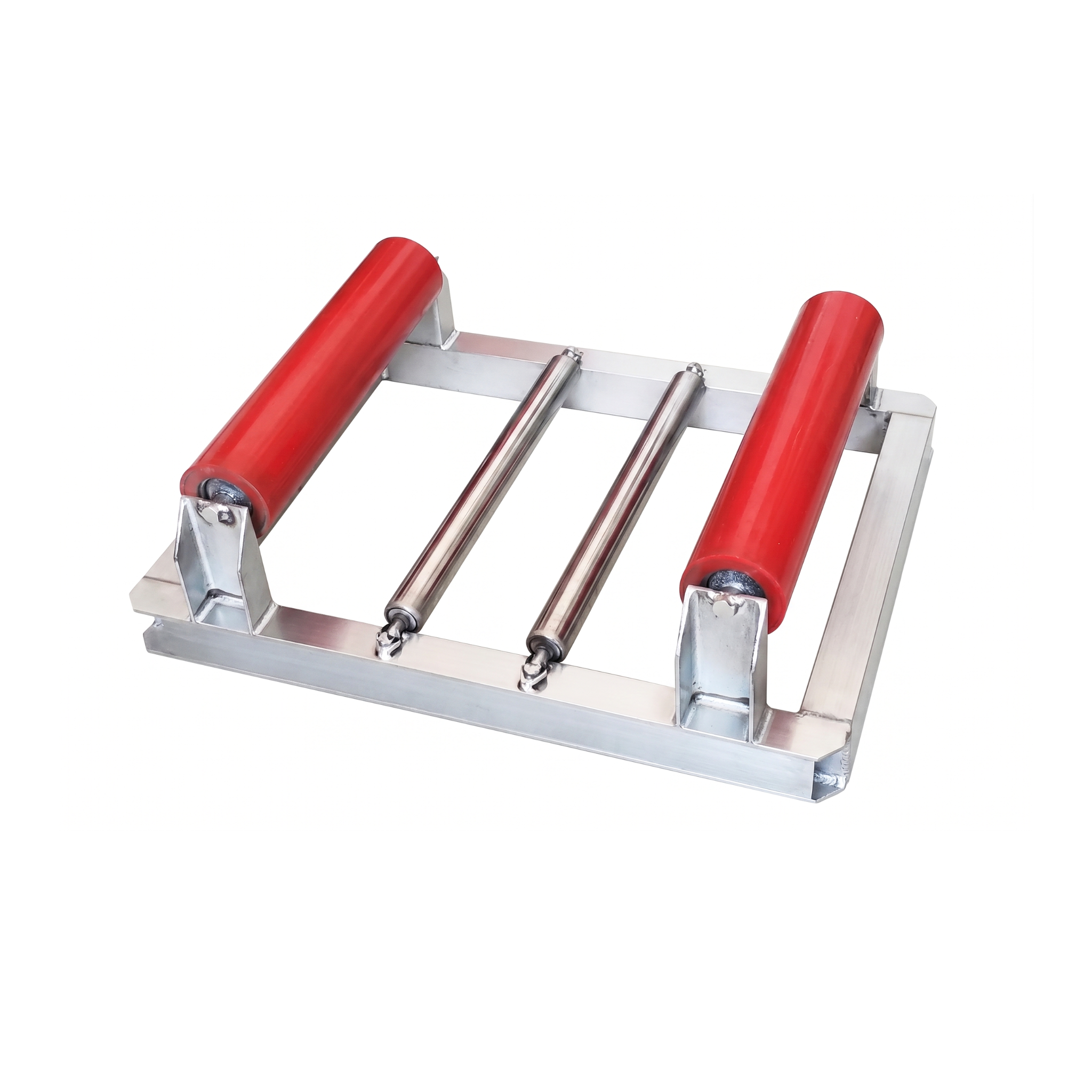
This guide covers the use of the roller unwinder for geomembrane: placing the roll, using several units on wide rolls, deploying the sheet, advancing along the front and feeding toward the welding area. Follow these steps to lay the geomembrane with less effort and without scratching it.
Product specifications
The roller unwinder is a motor-free piece of equipment that acts as a rolling support point to deploy rolls of geomembrane, geotextile, geocomposite and drainage sheets. The sheet comes off rolling over smooth rollers, reducing the crew's effort and preventing the material from scratching against the ground.
| Specification | Roller unwinder |
|---|---|
| SKU | 681540 |
| Frame | 710 × 540 mm (28 × 21 in) |
| Roller | 450 mm (17.7 in) |
| Rollers | 2 polyurethane + 2 stainless steel |
| Frame material | Aluminum |
| Weight | 18.5 kg (41 lb) per set |
| Power | Motor-free (manual) |
Step-by-step use
The goal is for the sheet to come out straight and without rubbing the ground. Follow these five steps:
Place the roll on the unwinder
Position the unwinder on a firm, level base at the start of the section to be covered, and rest the geomembrane roll on the rollers. Check that the roll spins freely before you start pulling.
Use several units on wide rolls
For large rolls —for example 6 m wide— spread 2 or 3 unwinders along the roll (at the ends and, if needed, in the middle). That way the weight is evenly supported and the sheet comes out straight, without sagging or twisting.
Deploy by pulling the free end
Pull the free end of the sheet in the direction of the section. The rollers spin on their own and the material advances with minimal push, passing over the smooth rollers instead of rubbing the ground, the gravel or the trench edge.
Advance and reposition the equipment
As the sheet is laid, move the unwinder(s) along the installation front. Thanks to their lightweight aluminum frame they are easy to reposition without stopping work.
Feed toward the welding area
Leave the sheet aligned and with the overlap ready for wedge or extrusion welding. Combine the unwinder with the pulling clamp to tension and square the sheet before sealing.
On industrial rolls of 5.8 m or more, three unwinders —one at each end and one in the middle— keep the roll straight and prevent it from "fanning open" as it deploys. It's the difference between a neat, easy-to-weld installation and one with wrinkles that later cause problems at the joint.
Complementary products
The unwinder deploys; the rest of the installation needs more equipment. These products go with it:
The self-locking pulling clamp pulls and tensions the sheet the unwinder has just deployed; together they cover the whole installation. The HDPE geomembrane is the sheet you will be laying, and the hot-melt adhesive is used to seal patches and finishes once the sheets are positioned.
Maintenance and care
At the end of the workday, clean the rollers of dust, sand and gravel so they keep spinning smoothly and don't mark the sheet. Periodically check that the rollers spin freely and that the frame has no deformations. Store the equipment dry to protect the metal parts and extend the life of the bearings.
Don't drag the roll directly across the ground to save using the unwinder: the sheet gets scratched and micro-perforated against stones and gravel, and those marks compromise watertightness. Also, don't use a single unit with a very wide roll: without even support, the sheet comes out crooked.
Frequently asked questions
How many unwinders do I need for a 6 m roll?
For wide rolls it is recommended to spread 2 or 3 unwinders along the roll, so the weight is evenly supported and the sheet comes out straight, without sagging or twisting. On rolls of 5.8 m or more, three units are ideal (ends and middle).
Is it only for geomembrane?
No. In addition to HDPE/LLDPE geomembrane, it can be used to lay geotextile, drainage geocomposite and protection sheets, since the principle is the same: advancing the roll over smooth rollers without rubbing the ground.
Does it need electricity or fuel?
No. It is a motor-free piece of equipment: the rollers spin freely and the sheet advances with the crew's push. It has no consumables and is ready to use in the open field.
