

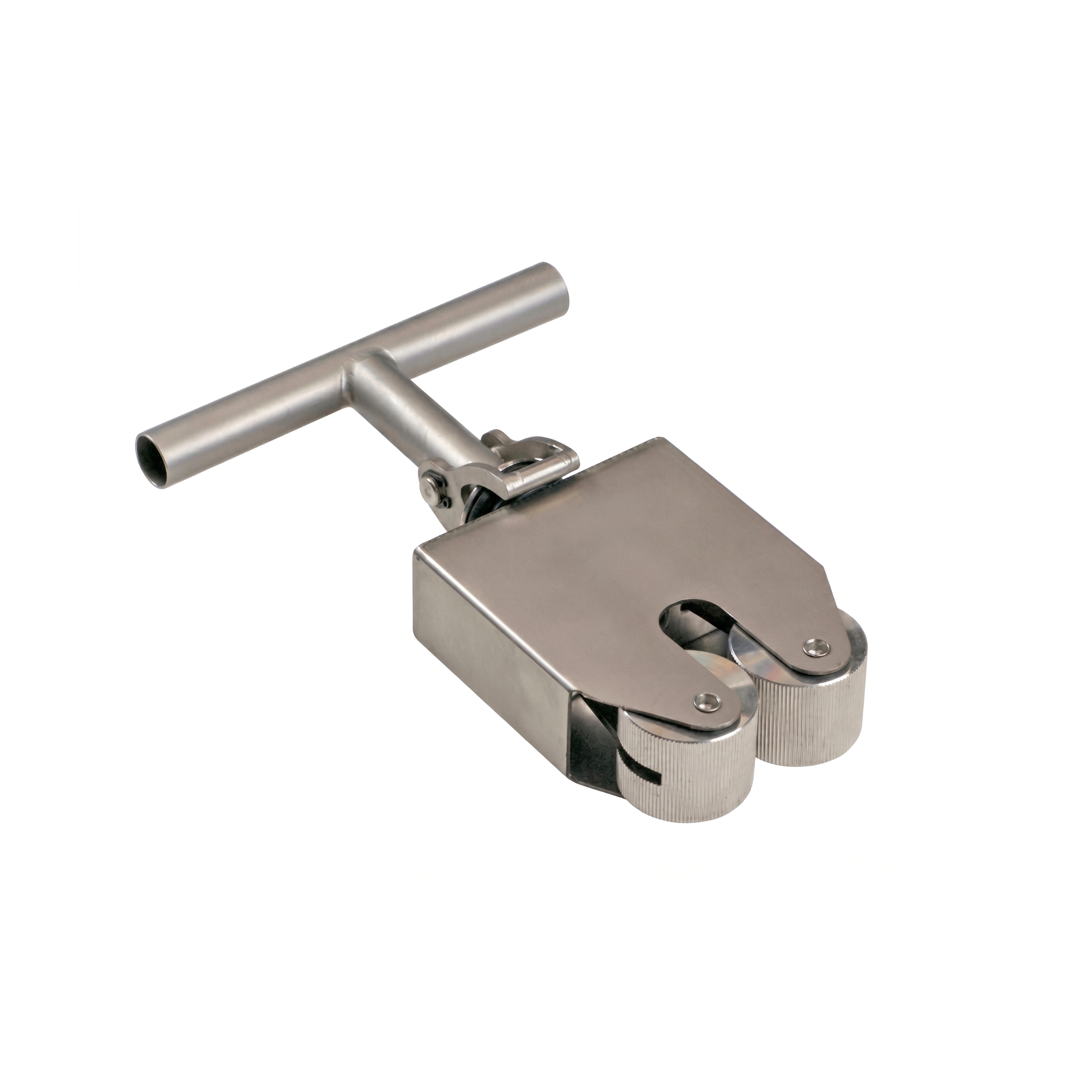
This guide covers the use of the self-locking pulling clamp for geomembrane: placing the sheet in the jaw, locking the grip, dragging and tensioning, aligning overlaps and releasing. Follow these steps to move and position the sheets safely and without damaging the membrane.
Product specifications
The self-locking pulling clamp is a manual tool that bites the edge of the sheet with knurled rollers and holds it with a mechanism that grips harder the more you pull. It is used to drag, tension and align geomembrane sheets without your hand slipping or damaging the material.
| Specification | Self-locking pulling clamp |
|---|---|
| SKU | 681027 |
| Compatible thicknesses | Up to 10 mm (0.4 in) |
| Mechanism | Self-locking (grips when pulled) |
| Grip type | Knurled pressure rollers |
| Compatible materials | Geomembrane, geotextile and geocomposite |
Step-by-step use
The trick is to fit the edge well and let the mechanism do the work. Follow these five steps:
Fit the edge of the sheet
Open the jaw and place the edge of the geomembrane between the knurled rollers, well seated all the way into the clamp. The better the edge goes in, the firmer the grip.
Let it bite
Close the clamp and start to pull. The self-locking mechanism tightens on its own: the more tension you apply, the firmer the grip becomes, without the sheet slipping out under load.
Pull in line with the sheet
Pull evenly and in the same direction as the sheet to position and tension it. On wide sheets, spread several clamps along the edge and have the crew pull at the same time to keep the sheet straight.
Align the overlaps
Use the tension to square the overlap with the adjacent sheet before welding. Keep the sheet taut while the joint is fixed so the overlap is uniform and wrinkle-free.
Release the sheet
Once the sheet is positioned, loosen the jaw to release the sheet without leaving marks. Check that the knurling is clean before the next grip.
On slopes, hook the clamp onto the top edge of the sheet to hold the liner while the crew works below: it prevents slipping and frees up hands. For very wide sheets, two or three clamps pulling at once spread the force and keep the edge straight, something impossible to achieve by hand.
Complementary products
The clamp positions and tensions, but the complete installation needs more equipment. These products go with it:
The roller unwinder deploys the roll over the ground before the clamp comes in to tension and align; together they cover the whole installation. The HDPE geomembrane is the sheet you will be handling, and the hot-melt adhesive is used to seal patches and finishes once the sheets are positioned.
Maintenance and care
After each workday, clean the knurled rollers of soil, sand and sheet debris so the grip doesn't lose its bite. Periodically check that the self-locking mechanism closes and releases smoothly; if you notice play or slipping, stop using it until it is inspected. Store it dry to prevent corrosion of the metal parts.
Do not use it on sheets thicker than its range (up to 10 mm): forcing the jaw beyond its capacity wears down the knurling and makes it slip. Also, do not pull with sharp jerks; the traction should be firm and steady so the self-locking works without damaging the edge of the membrane.
Frequently asked questions
How many clamps do I need for a wide sheet?
It depends on the width, but the practical rule is to spread several clamps along the edge and have the crew pull at the same time. That way the force is distributed and the sheet advances straight, without a single traction point throwing it off.
Does the clamp damage or mark the geomembrane?
No, if used within its range. The knurled rollers spread the pressure and grip without piercing or tearing the edge. On release, the sheet comes out unmarked as long as it has not been forced beyond 10 mm thickness.
Does it also work for geotextile and geocomposite?
Yes, it is compatible with geotextile and composite sheets within its range of up to 10 mm (0.4 in) thickness, in addition to HDPE/LLDPE geomembrane.
