

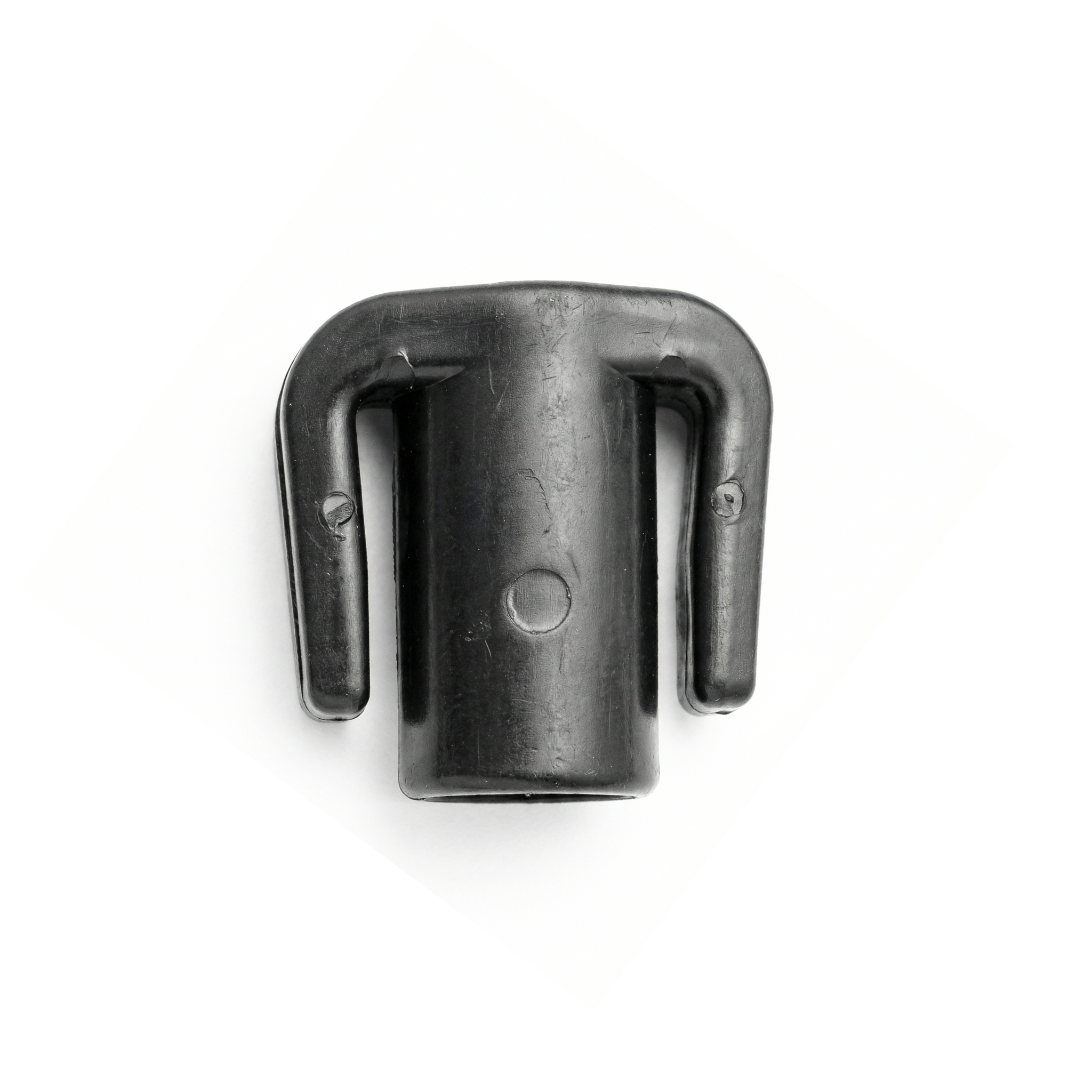
This guide covers the use of the anchor cap for the fiberglass rod: marking the fastening pattern, fitting the cap onto the rod, positioning it over the point, driving it in until the cap is flush, and checking the fastening. Follow these steps to temporarily hold the geocell in place on the ground while you roll it out and fill it, spreading the anchor pressure without puncturing the material.
Product specifications
The anchor cap is a plastic part shaped like an inverted cone or disc with a central hole. It is fitted over the end of the fiberglass rod and becomes trapped between that end and the geocell, spreading the anchor pressure over a wide surface so the rod does not puncture or tear the cell.
| Specification | Standard cap |
|---|---|
| SKU | 765770 |
| Material | UV-stabilized polypropylene |
| Color | Black |
| Box | 1000 caps |
| Application | Temporary geocell fastening |
Step-by-step use
The cap is installed together with the fiberglass rod. The safest method is to pass the rod through the cap before driving it in, so that the cap sits firmly against the geocell.
Mark the fastening pattern
On the rolled-out geocell, mark the points where the rods will go according to your project's pattern, centered on a cell. The typical pattern is 1 fastening per m² on flat areas and 2-4 per m² on steep slopes; slopes steeper than 1V:2H require an even denser pattern.
Fit the cap onto the rod
Take a fiberglass rod and a cap. Pass the rod through the cap's hole until the end sits inside the cone or disc. Make sure the orientation is correct: the flat side toward the geocell, the cone side facing up.
Position the rod at its point
Place the rod with the cap at the marked point, with the tip touching the geocell. On a flat surface, perpendicular to the ground; on a slope, tilt it toward the uphill side (not the downhill side) so the weight of the fill locks it in.
Drive it in until the cap is flush
Drive the rod in with a mallet until the cap is flush with the geocell, pressing it lightly against the ground without crushing it. To avoid breaking the cap or splintering the fiberglass, use short, controlled blows; if you prefer, first drive the rod in almost all the way and fit the cap for the final stretch.
Check the fastening
Gently pull on the geocell next to the rod. If it lifts, the rod is not driven in enough or the cap is not pressing hard enough: give it another blow or reposition it. If the cell stays firm against the ground, the fastening is correct. Repeat at each marked point.
For a large job, prepare batches in trays: rods with their cap already fitted, ready to drive in. It multiplies the crew's speed. Try it with two people: one hands out the pre-assembled rods and the other drives them in.
Do not drive the rod in by striking directly on the cap with a metal hammer: the cap breaks and sinks below the geocell, defeating its purpose. Use a mallet, or place a wooden block in between. If you break many caps, switch to a lighter mallet or drive the rod in first and fit the cap for the final finish.
Complementary products
The cap is one part of a fastening system. These are its usual partners:
The fiberglass rod is the part driven into the ground that holds the geocell; the cap spreads its pressure over the cell. The polyethylene geocell is the material that this combination temporarily fastens, and the geocell connector joins the panels together to maintain the continuity of the system.
Maintenance and care
The cap is a simple item to look after:
- Storage: in its box, in a dry, shaded place; direct, prolonged UV light degrades polypropylene over time.
- Temporary use and reuse: since the system holds the geocell while it is rolled out and filled, when the anchor is removed the cap can be recovered and reused if it has not been damaged.
- Inspection: if you leave the anchor in place, check the visible fastenings and replace any broken or displaced caps before the end of the rod becomes exposed.
- Spot reinforcement: where you notice movement of the geocell, add fastenings instead of removing the existing ones.
Frequently asked questions
Can I use the cap with any rod?
It is sized for the Dodom fiberglass rod, 12 mm (0.47 in) in diameter and 50 cm long. It works with rods of similar diameter and end, but verify in a test that the end is properly retained and that the cap's hole is not excessively large relative to the rod's body; a large clearance lets the geocell move.
What color is it, is it visible?
The standard cap is black. On a geocell filled with fine gravel, soil, or concrete, it is hidden under the fill once the job is finished; during installation it is visible, which helps to check the anchor points before filling.
What do I do if I break caps while driving them in?
If you break more than 5% of the caps, there is a systematic problem: a mallet that is too heavy, a sideways blow instead of a perpendicular one, or very hard ground that bounces the rod back. Use a lighter mallet, strike perpendicular, and, if the ground is very hard, pre-drill with a punch before driving the rod in with its cap.
