

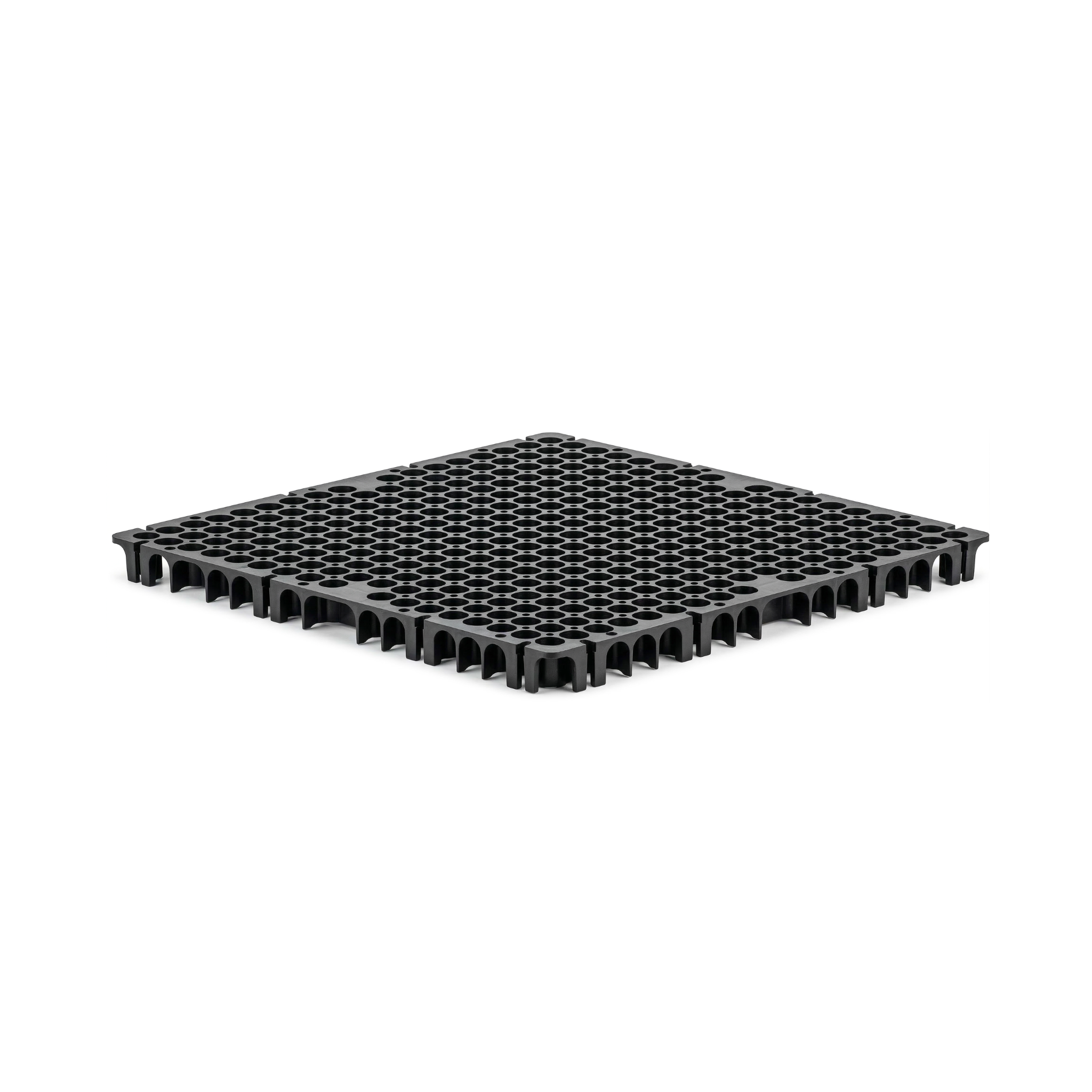
This guide covers the installation of the cellular drainage board: checking the waterproofing and root barrier, laying the protective geotextile, positioning and connecting the boards, covering with filter geotextile, and adding substrate with planting. Follow these steps to create drainage systems on a green roof, raised planter, or over a structure without overloading the system.
Product specifications
Modular board made of recycled high-density polyethylene (HDPE) with hollow cup-shaped cells that interlock with each other through a side-joining system. The cells create horizontal drainage channels and an air cushion beneath the substrate. Compression resistance sufficient to support the weight of the saturated substrate and mature vegetation without collapsing.
| Specification | Standard board |
|---|---|
| SKU | 345612 |
| Dimensions | 50 × 50 × 3 cm (19.7 × 19.7 × 1.2 in) |
| Material | Recycled HDPE |
| Pack | 8 boards (≈0.87 m²) |
| Application | Drainage on green roofs and rooftop gardens |
Step-by-step installation
The drainage board is one of the components of a multilayer system: each layer performs a function and all are necessary. One omission compromises the whole.
Check waterproofing and root barrier
Before installing the board, the slab must be properly waterproofed with a membrane specific to green roofs and protected with a root barrier (HDPE geomembrane of at least 1 mm or a specific sheet). If this stage fails, no drainage board will compensate for future leaks. Check with the site manager before proceeding.
Lay protective geotextile
Over the root barrier, spread a layer of polypropylene geotextile (200-300 g/m² weight). Its function: protect the lower membrane from the hard points of the board and absorb the friction of the weight. Overlap adjacent rolls by 30 cm.
Position the boards and connect
Position the boards with the cells (cups) facing down. Fit the side-joining system between adjacent boards, forming a continuous surface. Check that the assembly directs water toward the evacuation points planned on the roof (drains, scuppers). If slope is lacking, the boards do not solve drainage: the water will accumulate all the same.
Cover with filter geotextile
Over the boards, spread a new layer of polypropylene geotextile (this filter one with a weight of 150-200 g/m²). Its function: separate the substrate from the drainage system. Without this layer, the fine substrate moves down to the cells and clogs them, nullifying drainage within a few weeks. Overlap adjacent rolls by 20 cm.
Add substrate and planting
Spread the substrate specific to green roofs (lightweight substrate with coconut fiber, pumice, perlite, and organic matter) at the planned thickness: 8-15 cm for an extensive roof (sedum, aromatic plants), 25-50 cm for an intensive roof (shrubs, small trees). Plant according to the design and water to settle.
For green roofs in the Dominican climate (high rainfall in the rainy season, intense sun in the dry season), pay special attention to the sizing of the evacuation points: a tropical storm produces a volume of water that can saturate the drainage if the drains are undersized. Verify with the structural and water engineer that the evacuation capacity is sufficient for expected rainfall + safety factor.
Do not install the substrate directly over the boards, skipping the intermediate filter geotextile. It is the most frequent cause of failure in poorly executed green roofs: the fine soil moves down by gravity and rainwater to the cells and obstructs all the drainage channels within a few months. The roof becomes saturated, the plants die from root anaerobiosis, and leaks appear in the building. Always follow the sequence: board + geotextile + substrate.
Complementary products
The drainage board works within a multilayer system. These are the usual partners on green roofs:
The high-density polyethylene (HDPE) geomembrane is the root barrier that protects the building slab. The polypropylene geotextile appears in two positions on the roof: protective above the geomembrane and filter above the board. The coconut fiber substrate is the main component of green roof mixes: it provides lightness, water retention, and aeration suitable for planting over a slab.
Maintenance and care
The board installed beneath the substrate is not accessible for direct maintenance, but the roof requires periodic attention:
- Storage of boards: in a dry place in the shade before installation. Stabilized HDPE resists sun, but protecting them extends the service life of the batch.
- Inspection of the drainage points: annually, check the evacuation drains and scuppers. Leaves, branches, and debris can block them. A blocked drain nullifies the entire system, no matter how good the rest is.
- Monitoring of abnormally wet areas: if after rain you detect areas that take days to dry or vegetation of the "swampy area" type appears (reeds, excessive moss), it indicates that the drainage is failing locally. It is a sign that professional inspection is needed.
- Service life: 30-50 years beneath the substrate (without direct UV radiation). The limit is usually the waterproof membrane, not the boards.
- Partial replacement: if an area of the garden is lifted for renovations, you can reuse the extracted boards if they show no cracks.
Frequently asked questions
Can I do without the board if the roof has a good slope?
No. The slope guides the water, but the board performs two distinct functions: rapid drainage beneath the substrate and an air cushion for root aeration. Without a board, during a storm the substrate becomes saturated and the roots remain in water for days. Even if it eventually drains, the damage is already done. The boards guarantee immediate drainage and maintain constant aeration.
Does it work in ground-level gardens, not only on rooftops?
Yes, another important application: in gardens over underground garage slabs, over technical basements, in interior courtyards with a drainage problem, or in large pots and deep planters to prevent root rot. Any situation where water cannot percolate freely into the natural subsoil benefits from the drainage board.
Does it retain any water for the plants?
Some drainage board models have cells with a small water-retention capacity (3-5 L/m²) that acts as a reserve in dry periods. This reduces watering frequency and is an advantage in climates with periods of drought. For climates with abundant, evenly distributed rainfall, the water in the cells is renewed after each rain and does not provide a great advantage, but neither does it cause harm.
