

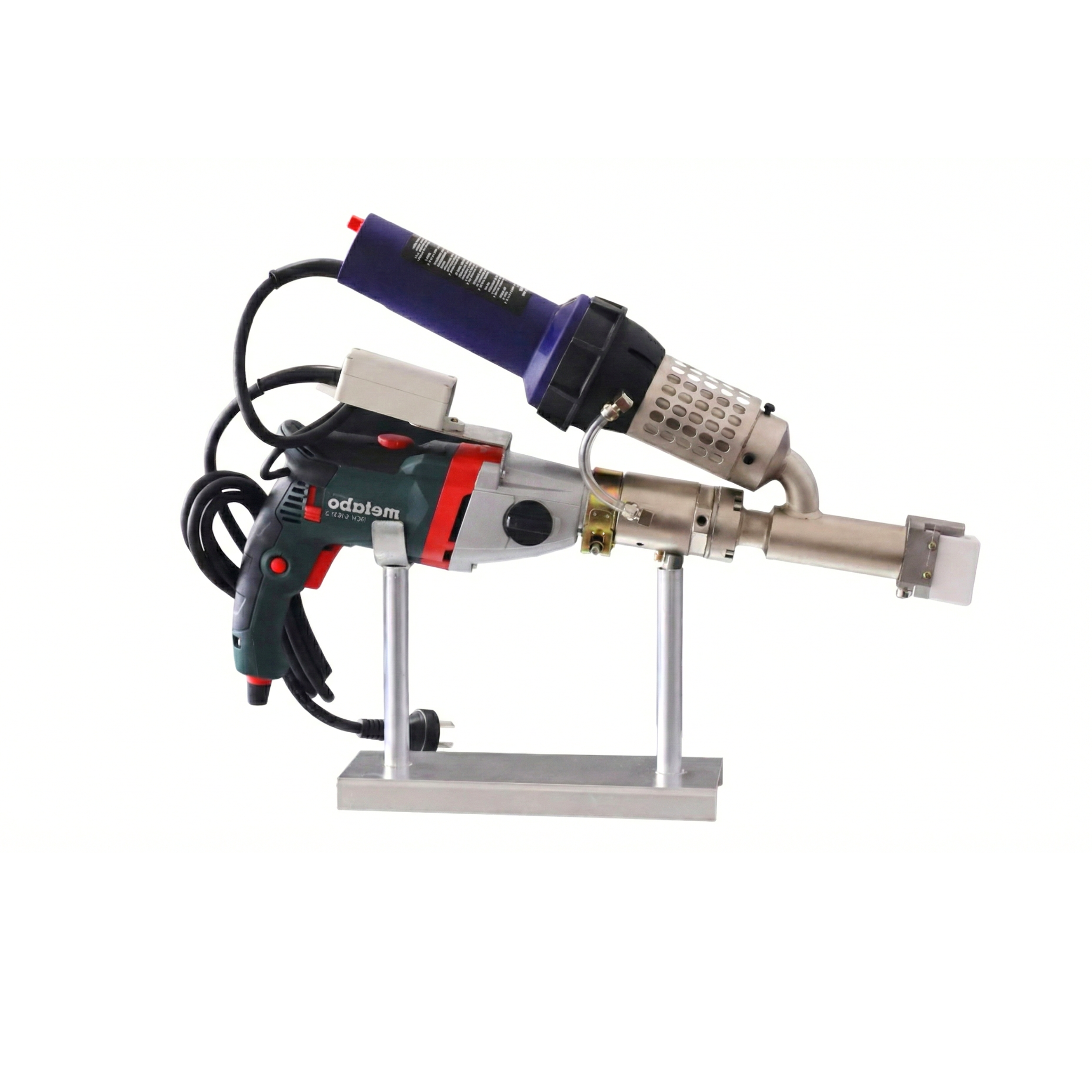
This guide covers the operation of the extrusion welding machine: joint preparation, preheating, testing the filler material, running the bead and final inspection. Follow these steps to weld critical areas and spot repairs on HDPE geomembrane where the hot wedge cannot operate.
Product specifications
The extrusion welding machine combines two elements: a hot air blower that preheats the two sheets to be joined, and an extruder screw that melts a bead of polyethylene and deposits it between them. The result is a visible, robust weld that can be verified visually, ideal for details, patches, connections to rigid structures and all areas where the hot wedge cannot operate.
| Specification | 3400 W extruder |
|---|---|
| SKU | 123765 |
| Total power | 3400 W |
| Voltage | 220 V (50/60 Hz) |
| Filler material | HDPE bead Ø 4-5 mm |
| Weld type | Single bead (visible) |
| Application | Details, patches, corners, pipes |
Step-by-step guide to using it
The extruder requires correct preheating, a constant travel speed and a clean shoe. If you advance too fast, the bead does not melt the sheet; if you advance too slowly, the sheet burns. Always practice on a scrap piece before welding the actual job.
Prepare the joint
Overlap the two sheets to be joined by at least 10 cm (4 in). Using a hand grinder and a grinding disc, sand them in the joint area to remove the surface oxidation layer. Clean with a dry cloth. The sheet must be free of dust, moisture and greasy contamination.
Preheat the machine
Connect the extruder to 220 V and set the two temperatures: hot air around 280 °C (536 °F) and extruder temperature at 220 °C (428 °F). Wait 8 to 10 minutes until stabilization. Do not start extruding before both temperatures have reached operating level.
Test the filler material
Load HDPE bead of 4 to 5 mm (Ø 0.16-0.2 in) and run an air extrusion test to verify that the material comes out uniform, without bubbles and with a homogeneous color. If the bead comes out lumpy or the melt indexer makes noise, raise the extruder temperature by 10 °C.
Run the bead
Position the shoe over the overlap, engage the extruder and advance at a constant speed (around 1 meter per minute / 3.3 ft/min). The hot air that precedes the shoe melts the surface and the bead is deposited immediately after. Keep the machine perpendicular to the joint without oscillations.
Inspect the weld
Wait 5 minutes for the bead to cool. Inspect it visually: it must be uniform, without discontinuities, without bubbles and well bonded to both sheets. Check with a screwdriver in doubtful areas: if it peels off, redo the weld. Every critical extrusion weld must be tested with a vacuum box or electric spark.
Before starting the workday, weld a 30 cm (12 in) test piece on a scrap of the same geomembrane, wait for it to cool and run a manual peel test. If the bead peels off the base material, the temperature is low or the surface lipid has not been removed. Those 5 minutes of testing prevent hundreds of poorly welded meters.
Do not weld on a wet or dirty sheet, or in high ambient humidity without ventilation. Trapped moisture turns into a bubble during melting and ruins the joint. On Dominican job sites, avoid extruding after rain and during morning dew hours. Wait until the sheet is visibly dry and warm in the sun.
Complementary products
The extruder always works together with the materials it joins and, on large jobs, with the hot wedge that makes the long runs. These are the typical allies of a waterproofing project.
The HDPE geomembrane is the base material that the extruder welds. The HDPE welding bead is the filler material loaded into the extruder: it must be of the same grade and supplier as the sheet to guarantee chemical compatibility. The hot wedge welding machine is the indispensable partner for long runs: the extruder and the wedge complement each other, they do not compete.
Maintenance and care
The extruder is an expensive and sensitive machine. Its maintenance directly determines its service life:
- Cleaning at the end of each workday: extrude into the air for 30 seconds before switching off to purge the material left in the screw. If you leave it with cold material inside, the next startup can damage the motor.
- Screw inspection: every 50 hours of use, remove the shoe and inspect the screw. Clean with a bronze brush, never a steel one.
- Hot air blower filters: check filters monthly. On dusty job sites (earthworks, nearby concreting) check weekly.
- Cables and connections: the machine works at 220 V with high consumption. Use only extension cords of adequate cross-section (≥5 mm² up to 25 m). Thin cables cause voltage drop and the machine works cold.
- Storage: store it in its original case, dry and horizontal. Never lying down with the shoe facing down resting on the floor: it deforms the outlet area.
Frequently asked questions
When do I use the extruder and when the hot wedge?
The hot wedge is the main machine for long runs on large jobs: ponds, lagoons, landfills. It welds with a double bead and a test channel, faster and verifiable by pressure. The extruder is used where the wedge cannot reach: details, corners, patches, connections to rigid structures, around pipes. A professional waterproofing job needs both.
What geomembrane thickness can I weld?
This extruder works comfortably with HDPE geomembrane of 0.5 to 2.5 mm (20 to 100 mil). For thinner thicknesses, adjust the hot air temperature downward and increase the travel speed. For thicker thicknesses, extrusion still works but it is advisable to preheat the area with an additional blower to prevent the heat from dissipating before melting the base material.
Can I use it with a generator on jobs without mains power?
Yes, but the generator must deliver at least 5 kVA of continuous power and a pure sine wave. Cheap job-site generators deliver an unregulated wave that confuses the extruder's temperature PID and the machine works unstably. If you are going to operate far from the mains, invest in a quality inverter generator.
