

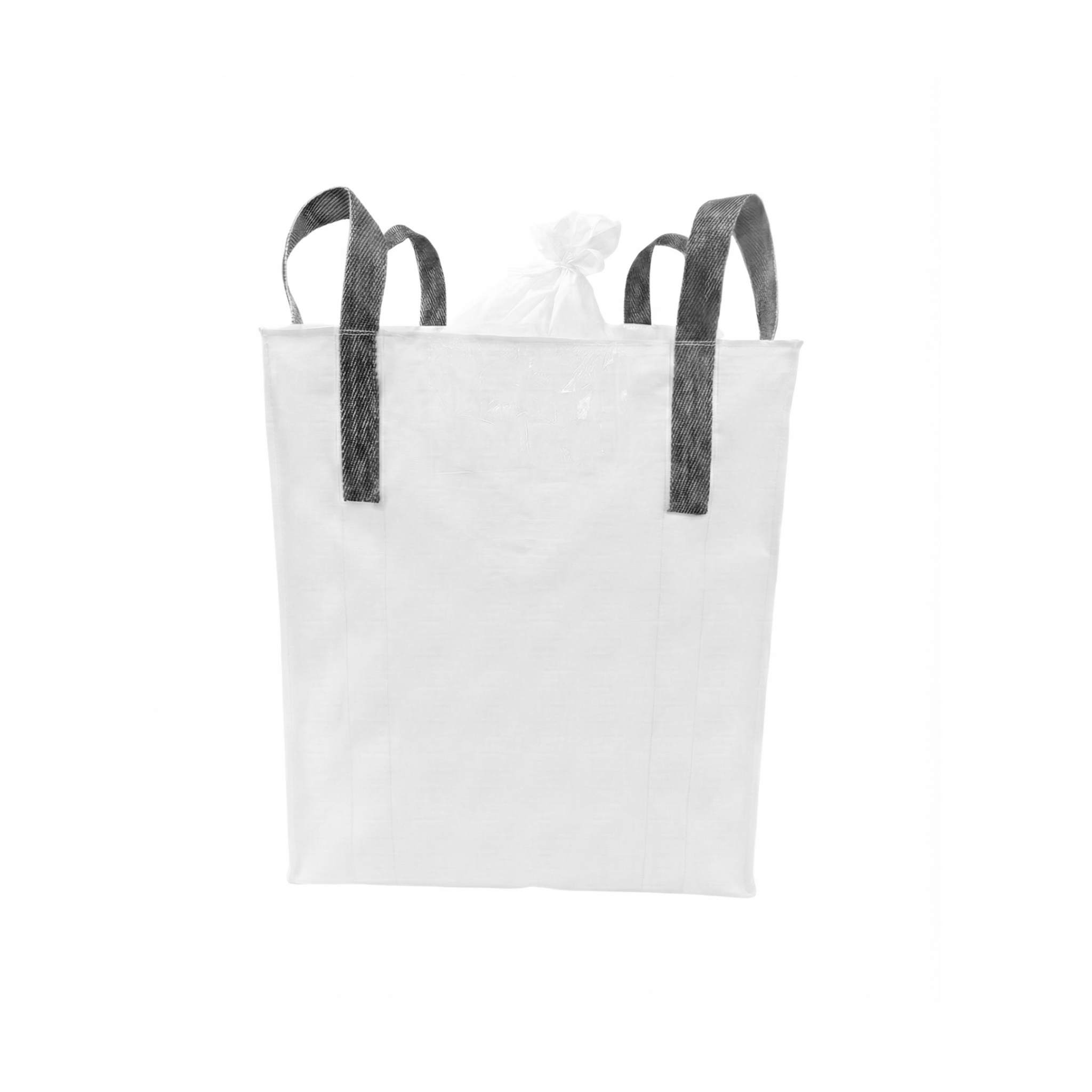
This guide covers the use of the bulk bag with loading valve and flat bottom: pre-use inspection, positioning under the hopper, connecting the valve to the spout, metered and controlled loading, and closing before lifting. Follow these steps to bulk-pack powders, grains and fine materials with the professional format that prevents spillage during loading.
Below, you will find the technical specifications, the step-by-step procedure, the recommended complementary products and the maintenance guidelines that will extend the service life of your bulk bag.
Product specifications
These are the technical characteristics that define this specific model and will allow you to quickly identify which units apply to your order.
| Specification | Value |
|---|---|
| SKU | 972400 |
| Material | Virgin woven polypropylene with UV treatment |
| Opening | Top loading valve compatible with hoppers and filling spouts |
| Bottom | Flat bottom |
| Inner liner | With liner (additional plastic barrier against moisture and contamination) |
| Dimensions | 90 × 90 × 110 cm (3 × 3 × 3.6 ft) |
| Payload capacity | 1500 kg (3300 lb) |
| Safety factor | 5:1 |
| Handles | 4 reinforced handles for lifting |
| Color | Translucent white |
| Presentation | Pack of 30 bulk bags |
Step-by-step usage
Follow this procedure from the very first time to integrate the bag into your operations safely and take advantage of the 5:1 safety factor for which it is designed.
Inspect the bag before loading it
Unfold the bag and check the seams of the handles, base and top valve area. Verify that the inner liner does not show excessive wrinkles, perforations or tears. The integrity of the liner is the barrier against moisture and cross-contamination; if it is damaged, replace it before packing.
Position the bag under the hopper or spout
Center the bulk bag on a clean pallet and beneath the hopper outlet. Lift the four handles and fit them to the guides of the filling station; keep the bag vertical and stable. Unfold the top valve upward to connect with the hopper spout.
Connect the valve to the filling spout
Fit the loading valve over the discharge tube or spout of the hopper, making sure it covers the entire perimeter. On systems with a clamp, tighten it to seal the connection and prevent dust dispersion. The correct connection is what allows you to pack flour, cement or pigments without environmental contamination.
Load in a metered and controlled manner
Activate the hopper discharge and load up to the target weight (maximum 1500 kg). Monitor the weight with a platform scale; if the system allows it, program an automatic cut-off when the target is reached. Keep the bag stable throughout filling so that the flat bottom forms correctly.
Close the valve and prepare for lifting
Once the weight is reached, tie, knot or seal the top valve according to the system (inner cord, clamp or heat-sealing). Verify that the closure is airtight if it is going to be stored outdoors or for the long term. Check that the four handles are free and use a spreader bar or central hook to lift, distributing the tension.
When packing cement or materials with fine dust, lightly dampen the outer area of the valve with a cloth before connecting it to the hopper. This reduces the static electricity that disperses dust during filling and keeps the packing area much cleaner.
Complementary products
If your process also requires metered discharge into mixers, consider the bulk bag with loading and discharge valve. For volumes with coarse or irregular material that does not fit through the valve, use the open-mouth model. Stretch film for machines secures the pallet of several full bulk bags with automated wrapping.
Maintenance and care
A well-maintained bulk bag can be reused for several cycles; a poorly stored one fails on the first lift of its second use. These guidelines are the ones that most extend the service life of the bag:
- Before reusing, empty the bag completely and check the condition of the inner liner. Replace the bag if the liner shows cracks, perforations or non-removable adhered residue.
- Store empty bags in a dry area, without compression and in the shade. Avoid the top valve being sharply folded for long periods; this can create permanent creases that make connection to the hopper difficult.
- Inspect the valve area and the liner seams periodically. Any tear here compromises the barrier against moisture and contamination.
Do not force the valve onto the hopper spout if it does not fit smoothly. A forced connection can tear the seam area, disperse the material during filling and ruin the bag for future cycles. If the valve does not fit, verify the measurements with your supplier before continuing.
Frequently asked questions
Can I use this bulk bag for product without a liner?
Yes, the inner liner adds protection against moisture and contamination, but it is not mandatory for every material. If you pack dry, non-hygroscopic and low-value product, the liner is optional. For cement, flour, salt or moisture-sensitive products, the liner is highly recommended.
How much does the standard loading valve weigh?
The standard top valve is a woven polypropylene sleeve of the same material as the bag. It does not add significant weight and typically fits hoppers with a circular spout of 35-40 cm in diameter. For different measurements, consult the technical team.
Can I close the valve with any knot?
The closure depends on the system of your line: manual knot with inner cord, mechanical clamp or heat-sealing. For prolonged storage or transport, use the most airtight method possible. A simple knot is enough for short cycles in the plant; for export, it is advisable to heat-seal or use a clamp.
