

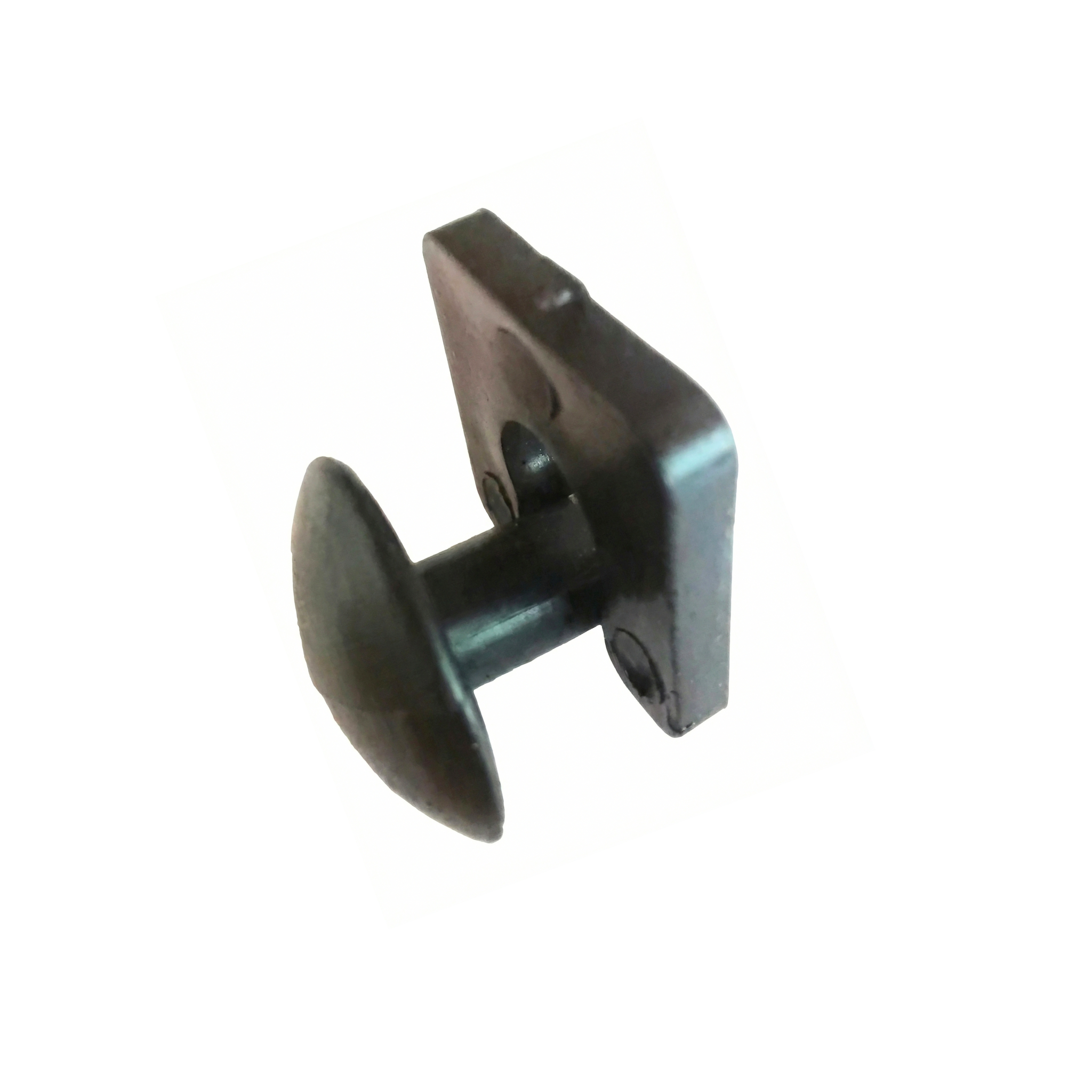
This guide covers how to use the geocell connector: deploying the two panels to be joined, overlapping the two side walls, inserting the connector, repeating across all holes, and tensioning the cell with anchoring to the ground. Follow these steps to join geocell panels on site quickly and without reducing the strength of the grid.
Product specifications
The geocell connector is a plastic part shaped like a T or an I that is inserted into the pre-drilled holes in the walls of the geocell panels. It locks the position between two adjacent panels, transmitting the tensile force and maintaining the regular cellular geometry. Without connectors, two adjacent panels separate as soon as they bear a load.
| Specification | Standard connector |
|---|---|
| SKU | 765888 |
| Material | High-density polyethylene (HDPE) |
| Box | 400 connectors |
| Application | Joining geocell panels on site |
Step-by-step instructions
The connector is installed during deployment of the geocell, before fixing it to the ground with metal stakes. It is a simple but meticulous operation: every poorly placed connector is a weak point for the entire slope.
Deploy the two panels to be joined
Fully spread out each panel over the prepared ground. Bring the second panel close until its side walls are aligned with those of the first. The pre-drilled holes in the walls to be joined must line up one to one: if they do not line up, a panel is shifted or flipped.
Overlap the two side walls
Place the wall of the second panel pressed or overlapped on top of that of the first, so that the holes face each other. The correct overlap makes the shared wall double-thickness where the connector will go.
Insert the connector
Take a connector and push it through the aligned holes, passing through the two overlapped walls. Push until you hear the locking click and check by hand that the connector is firm with no way to come out.
Repeat across all holes
Along the seam between the two panels, install a connector in each hole. Do not leave any holes unconnected, even if it seems redundant: the force is shared among all of them. A correctly connected seam feels like a continuous wall when you pull on it.
Tension the cell and fix it to the ground
Once the panels are connected, deploy the geocell to its maximum by opening each cell to its regular hexagonal or square geometry. Fix the edges with metal stakes, anchor caps and, if the slope is steep, top anchoring with specific parts. The connectors do not replace anchoring to the ground.
Before you start connecting, calculate how many connectors you need: count the holes per panel and the sides to be joined. A box of 400 connectors covers approximately 100 m² of geocell with typical panels. Having too few means stopping the job; having too many is just inventory. Order with a 10% margin over the calculation.
Never replace connectors with ties made of wire, plastic clamp or cord to “save money”. The plastic connector is designed to share the force between the two walls and resist UV throughout the service life of the slope. Any substitute fails within months under the Caribbean sun and the geocell separates at the seams. If you run short, stop and restock.
Complementary products
The connector is a component of a larger system. Correct geocell installation includes these ground-fixing products:
The polyethylene geocell is the material that the connector joins. The metal stake is the part that anchors the geocell to the ground and works together with the anchor cap for metal stake, which holds the geocell against the head of the stake. All three are essential: without any one of them, the installation is not durable.
Maintenance and care
The installed connector requires no maintenance, but the batch in storage does:
- Storage: in its original box, in a dry place, protected from prolonged sunlight. UV-stabilized HDPE lasts for decades, but units stored outdoors lose quality.
- On-site inventory: count on receiving the box and check that the contents match the stated quantity. A box with fewer connectors on a large job can cause a stoppage due to a missing part.
- Periodic inspection of the installation: on slopes with geocell, inspect the seams where the connectors go every six months. If you notice separation between panels or broken connectors, reinforce immediately.
- Replacement: if after a storm you find several broken connectors in one area, it indicates the installation was undersized. Repair it and check whether it is advisable to reinforce with additional connectors or supplementary anchoring.
Frequently asked questions
Can I use connectors from another brand with your geocell?
The connector and the pre-drilled holes of the Dodom geocell are dimensioned to work together. Connectors from another brand may have different diameters, lengths or locking systems that do not fit or do not guarantee the correct joining force. If you take over a job and have to complete it with material from another brand, check compatibility before ordering.
How many kilos can each connector withstand?
Nominal tensile strength per unit: approximately 2-3 kN (200-300 kg / 450-650 lb). When installed correctly with several connectors per seam, the force is shared and the seam withstands loads equivalent to those of the panel itself. For extreme slope conditions or hydraulic flows, consult an engineer to verify the number of connectors per metre of seam.
Can I remove a poorly placed connector?
Once locked, the connector cannot be removed without destroying it. If it is poorly positioned, cut it with a utility knife or pliers, remove the remains from the holes and use a new connector. Stocking an extra 10% over the theoretical calculation covers these typical on-site corrections.
