

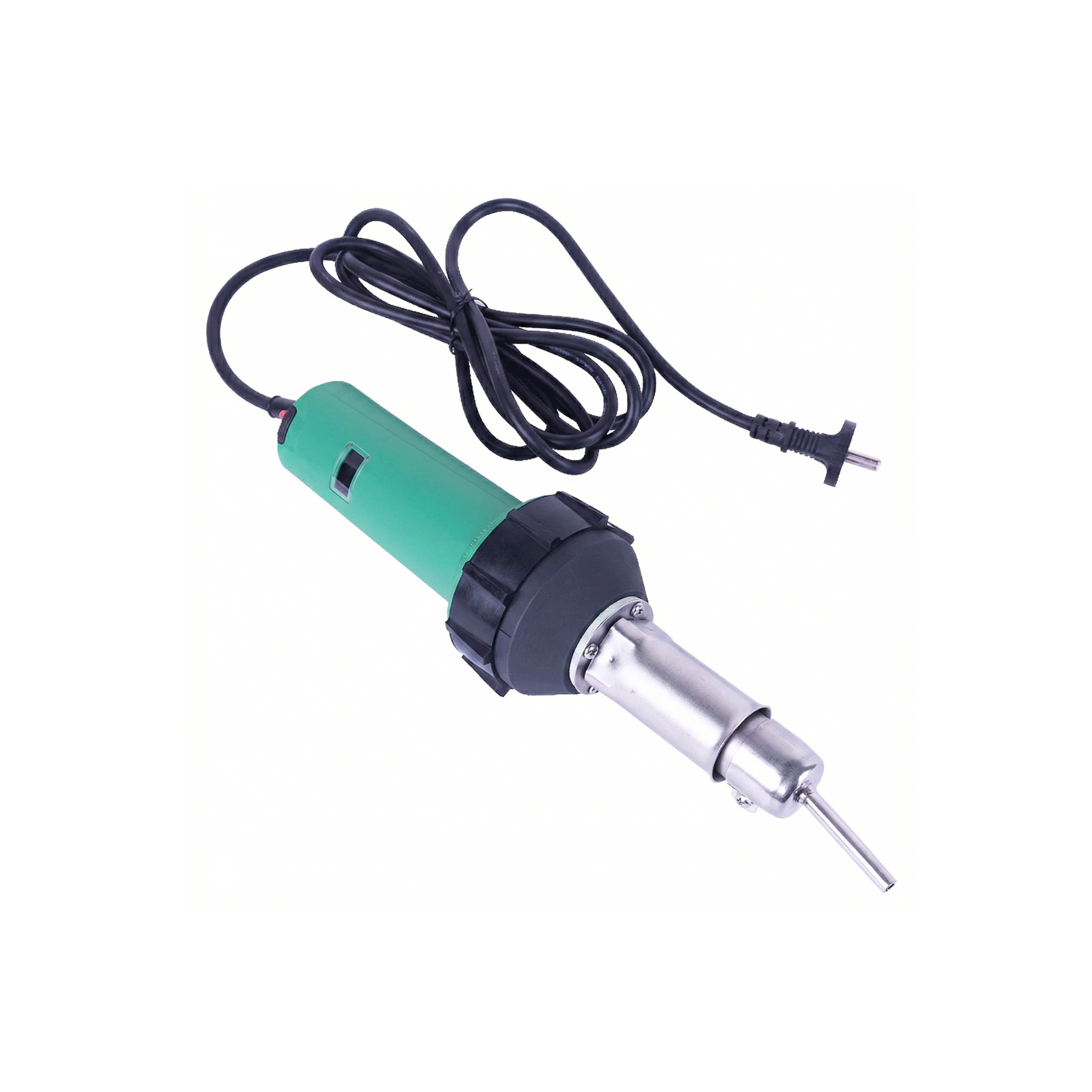
This guide covers the operation of the hot air welding machine: overlap preparation, heating with temperature calibration, test weld, welding the actual seam, and inspection with cooling. Follow these steps to weld thin geomembranes, patches, and areas the hot wedge cannot reach.
Product specifications
The hot air welder projects a jet of high-temperature air onto the overlap area between two sheets. While one operator advances with the gun, another operator (or the same one) presses with a silicone roller immediately after the air passes. The surface melts, the roller presses, and the seam forms. It is the most practical tool for repairs, test welds, and small jobs.
| Specification | Hot air 1600 W |
|---|---|
| SKU | 982342 |
| Power | 1600 W |
| Voltage | 220 V (50/60 Hz) |
| Temperature range | 20 – 600 °C (68 – 1112 °F) |
| Application | Patches, small jobs, repairs |
Step-by-step to use it
Hot air welding requires constant coordination between temperature, advance speed, and roller pressure. Getting it right is a matter of rhythm: once you find it on a test piece, you replicate it on the job.
Prepare the overlap
Overlap the two sheets 5 to 10 cm (2 to 4 in). Clean with a dry cloth to remove dust, moisture, or grease. If the sheet has been exposed to the elements for more than a month, a light surface grinding is recommended to remove UV oxidation.
Heat the machine and calibrate temperature
Plug in and set the temperature according to the material: HDPE 350-400 °C (662-752 °F), PVC 300-350 °C (572-662 °F), polypropylene 300 °C (572 °F). Wait 2 to 3 minutes until it reaches a stable state. Point the jet into the air while heating, never toward the material or your hands.
Test weld
Weld a 30 cm (12 in) test on a scrap identical to the job material. Wait for it to cool and do a peel test: the seam must break through the base material, not through the weld. If it peels off, raise by 10 °C or advance more slowly. Repeat the test until the material fails before the seam.
Weld the actual seam
Insert the nozzle between the two sheets at the start of the overlap, at a 30 to 45° angle. Advance the machine at a constant speed (around 1 m/min / 3.3 ft/min) and immediately follow with the roller, applying firm and even pressure. The distance between nozzle and roller is the speed: never let the hot air blow over material that will not be pressed right after.
Inspection and cooling
Allow 5 minutes of cooling. Visually inspect the bead: it should look continuous, with a thin bleed at the edges that indicates proper melting. Run a screwdriver along the line: if it peels off, weld that area again. For critical seams, test with a vacuum box.
On a Dominican job in full sun, the ambient temperature changes the welding range. At 6:00 a.m. with a cold sheet you need 380 °C; at midday, with the sheet exposed to the sun for hours, 340 °C is usually enough. Recalibrate with a peel test at least twice a day: once in the morning and again after lunch.
Do not neglect the roller pressure after the hot air. An area where the air melted but the roller did not press at the right moment is left with microscopic blistering that looks like a good weld to the eye, but peels off with any pull. Always keep the roller 1-2 cm (0.4-0.8 in) behind the nozzle, with no delays.
Complementary products
The hot air welder rarely works alone. It is part of a kit alongside the other joining machines and the materials it seals.
The HDPE geomembrane is the main material the machine joins. The hot wedge welding machine is the complementary tool for long runs on large jobs, while the hot air one covers details. The extrusion welding machine handles corners, patches, and connections to rigid structures. The three complement each other in a professional waterproofing kit.
Maintenance and care
Maintaining a hot air welder is simple but critical:
- Always shut down with cold air: when you finish, lower the temperature to 0 °C before turning off and let the fan run for 2 minutes. Turning it off while hot burns out the heating element.
- Clean the nozzle: after each workday, remove the nozzle while cold and clean off the melted plastic residue with a bronze brush. A clogged nozzle changes the jet pattern and ruins the next day's welds.
- Filters and air intakes: check monthly that the air intakes are not blocked with dust. On dusty jobs, clean them weekly.
- Cable and plug: inspect after each workday for cuts, burns, or loose connections. The machine works with high current and the cables take a beating.
- Storage: store it in its original case with the roller separated, in a dry place and protected from moisture.
Frequently asked questions
What materials can I weld with hot air?
Any thermoplastic: HDPE, LDPE, PVC, PP, PVC tarpaulins, waterproofing geomembranes, heat-shrink tape, plastic greenhouse covers. It does not weld EPDM, hypalon, or vulcanized elastomers (those require adhesive). For each material, adjust the temperature: lower for PVC, higher for HDPE.
Can I weld long runs with hot air?
You can, but it will be slow and the quality less uniform than with the hot wedge, which is specifically designed for large runs. Use hot air for patches, corners, connections to structures, and small jobs under 50 linear meters. For large ponds and landfills, invest in a hot wedge; it will save you days of work.
Does it work outdoors in wind?
Yes, but with difficulty. The wind deflects the hot air jet and cools the area before the roller. If working outdoors, set up a windscreen with thick cardboard or board. On a coastal Dominican job with a constant sea breeze, welding with hot air without a screen is a waste of time and sheet.
