

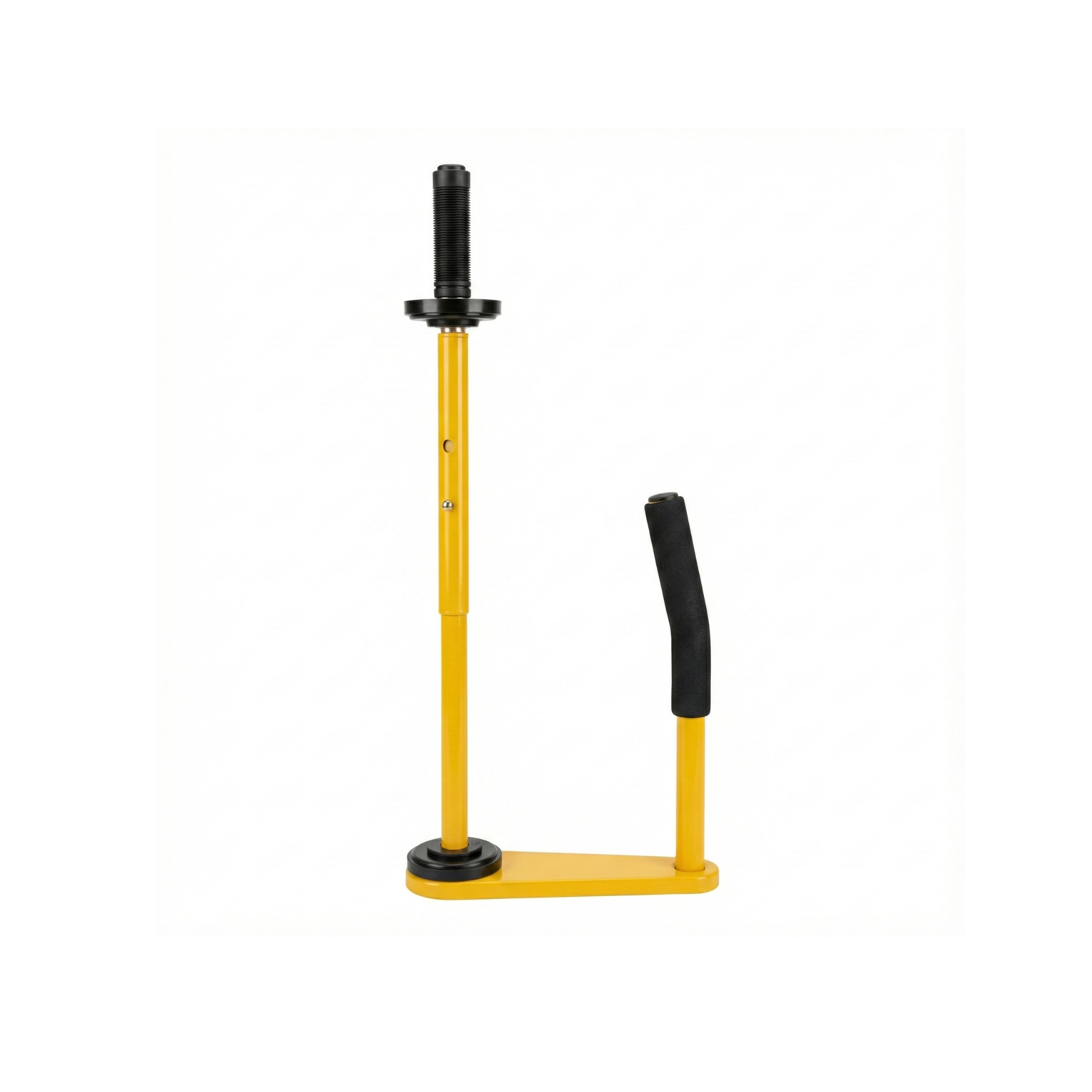
This guide covers using the manual stretch film or net applicator: loading the roll onto the spindle, adjusting the brake, anchoring the end at a pallet corner, the spiral path going up and down, and cutting with a final seal. Follow these steps to wrap pallets without bending down to pick up the roll on every turn and with constant tension from start to finish.
Product specifications
The applicator is a metal grip with an internal rotating spindle and an adjustable brake. The roll of stretch film or net is mounted on the spindle, spins freely as you walk around the pallet, and the brake lets you adjust the tension at which the film comes off. It accepts standard rolls 45-50 cm tall with a 50 mm cardboard core.
| Specification | Standard applicator |
|---|---|
| SKU | 51234 |
| Compatible height | 45-50 cm (18-20 in) |
| Roll core | 50 mm (2 in) |
| Brake | Adjustable, tension control |
| Application | Manual wrapping of pallets and loads |
Step-by-step instructions
Manual wrapping with an applicator is a full-body movement: one person walks around the pallet applying layers along the way. The technique determines how much film is consumed and how well the load is secured.
Load the roll onto the spindle
Open the applicator's top latch and slide the roll of film or net onto the spindle until it seats on the lower plate. Close the latch: the roll should spin freely when you push it with your hand. Check the direction: the film should come off the outer side of the roll, not the inner side, so that the adhesive face (on stretch film) faces the load.
Adjust the brake
With the roll loaded, adjust the adjustable brake on the applicator. Low tension for lightweight film or fragile loads, high tension for thick pre-stretchable film and heavy loads. Test with a short movement: the film should come off taut but without tearing when pulled.
Anchor the end at a pallet corner
Pass the free end of the film under a pallet corner (between the board and the load) or tie a quick knot on an edge. That initial fixing keeps the film from coming loose when you start walking. For a better hold, make two or three initial turns at the base before going up.
Walk in a spiral going up and down
Walk around the pallet holding the applicator in one hand and guiding the film with the other. The standard technique is: two turns at the base, spiral up with half-height overlap between turns, two turns at the top, and spiral back down again. A normal load is wrapped with 8-10 total turns and 80-150 g of film.
Cut and seal the end
When you finish the last turn, cut the film with scissors or by hand (stretch film tears cleanly if pulled sideways with a sharp snap). Press the final end against the previous turns: the natural adhesive of stretch film self-adheres. For stretch net, knot the end at a corner or secure it with adhesive tape.
For pallets that travel outdoors in the rain, reinforce the top closure: after standard wrapping, add a final "hat" layer by folding the film over the top face of the pallet instead of only the sides. That horizontal layer keeps water from getting in through the top and soaking the boxes. An extra 30 seconds that saves claims for wet goods.
Don't walk too fast thinking you're saving time. If you walk faster than the roll can release film, it tears at the weakest point and you have to start the closure over. Move at a steady, comfortable pace: 90 seconds per pallet with any trained person, 60 seconds with an expert operator. Forcing it lowers quality and increases consumption from tears.
Complementary products
The applicator works with the consumable rolls and pairs with the sister tape tool:
The transparent manual stretch film is the most-used consumable: watertight, transparent for visual inspection, and self-adhesive. The manual stretch net is the breathable alternative for loads that generate condensation (fruit, moist products, organic matter). The adhesive tape applicator is the sister tool for sealing boxes: the minimum equipment for any packing station includes both.
Maintenance and care
The metal applicator is robust and lasts for years with simple care:
- Spindle lubrication: every 3-6 months, put a few drops of light oil on the rotating spindle. A dry spindle spins with resistance and forces the operator to pull hard, causing fatigue.
- Brake adjustment: check that the brake screw adjusts correctly. If it became too tight or spins idle, adjust or replace it. A faulty brake forces you to buy a new applicator.
- Ergonomic grip: if the rubber cover of the grip comes unstitched or wears out, replace it. A worn grip causes chafing on the hand after several pallets in a row.
- Storage: in a dry place, hung from a hook. Avoid impacts that could deform the lower plate, where the roll seats.
- Start-of-shift check: load a roll and do a short test turn. If the film comes off taut and uniformly, all is well. If it comes off in jerks, check the spindle and brake before starting production.
Frequently asked questions
How much film does one pallet use?
A standard pallet (1.2 × 0.8 m, 1.5 m tall) uses 80-150 g of manual stretch film with correct technique and 8-10 turns. Beginners use 200-250 g per pallet from too many turns or insufficient tension. With higher-performance pre-stretchable film, this drops to 50-90 g per pallet. A box of 6 rolls of transparent film covers approximately 100-150 standard-size pallets.
Can I use it with smaller 25 cm rolls?
The standard applicator is sized for rolls 45-50 cm tall. Smaller rolls fit on the spindle but sit loose vertically and produce unstable wrapping. For narrow 25 cm film (sealing trays, tying small bundles) there are "mini" applicators with a shorter spindle.
When should I move to an automatic stretch wrapper?
Manual wrapping is efficient up to 50-80 pallets per shift. From 100 pallets/day with the same repetitive format, an automatic turntable stretch wrapper quickly pays back the investment and frees the operator for other tasks. For high volume but varied formats, keep the manual applicator: the automatic machine does not adapt well to pallets with heterogeneous geometry.
