

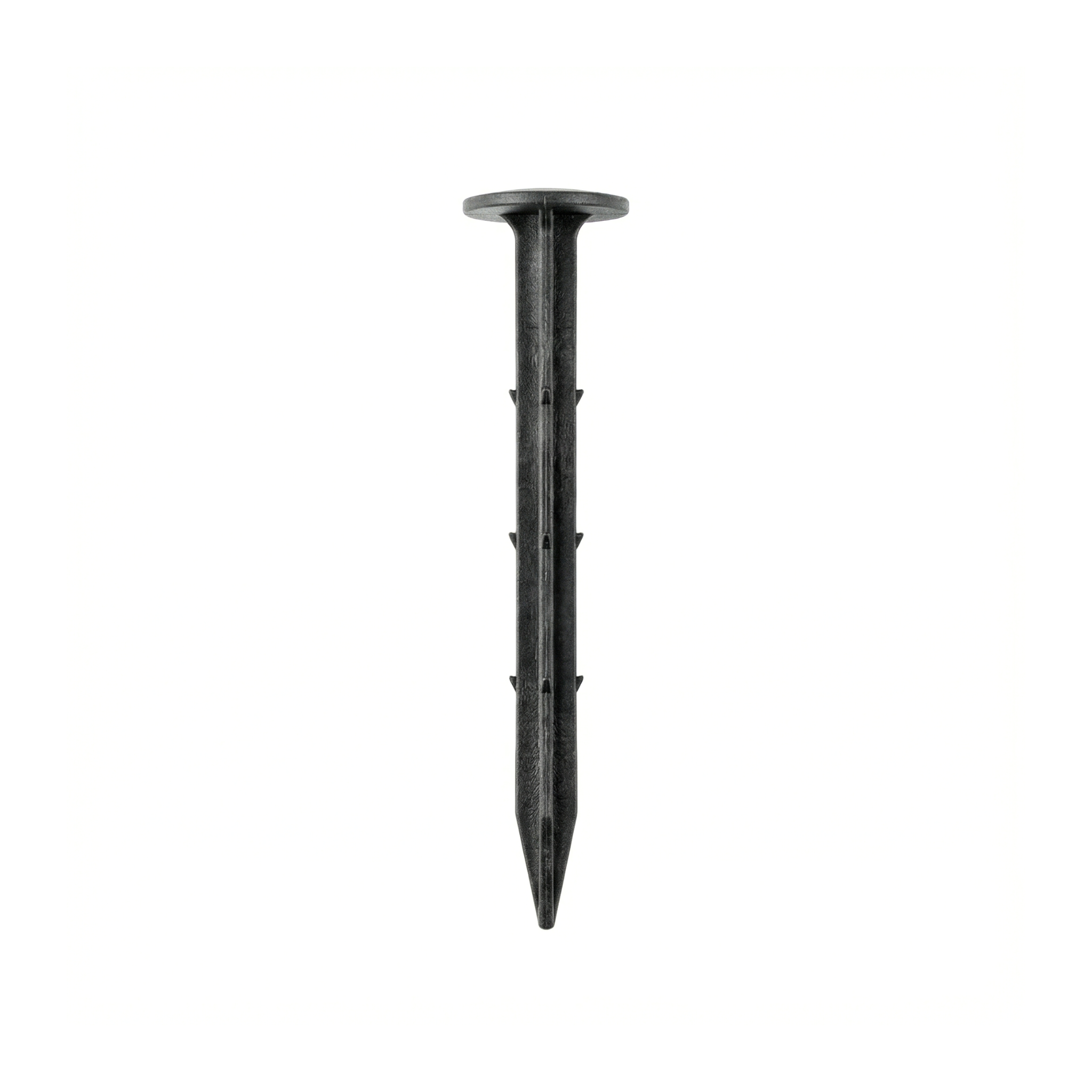
This guide covers the use of the plastic garden peg: checking that it is the right fastening for the material, spreading out the material to be fixed, positioning the peg, driving it in until the head is flush, and spacing it according to the type of material. Follow these steps to fix nets and sheets in soils where metal is not an option (barefoot traffic areas, children's areas, ground where tilling will be done later).
Product specifications
The plastic garden peg is a polypropylene piece with a 16 cm cylindrical body, a sharp point and a wide head 3-4 cm in diameter. The wide head acts as a stop against the material to be fixed. It is pushed in by hand into soft garden soils and becomes almost invisible once seated beneath the cover of the material itself.
| Specification | 16 cm peg |
|---|---|
| SKU | 654210 |
| Length | 16 cm (6.2 in) |
| Material | Polypropylene with UV stabilization |
| Box | 1000 pegs |
| Application | Thermal blankets, fleece, light covering |
Step by step
The plastic garden peg is installed by hand, with no tool. Speed is its great advantage: one person places 200-300 pegs per hour.
Check that it is the right fastening
The plastic peg is for light materials that do not take significant vertical pull: frost-protection thermal blanket, greenhouse fleece, surface bio-blanket over flat ground. For weed-control net in a permanent garden, agricultural ground plastic or edges exposed to wind, do not use the peg: switch to a metal garden staple.
Spread out the material
Unroll the blanket or fleece over the crop or ground. Tension it lightly by hand and position the edges with stones or temporary soil so that it does not move while you place the pegs.
Position the peg
Hold the peg by the head with your hand. Rest the point perpendicular to the ground on the material. Push down with your palm. In soft garden soils (loose substrate, watered soil), it goes all the way in with a single movement.
Drive it in until the head is flush
The head of the peg must sit flush with the material, pressing it against the ground. If the head is left sticking out and visible, the material is not held properly and the peg creates a trip point. If it does not go all the way in with your hand alone, help it with a gentle tap of a rubber mallet on the head.
Space them according to the type of material
For thermal blankets and fleece: 1 peg per m² in the interior + every 50 cm along the edge. For surface bio-blanket on a gentle slope: 2 pegs per m². In areas with air currents or slope, increase the density. A box of 1000 pegs covers approximately 800-1000 m² of typical covering.
The plastic peg is ideal for seasonal coverings that are removed and put back: a thermal blanket taken off in spring, a fleece used only during flowering, a surface bio-blanket until germination. Being plastic, it does not rust and does not damage gardening tools if it ends up buried by mistake. When the covering has finished its job, the pegs can be collected and reused.
Do not use a plastic peg instead of a metal staple to fix weed-control net or agricultural ground plastic. The plastic peg does not withstand the vertical pull generated by wind on wide rolls of sheet: it pulls out of the ground and the net lifts up. For those materials, switch to a 4×20 cm metal garden staple, which does withstand significant vertical pull.
Complementary products
The plastic peg covers the light end of garden fastenings. For more demanding applications, consider the alternatives:
The metal garden staple is the partner of the plastic peg: for materials that take significant vertical pull (weed-control net, agricultural ground plastic in raised beds). The weed-control net and the agricultural ground plastic are the materials fixed with a staple, not with a plastic peg. Keeping both fastenings in stock lets you cover any type of garden installation.
Maintenance and care
The plastic peg is reusable if kept well:
- Storage: in its box, in a dry, shaded place. UV-stabilized polypropylene lasts for years, but prolonged sunlight degrades the material.
- Collection after removing the covering: when the thermal blanket or fleece season ends, collect all the pegs. Run your hand over the ground to detect any that are buried. Clean off the soil and return them to the box for reuse.
- Inspection before reuse: discard pegs that are broken, bent or have a fractured head. A well-collected box lasts 3-5 seasons of use.
- Disposal: polypropylene is recyclable. When the pegs have reached the end of their useful life, send them to a plastics recycling center rather than to general waste.
Frequently asked questions
Why plastic and not metal?
For light coverings such as thermal blankets, plastic has three advantages over metal: it does not rust (ideal for garden moisture and daily watering), it is lighter (less weight to transport in large quantities), and it does not damage gardening tools if it is left forgotten in the soil (a metal peg can ruin a rotary tiller). The limit is strength: for heavier loads, switch to metal.
Does it go into compacted soils?
The plastic peg is sized for the soft soils typical of a home garden or greenhouse. In compacted, dry or gravelly soils, manual insertion does not work. If the soil where you want to install is hard, water it 24 hours beforehand to soften the surface layer, or use a metal garden staple, which goes in better with a mallet tap.
How many kilos of vertical pull do they withstand?
Nominal strength per unit: approximately 8-12 kg (18-26 lb) of vertical pull in soft soil. It is enough to hold a light covering against a moderate breeze, but insufficient for strong winds on large rolls of sheet. For reference: a metal garden staple withstands 30-50 kg (66-110 lb) in the same soil.
