

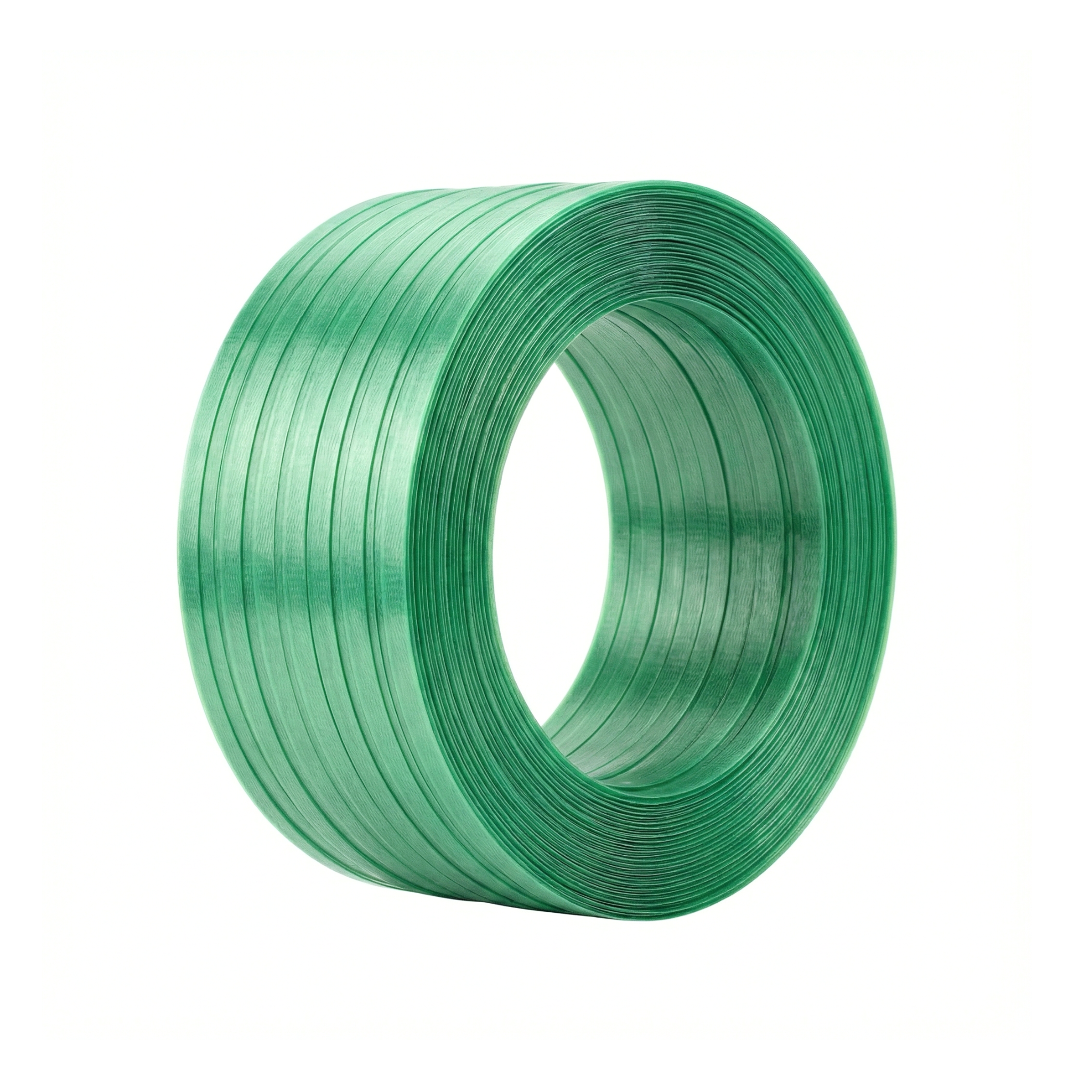
This guide covers correct strapping with polyester (PET) strapping: preparing the load, running the strap around the bundle, tensioning, sealing the joint and the final check. Follow these steps to secure heavy loads with the retained tension of PET, with specific notes for the coil width you use.
Product specifications
PET strapping comes in four widths. All share virgin polyester, an embossed finish, green color and a cardboard core; what changes is the width, thickness, breaking strength and meters per coil. Locate your variant before you start.
| Specification | 12 mm | 16 mm | 19 mm | 25 mm |
|---|---|---|---|---|
| SKU | PET-1206 | PET-1608 | PET-1910 | PET-2512 |
| Thickness | 0.6 mm | 0.8 mm | 1.0 mm | 1.2 mm |
| Breaking strength | > 210 kg | > 380 kg | > 600 kg | > 1,100 kg |
| Length per coil | 2,300 m | 1,080 m | 740 m | 500 m |
| Core (mandrel) | Cardboard 406 × 152 mm | Cardboard 406 × 152 mm | Cardboard 406 × 152 mm | Cardboard 406 × 152 mm |
| Net coil weight | 18.5 kg | 18.5 kg | 18.5 kg | 18.5 kg |
Step by step: strapping with PET
Prepare and align the load
Stack and align the goods stably on the pallet, with boxes or bundles flush so the strap sits evenly. If the load has sharp edges — block, profile, lumber — place plastic edge protectors on the corners where the strap will pass: this keeps the tension from biting into the edge and cutting the strap.
Run the strap around the load
Unwind the strap from the coil and run it around the bundle until you return to the starting point. For large coils, a dispenser cart keeps the roll at pallet height and prevents the strap from getting dirty or tangled on the floor. Leave enough excess to thread the tool.
Tension the strap with your tool
Thread the two strap ends into the tensioner or strapping tool and apply tension until the strap sits firm and without slack over the load. PET has elastic memory: tension firmly, but without deforming the boxes.
- If you have the 12 or 16 mm variant: you can tension with a battery-powered strapping tool (13–16 mm) or with a manual tensioner.
- If you have the 19 mm variant: use a manual tensioner or sealer (they cover 13–20 mm); the battery-powered strapping tool does not reach this width.
- If you have the 25 mm variant: it requires a larger pneumatic strapping tool, since manual tools go up to 20 mm.
Seal the joint
Close the strap joint. With a metal seal, place the seal over the two strap ends and close it with the sealer until it bites firmly. With a battery-powered strapping tool, the unit friction-welds without the need for a seal.
- If you have the 12 or 16 mm variant: a 13–16 mm seal closed with the sealer, or friction welding with a battery-powered strapping tool.
- If you have the 19 or 25 mm variant: use the metal seal of the matching width; at these widths the usual closure is with seal and sealer (or welding on a pneumatic strapping tool).
Check the tension and trim the excess
Check that the strap is firm and that the joint does not slip by pulling lightly on the strap. Cut the excess flush with the seal to avoid sharp ends. If the load needs securing in two directions, repeat the strapping crosswise.
The embossed finish of PET improves the grip of the seal and of the friction weld: the seal bites better than on smooth strapping. Even so, always check the first joint of each batch by pulling firmly before strapping the whole run.
Complementary products
To strap with PET you need, depending on your workflow, a tensioning tool, a sealing tool and the closure consumables. These complements cover the full cycle:
The tensioner applies the tension; the sealer closes the seal; the seal is the metal closing clip; and the dispenser cart brings the coil up to pallet height. The manual tensioner and sealer cover 13–20 mm, so they work for 12, 16 and 19 mm; 25 mm requires a pneumatic strapping tool.
Maintenance and care
PET strapping requires no special maintenance. Store the coils in a dry, sheltered place, resting on the mandrel and not on the edge of the roll, and secure the strap end so the coil does not unwind on its own. Although polyester withstands sun and outdoor exposure, keep the coils in the shade before use to keep the strap in optimal condition.
Do not use a coil in a tool of a different width without adjusting the guide. If you strap 19 mm in a tool calibrated for 16 mm, the strap scrapes, jams and the seal closes poorly. Confirm that the width of your tensioner, sealer or strapping tool matches that of the coil.
Frequently asked questions
Do I need a metal seal, or can I close without one?
It depends on your tool. With a manual tensioner and sealer, the closure is made with a metal seal that bites the two strap ends. A battery-powered strapping tool, on the other hand, friction-welds the PET and needs no seal. Both closures are secure if the tension is correct; choose according to the equipment you have.
How much tension should I apply?
Just enough for the strap to sit firm and without slack, without deforming the load. PET has elastic memory: it recovers and holds tension despite transport vibration, so there is no need to over-tension. If the box starts to dent, you are overdoing it; ease off a notch.
Does PET strapping hold up outdoors and in the sun?
Yes. Polyester does not rust or stain the goods and withstands humidity, rain and solar radiation without accelerated degradation, which allows pallets to be stored outdoors. Even so, to keep new coils in top condition, store them in the shade before using them.
