

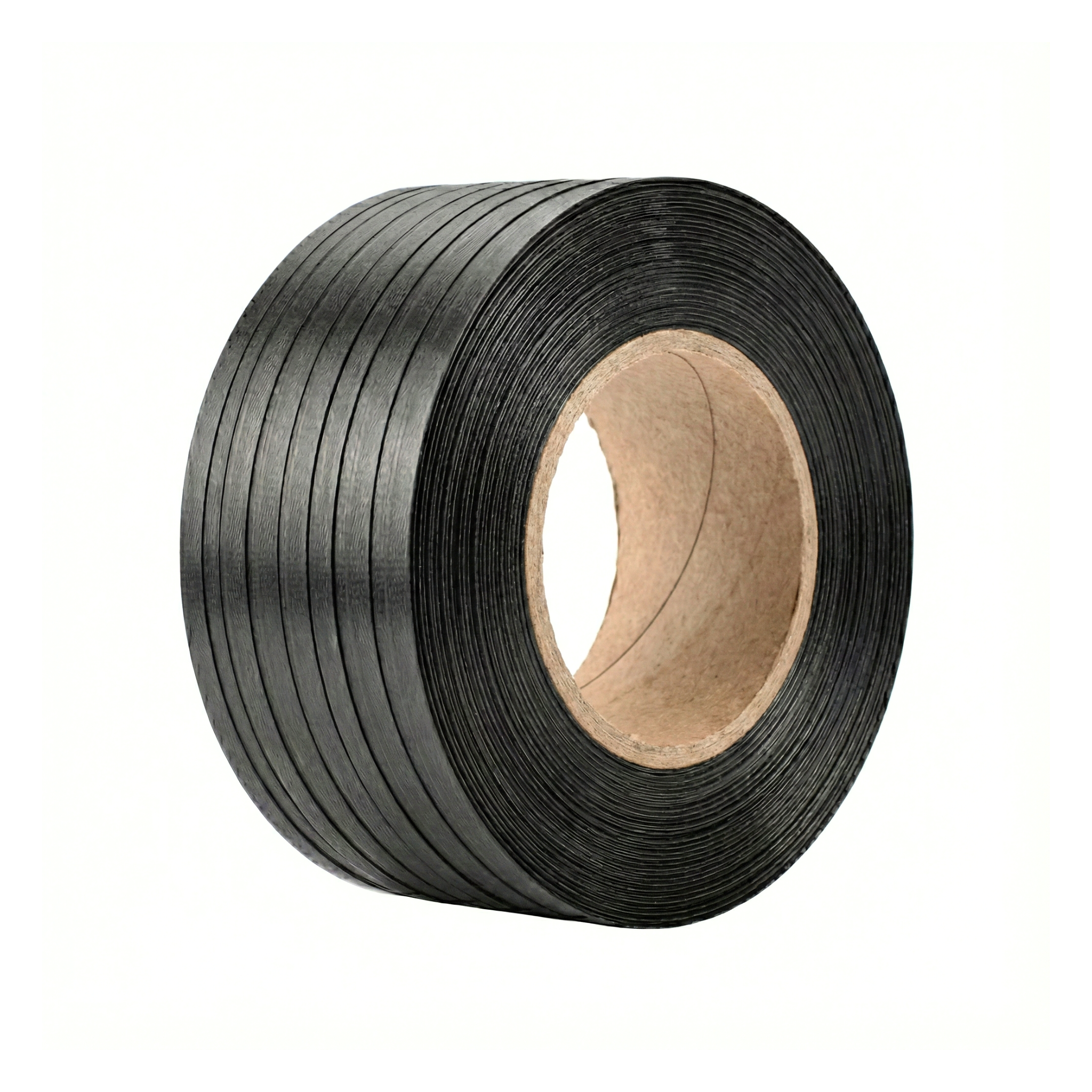
This guide covers correct strapping with polypropylene (PP) strapping: preparing the load, running the strap, tensioning, sealing the joint, and the final check. Follow these steps to secure boxes and light pallets with a firm closure, with notes depending on whether you use a machine width (5 and 9 mm) or a manual strapping width (12, 15 and 19 mm).
Product specifications
PP strapping comes in five widths. They all share virgin PP, an embossed finish, black color, and a cardboard core; what changes is the width, the breaking strength, the meters per coil, and whether they are intended for machine or manual use. Find your variant before starting.
| Specification | 5 mm | 9 mm | 12 mm | 15 mm | 19 mm |
|---|---|---|---|---|---|
| SKU | PP-05050 | PP-09060 | PP-12070 | PP-15080 | PP-19080 |
| Mode | Automatic | Automatic | Auto + manual | Manual | Manual |
| Thickness | 0.5 mm | 0.6 mm | 0.7 mm | 0.8 mm | 0.8 mm |
| Breaking strength | > 60 kg | > 100 kg | > 140 kg | > 180 kg | > 240 kg |
| Length per coil | 6000 m | 3000 m | 2100 m | 1300 m | 1000 m |
| Net weight per coil | 9.5 kg | 9.5 kg | 9.5 kg | 9.5 kg | 9.5 kg |
Step-by-step guide to strapping with PP
Prepare and align the load
Stack and align the boxes or packages so they are stable and flush, so the strap sits evenly. If the load has sharp edges, place plastic edge protectors on the corners where the strap will pass so the tension does not cut into the cardboard.
Run the strap around the load
In manual strapping, unwind the strap and pass it around the package until you return to the starting point, leaving enough excess to thread the tool. A dispenser cart keeps the coil at pallet height and prevents the strap from getting dirty on the floor.
- If you have 5 or 9 mm: these are machine widths. The coil goes on the coil holder of the automatic strapping machine, which runs and tensions the strap by itself; follow your machine's manual.
- If you have 12, 15 or 19 mm: this is manual strapping; run it by hand around the load as described above.
Tension the strap
In manual mode, thread both strap ends into the tensioner and tighten until the strap is firm and free of slack, without deforming the box. PP has good elasticity: tension firmly but do not overdo it. In machine mode, the strapping machine tensions automatically according to the configured setting.
Seal the joint
Close the joint with a metal seal (clip) and sealer, with a tool-free plastic buckle for light loads, or by friction welding if you use a battery-powered strapping tool or an arch machine. Make sure the joint bites firmly before releasing the tension.
Check the tension and trim the excess
Check that the joint does not slip by pulling lightly on the strap, and trim the excess flush. If the load requires it, repeat the strapping crosswise to hold it in both directions.
Choose the closure according to your volume: the plastic buckle is the fastest tool-free option for light loads; the metal seal with a sealer withstands more tension; and friction welding (machine or battery tool) is the most efficient at high volume. The embossed finish of PP helps the seal and the weld grip better.
Complementary products
To strap with PP by hand you need a tensioning tool, a sealing tool, and the closure consumable. These accessories cover the complete manual cycle:
The tensioner applies the tension; the sealer closes the clip; the seal is the metal clip; and the plastic buckle allows tool-free closure on light loads. For machine widths (5 and 9 mm), the closure is made by the automatic strapping machine itself by welding.
Maintenance and care
PP strapping requires no special maintenance. Store the coils in a dry, sheltered place, resting on the core and not on the edge, and secure the end of the strap so the coil does not unwind on its own. Polypropylene is somewhat more sensitive to prolonged sun than polyester, so keep the coils in the shade until you use them.
Do not use a width your tool or machine does not accept. Strapping that is too wide jams in the guide and the seal closes poorly; strapping that is too narrow is left with slack and the joint fails in transport. Confirm that the coil width matches that of your tensioner, machine, or seal.
Frequently asked questions
Do I need a seal, a buckle, or a machine to close PP strapping?
It depends on your workflow. With a manual tensioner, the closure is made with a metal seal (clip) closed with a sealer, or with a tool-free plastic buckle for light loads. Battery-powered strapping tools and arch machines weld PP by friction without a clip. All three closures are valid if the tension is correct; choose according to your volume and equipment.
Which width goes on a machine and which is for hand use?
The thin 5 and 9 mm widths are intended for automatic and semi-automatic strapping machines. The 15 and 19 mm widths are for manual strapping with a tensioner. The 12 mm width is the most versatile: it works well both in a semi-automatic machine and by hand, which is why it is the best-selling PP width in the world.
How much tension should I apply without breaking the strap?
Just enough for the strap to be firm and free of slack, without deforming the box. PP has good elasticity and absorbs settling of the package, but if you over-tension it you can break it as it passes through the seal or cut into the cardboard. If the box starts to dent, ease off a notch. On a machine, set the tension to the minimum that holds well and increase it little by little.
