

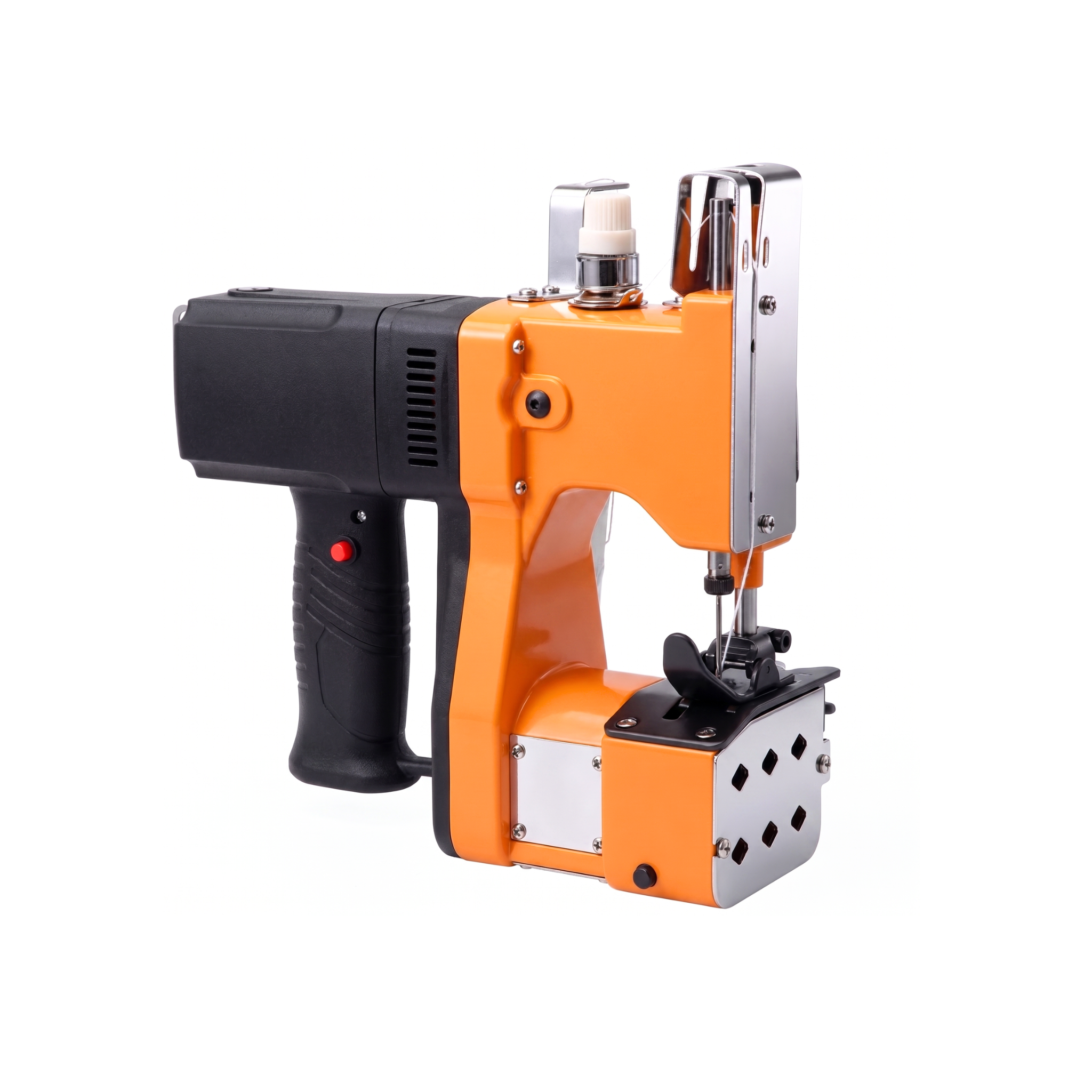
You have just added to your operation a portable sewing machine designed to close bags of raffia, jute, paper and net directly in the loading area, without moving heavy loads to a fixed station. This guide covers everything you need to know to get the most out of it: how to prepare it, how to correctly sew each type of bag, and how to maintain it so it withstands years of intensive work.
Product specifications
Dodom's portable sewing machine is a single-thread chain-stitch bag closer with a 210 W pure copper motor and an aluminium alloy housing. It weighs 3 kg, measures 29.3 × 21 × 28.5 cm and is operated with one hand thanks to its pistol grip. These are the technical details relevant for preparing the machine and choosing compatible consumables.
| Specification | Portable sewing machine |
|---|---|
| SKU | 349832 |
| Stitch type | Single-thread chain stitch |
| Needle | GK9-230# |
| Recommended thread | Nylon 21 × 2×3 |
| Stitch length | 7–11 mm |
| Sewing thickness | 0.2–6 mm |
| Sewing speed | 2,700 stitches/min |
| Power | 210 W |
| Voltage | 220 V |
| Dimensions | 29.3 × 21 × 28.5 cm |
| Weight | 3 kg |
| Housing | Aluminium alloy |
Step-by-step use
The complete procedure —from taking the machine out of the box to closing the first bag— takes you about 10 minutes the first time. Once familiar, each bag is closed in a few seconds.
Check the voltage and connect the machine
The machine operates at 220 V. Confirm that your outlet matches that voltage before plugging it in. If your installation is 110 V, use a 110/220 V step-up transformer of at least 300 W or a generator output at 220 V. Always use a three-prong cable with grounding.
Apply oil before starting
Locate the lubrication points on the head (marked as "oil-way" and "refueling point" on the side plate) and apply a few drops of lubricating oil to each one. Lubrication before the first use of the day prevents premature wear of the needle, the connecting rod and the internal cams.
Position the needle correctly
Turn the handwheel until the needle bar reaches its highest point. Insert the needle with the groove facing outwards and push it all the way to the stop. Tighten the fixing screw. The orientation of the groove is critical: if you place it the wrong way round, the thread will not engage with the hook and the stitch will skip.
Thread the machine following the path
Place the thread cone on the upper cone holder. Pass the thread through the numbered guides on the head in order (1 → 2 → 3 → 4 → 5) until it reaches the eye of the needle. The last step is to thread it from the outside inwards through the eye. Leave about 10 cm of thread free to start the first seam.
Adjust the stitch length and the tension
Turn the upper regulator clockwise to tighten the stitch or counterclockwise to loosen it. To lengthen the stitch, loosen the screw of the feed device and move the teeth upwards; to shorten it, downwards. Start with a medium stitch (8–9 mm) and adjust according to the thickness of the bag.
Sew a pass to secure the knot
Before closing your first bag, sew about 5 cm onto the bag itself to fix the thread and then make the knot. Do not make the knot over an empty seam: the thread will come loose. This sequence (sew first, knot afterwards) is the condition for the chain stitch not to unravel when transporting the bag.
Close the bag with a continuous movement
Hold the bag with your left hand and the machine with your right. Place the mouth of the bag between the presser foot and the feed teeth, press the trigger and let the machine move along the top edge of the bag. When you reach the end, pull the machine away from the bag: the thread will be cut automatically by the cutter on the head.
Do not fill the bag up to the top edge before sewing: leave at least 8–10 cm of empty fabric at the mouth so the machine enters comfortably and the seam withstands the tension of lifting. If the bag is closed too close to the contents, the pressure of the product on the seam increases the risk of the seam coming apart during transport.
Complementary products
To get the most out of the machine you need the bags you are going to close. These are the most common formats in Dominican agro-industrial and warehouse operations, all compatible with the single-thread chain stitch of the bag closer:
Polypropylene raffia bags are the standard format for grains, fertilisers and construction materials. Jute bags are used for coffee, cocoa and agricultural products that need to breathe during storage. Plastic net bags are ideal for vegetables (potatoes, onions, citrus) where ventilation prevents the build-up of moisture and mould.
Maintenance and care
Maintenance of the bag closer comes down to three simple routines: lubrication, lint cleaning and replacement of consumables. Doing them on time is what separates a machine that lasts 5 years from one that fails after 6 months.
- Lubrication every 2 continuous hours of work. Apply a few drops of oil to the marked points on the head. Before and after each shift as well.
- Lint cleaning in the needle area. Use a dry brush to remove fibre residue from the presser foot and the feed teeth. Accumulated lint blocks the feed.
- Needle replacement when it starts skipping stitches or you notice it is bent. The box includes spare needles.
- Replacement of the drive belt and cutting blade when they show visible wear. Both are changed with the included Allen keys.
- Storage in a dry place. Do not expose the machine to moisture or wash it with water: it causes short circuits and corrosion of the head.
Do not block the motor's ventilation grilles with your hand or rest the machine on soft surfaces (stacked bags, cloths) during use. The copper motor generates heat in continuous operation and needs free dissipation; obstructing it reduces the life of the winding and, on long shifts, can burn it out.
Frequently asked questions
What do I do if the machine skips stitches in the middle of the seam?
Stop the machine and check three things in this order: that the needle is positioned with the groove facing outwards and well tightened (one turn renders it useless), that the plane of the needle eye is parallel to the hook (if it is off, adjust the position of the hook), and that the thread tension is neither too loose nor too tight. The most frequent cause is a bent or poorly oriented needle: replace it with a new one from the included spares.
How long can I work continuously without resting the machine?
The manufacturer recommends shifts of up to 2 continuous hours of work, followed by a short break to apply oil to the lubrication points. With that routine the machine sustains intensive operation without loss of power. On shorter shifts it does not need the break, but lubrication at the start and end of the day is mandatory.
How do I change the stitch length if the bag I am sewing is very thick?
Loosen the screw of the feed device that is above the presser foot area and move the teeth piece upwards: the stitch lengthens (up to 11 mm maximum, ideal for thick jute and laminated bags). For a shorter stitch (paper or fine raffia bags) move it downwards. Tighten the screw after each adjustment and make a test seam before closing a real bag.
