

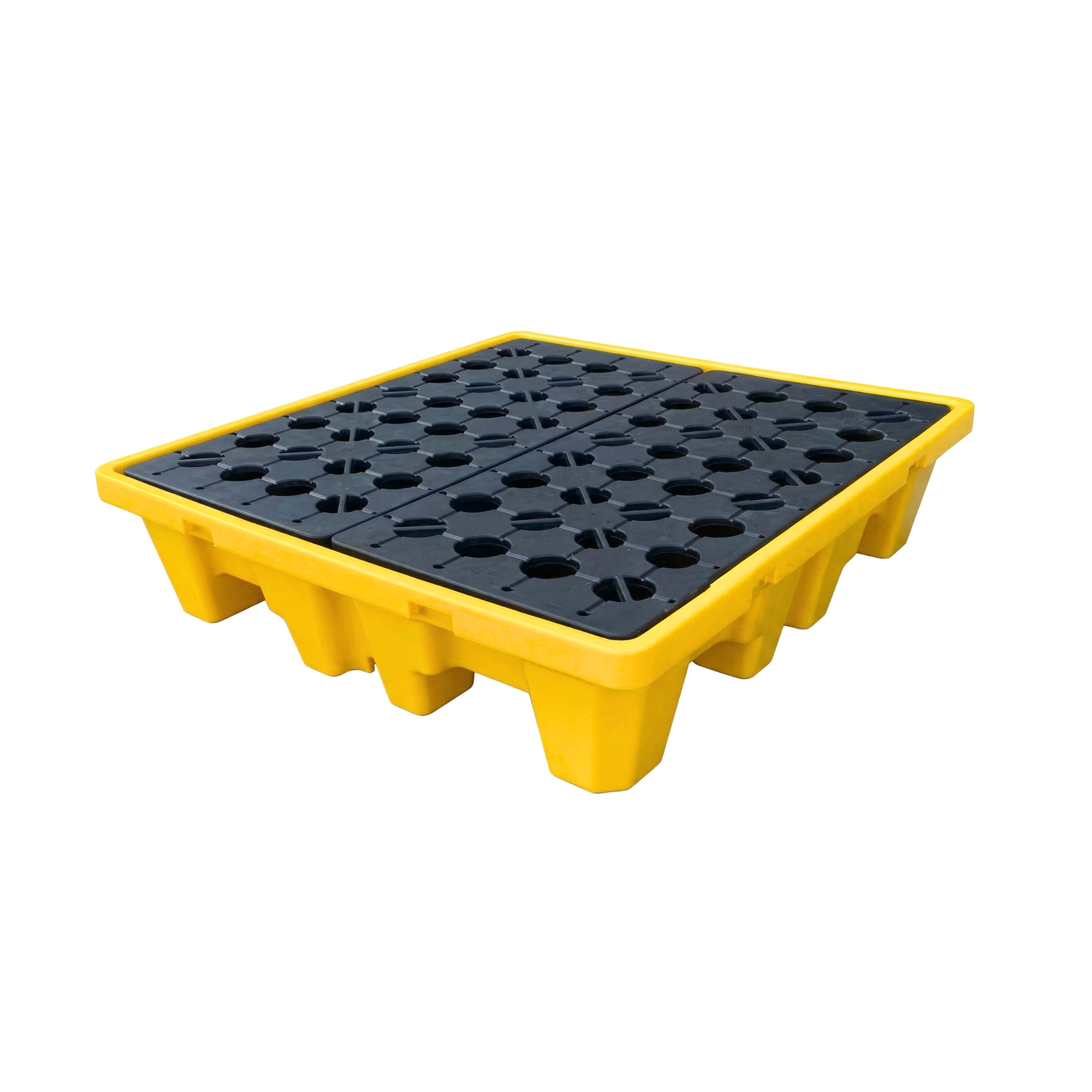
This guide covers the installation of the spill-containment plastic pallet: preparing the area, placing it in its final position, installing the top grate, positioning the drums and checking the drain plug and the sump. Follow these steps to comply with containment regulations and protect your facility against spills of hazardous liquids or chemical waste.
Product specifications
The CARGOBO spill-containment plastic pallet is a containment platform manufactured from injection-molded HDPE, with a sump-type lower base, a removable top grate and a side drain. Below are the technical specifications of the available model.
| Specification | 130 × 130 × 30 cm (51 × 51 × 12 in) |
|---|---|
| SKU | 477234 |
| Material | Injection-molded HDPE (high-density polyethylene) |
| External dimensions | 130 × 130 × 30 cm (51 × 51 × 12 in) |
| Structure | Base with collection sump + removable top grate |
| Drainage system | Drain plug in the base |
| Stackable when empty | Yes, without grate (nestable) |
| Chemical compatibility | Oils, hydrocarbons, fuels and non-aggressive chemicals* |
| Load capacity | — |
| Retention volume | — |
*Always check the specific chemical compatibility chart before storing aggressive products such as strong acids, chlorinated solvents or oxidizers.
Step-by-step usage guide
Follow these five steps to install the spill-containment pallet and get it ready to receive drums in your warehouse, mechanical workshop or industrial plant.
Prepare the installation area
Clean and level the floor where you will place the pallet. The surface must be dry, free of debris and level so that the containment sump drains correctly toward the plug. Leave at least 30 cm of clear space around the pallet to make maintenance and emptying easier.
Place the pallet in its final position
Position the base with the sump facing up and orient the drain plug toward an accessible side for future emptying. Confirm that the pallet sits firmly on all four corners before loading any weight. Once in position, the pallet should not be moved: it is designed as a fixed storage point.
Install the top grate
Fit the removable grate onto the base until it rests on the interior support points. The grate must sit flat, without rocking. This is the surface that will bear the weight of the drums and must be easy to remove when the time comes to clean the sump.
Place the drums on the grate
The 130×130 cm dimensions allow up to four standard 200 L (55 gal) drums to be arranged in a square layout. Place each drum centered on the grate, away from the edge to prevent tipping. If you are going to store a single larger drum, center it on the pallet.
Check the drain plug and the sump
Confirm that the drain plug is properly closed before putting the pallet into service. Include in your inspection routine a visual check of the sump at least once a week to detect leaks in time, and open the drain only when you are going to evacuate the retained liquid.
When you are going to empty the sump, connect a short hose to the drain plug and direct the liquid into a dedicated waste collection drum. Never discharge to a common drain: in the DR, most industrial discharges require management by an authorized handler, and a poorly managed spill can trigger an inspection by the Ministry of the Environment.
Complementary products
A well-organized industrial operation combines the spill-containment pallet with other plastic pallets for the areas that do not require containment. These are the most useful complements in Dominican warehouses and plants that already have their drum area sorted out.
The 3-runner pallet is the standard option for professional palletizing on rack shelving in the rest of the warehouse. The hygienic pallet is ideal if you have food-handling, pharmaceutical or cold-room areas near the drum zone. The one-way pallet handles international shipping of goods without spending on returnable pallets.
Chemical safety and compatibility
The injection-molded HDPE of the spill-containment pallet withstands a wide range of industrial liquids, but its behavior depends on the substance and on the contact time. Check this table before assigning the sump to contain a specific product.
| Compatibility level | Substances |
|---|---|
| Fully compatible (prolonged contact) | Petroleum oils and fuels (motor, hydraulic, gear, grease, diesel, gasoline, kerosene); diluted weak acids (acetic, citric, boric, carbonic, diluted phosphoric); mild alkalis (ammonia, diluted sodium bicarbonate, soap, mild detergent); alcohols and aqueous solutions (ethanol, isopropanol, ethylene glycol, brine, seawater, water); everyday oils and chemicals (vegetable/animal oil, water-based paint, general industrial cleaner). |
| Brief spills only, no immersion | Diluted sulfuric/hydrochloric acid; toluene and xylene; low-concentration bleach. |
| Not compatible | Concentrated strong acids (sulfuric, nitric); strong oxidizers (high-concentration bleach, hydrogen peroxide); strong organic solvents (acetone, methylene chloride, trichloroethylene, ethyl acetate); hot concentrated strong alkalis. |
Maximum temperature for chemical compatibility: ≤ 60 °C.
Maintenance and care
The spill-containment pallet lasts for years of continuous service if it is inspected and emptied regularly. These are the minimum routines to keep it in regulatory compliance.
Weekly inspection
Remove the grate and visually inspect the inside of the sump. Confirm that there is no unexpected accumulation of liquids and that the drain plug shows no leaks. Replace the grate and leave the pallet ready for the following week.
Emptying the sump
When liquid has been retained, always empty it through the drain plug into a labeled container authorized for waste management. Never empty it into the common wastewater network or onto the ground. The drain system means you do not have to tip over or uninstall the platform.
Monthly deep cleaning
Remove the grate, empty the sump and wash with water and a neutral detergent. For hydrocarbon residues, use an industrial degreaser compatible with HDPE. Rinse, dry and reinstall the grate. Take advantage of the cleaning to check the condition of the drain plug and the seals.
Do not use the spill-containment pallet as a moving pallet within the operation, and do not load it with a forklift under side-load conditions. It is designed as a fixed storage point for drums, and the grate can give way if subjected to the impacts typical of mobile handling. To move loaded drums, use a standard plastic pallet or a dedicated transport pallet.
Frequently asked questions
How many 200 L drums fit on the 130×130 cm spill-containment pallet?
Up to four standard 200 L (55 gal) drums fit in a centered square layout. Always confirm the total weight against the structural capacity of the grate before loading to the maximum.
Does the spill-containment pallet withstand acids or aggressive chemicals?
Injection-molded HDPE withstands oils, hydrocarbons, fuels and non-aggressive chemicals without structural degradation. For strong acids, chlorinated solvents or oxidizers, consult the specific chemical compatibility chart before storing.
Can it be stacked for storage when not in use?
Yes. Remove the top grate and the bases nest within each other (nestable), which reduces the space taken up in the warehouse when you have empty pallets in stock between operations.
