

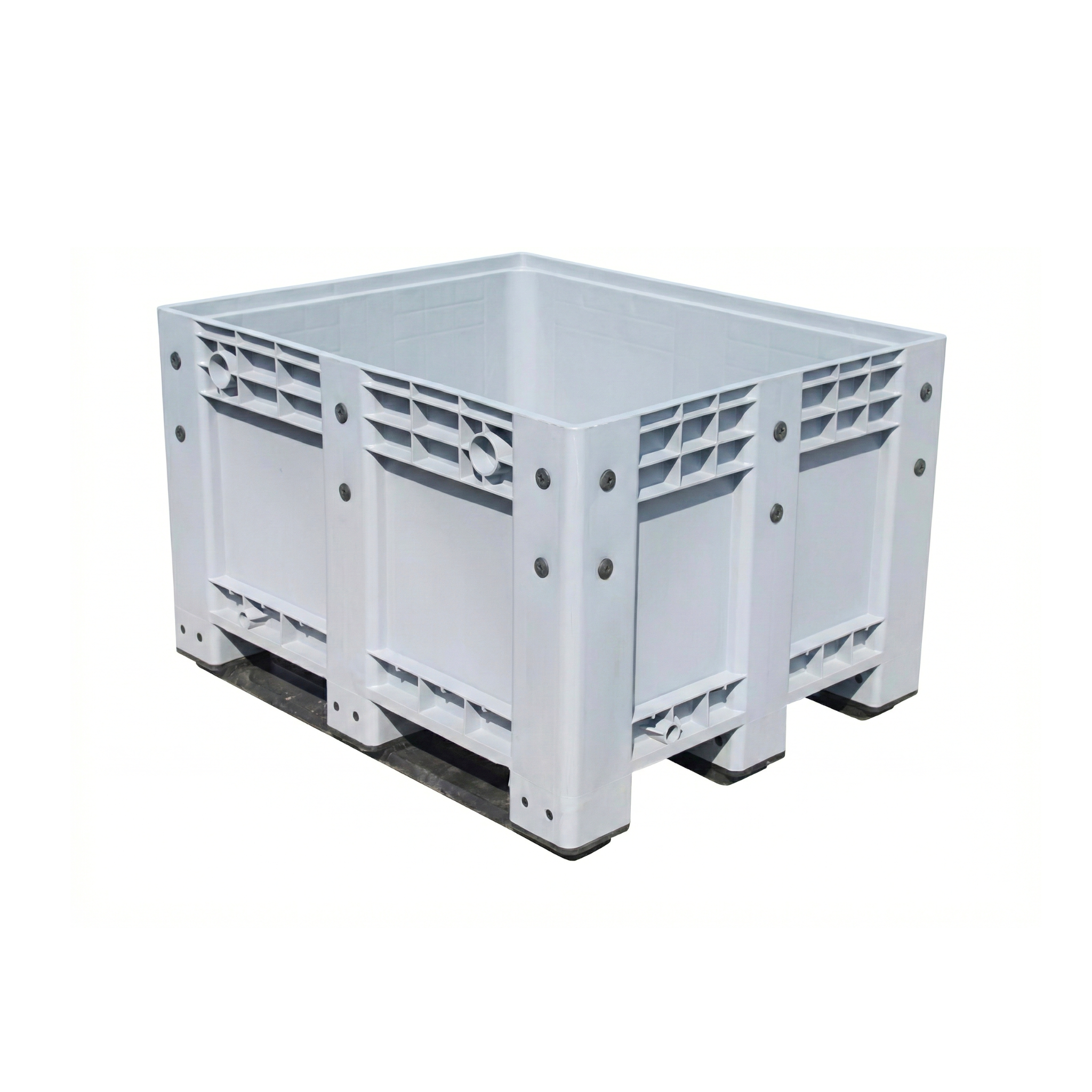
If you operate an agro-industrial facility with continuous flow of solid bulk (cereals, sugar, flour, animal feed), you need to move the full container through a plant without a forklift in short aisles, you discharge non-hazardous liquids (clarified juices, brines, non-contaminated industrial water) on a process line, or you require a rigid structural bin with audited stacking for packaged food industry, the modular rigid box plastic pallet is the tool designed for those scenarios. Unlike the collapsible version, its body is fixed —greater structural rigidity—, and it is complemented by three optional accessories (lid, casters, valve) purchased according to the operation to configure it to measure.
This guide explains how to choose among the accessories according to the case, how to combine them for hybrid configurations (example: pallet + casters + valve for itinerant discharge of non-hazardous liquids on a line), how to stack correctly with a lid, and how to wash the bin after each cycle. For circuits where return logistics justify collapsing, go back to the collapsible version; for UN-class hazardous liquids, step out of this family and evaluate the IBC line.
Product specifications
The rigid box pallet is offered as a modular system with four components that are purchased independently according to the operation. All share the American format 120 × 100 × 76 cm in gray color. The following table gathers the complete technical specifications of the four variants:
| Specification | Pallet (body) | Lid | Casters (pack of 5) | Discharge valve |
|---|---|---|---|---|
| SKU | 765776 | 765777 | 765778 | 765779 |
| Material | Virgin HDPE | Virgin HDPE | HDPE + metal components | PVC with adhesive cement |
| Function | Rigid structural bin with integrated pallet base | Top closure and stacking platform | Mobility without forklift in short aisles | Controlled emptying of non-hazardous liquids |
| Dimensions | 120 × 100 × 76 cm | 120 × 100 × ~5 cm | 5 units for base + auxiliary | Fitting for cylindrical hole pre-arranged in lower wall |
| Usable volume | ~700 L | N/A | N/A | N/A |
| Fork entry | 4-way | N/A | N/A | N/A |
| Suitable for | Solid bulk, agro-industry, packaged food | Stacking up to 3 levels depending on weight | Assembly lines, picking, kitting | Non-hazardous liquids on a process line |
| Not suitable for | UN-class liquids (use IBC) | Stacking without an intermediate lid | Continuous loads on uneven floor | Hazardous liquids, aggressive chemicals |
The body alone covers the simplest case (solid bulk without stacking). Body + lid covers stacking of solid bulk in a warehouse. Body + casters covers assembly lines and picking without a forklift. Body + lid + casters covers stackable and movable parts kitting. Body + valve covers controlled emptying of non-hazardous liquids. Modularity makes it possible to build the exact system for each operation without paying for accessories you will not use.
Step-by-step use
The following procedure covers the complete cycle: accessory selection, filling, handling according to configuration, stacking, and washing after each cycle.
Selecting accessories according to operation
Before purchasing, map the flow of the bin in the plant and select strictly the necessary accessories. If the bin travels through short aisles without a forklift, casters are mandatory; if it is going to be stacked during storage, the lid is mandatory; if it discharges non-hazardous liquids on a process line, the valve is mandatory. Modularity allows each bin in the fleet to have the exact configuration for its operation: 30 body-only bins for bulk in the warehouse + 10 with casters for the line + 5 with valve for mixing, all in the same compatible format.
Installing accessories and filling
For casters: turn the bin onto its side and screw the five casters into the preformed fixing points of the base (four at the corners + one central support). Verify that each caster turns freely and that the brakes (if applicable) operate correctly before returning the bin to the upright position. For the valve: the bin comes with a cylindrical hole pre-arranged in the lower wall, still unperforated. Drill following the circular guide of the hole with a PVC bit of the diameter indicated by the valve manufacturer, remove the disc of excess material, and clean the drilling dust with a dry cloth. Apply PVC adhesive cement to the part of the valve that will fit into the hole and insert it until it stops; keep the valve without moving it during the curing time indicated by the cement used (typically 2 hours for handling and 24 hours for use with liquid). The installation is permanent: once glued, the valve cannot be removed. After installing accessories, fill with the product: solid bulk to 95% of the usable volume; non-hazardous liquids to 90% to leave a safety margin against hydraulic pressure.
Handling according to chosen configuration
Without casters: handle with a forklift by inserting the forks fully into any of the four sides (4-way), with a dynamic capacity of up to ~750 kg. With casters: push manually with the force of one or two operators on firm floor, avoiding steep ramps and unevenness that could tip the loaded unit. With the valve: for in-line emptying, position the bin over the receiving hopper or chute, open the valve gradually to avoid spillage from excessive speed, control the flow rate with partial opening. Close the valve completely when finished and verify that no residual dripping remains.
Stacking with a lid
To stack full bins, install the lid on the lower bin securing the fit at the four corners. The lid redistributes the weight of the upper bin to the walls of the lower one. Stack up to three levels with medium-bulk bins (~500 kg), or two levels with heavy bulk (~700 kg). Do not stack bins with casters installed —casters do not withstand structural stacking and may give way or break—; remove the casters beforehand or use only bins without casters for stacking. Cross-compatibility with the collapsible version allows stacking rigid bins on top of a collapsible lid and vice versa, in a mixed fleet.
The combination of box pallet + casters eliminates the need for pallet jacks in short assembly-line operations (parts kitting, small-order picking, ingredient mixing in an industrial kitchen). On lines with a flow of 50-100 linear meters, two operators easily move bins loaded with 200-300 kg, eliminating the wait for the forklift and reducing internal logistics cost. The additional investment in casters pays for itself in a few months by freeing the forklift for operations where it truly adds value (truck loading/unloading, high-bay storage), while the continuous line flow is handled by the rolling bin.
Pressure washing and drying
After discharge, pressure-wash with water and neutral detergent or the chemical of your protocol (chlorine 200 ppm, PAA 0.1-0.3% for food). For bins with a valve, open the valve completely during washing to drain water and residue from the bottom of the bin. For bins with casters, avoid prolonged direct jets on the bearings so as not to compromise their lubrication. After washing, let it air-dry with the valve open and without the lid, in a ventilated area. For the food industry, record the washing in a hygiene log as part of the HACCP/GMP program.
Do not use the discharge valve with UN-class hazardous liquids (fuels, classified chemicals, hazardous waste). The valve is not UN-approved for hazardous substances, and both the PVC body and the adhesive installation cement can degrade with aggressive solvents, leading to spillage with serious regulatory consequences. For hazardous liquids, the correct choice is the UN/ADR-approved IBC container, designed and certified for that class of substances. The box pallet valve is reserved strictly for non-hazardous liquids: juices, food brines, non-contaminated industrial water, aqueous solutions with a pH close to neutral.
Complementary products
To complement the rigid box pallet in agro-industry, assembly lines, and discharge of non-hazardous liquids, the following products cover the most common adjacent needs:
The collapsible box pallet is the version with folding walls of the same family for circuits where return logistics justify the extra cost of the collapsible system. The 3-runner pallet is the base for conventional palletizing when the structural bin does not apply. The IBC container is the correct choice for UN-class hazardous liquids and for larger volumes (1,000 L standard). The food-grade virgin HDPE hygienic pallet is a natural complement in food areas where the box bin is used for bulk and the transport pallets must comply with HACCP/GMP.
Maintenance and care
Inspect each bin before loading it, looking for structural cracks, deformed walls (from heat exposure or impacts), valves with residual dripping, or aged PVC body (pronounced discoloration, brittleness to the touch). The PVC valve, fixed with adhesive cement, is permanently installed: it is not replaced by unscrewing as in flanged systems. If the opening mechanism stiffens, lubricate the shaft with food-grade silicone grease (in food-grade bins) or multipurpose grease (in industrial bins). If the valve develops permanent dripping when closed (degraded internal body), the solution is to cut the valve flush with the bin using a PVC saw, rework the original hole, and glue a new valve with the same installation procedure. For industries with intensive use, keep 1-2 spare valves and a container of PVC cement in the warehouse to minimize downtime when replacement is necessary. The casters are also consumables: bearings with excessive play, cracked wheels, or unresponsive brakes must be replaced as soon as the failure is detected, not kept in operation hoping «it will hold out a little longer».
For prolonged storage of the fleet, keep the bins clean and dry in a covered area on flat platforms, away from direct sun. UV exposure degrades the HDPE on the surface and compromises the cemented bond of the installed PVC valves, so a fleet stored in the sun loses valve tightness faster than a covered one. Keep a record of the fleet by complete cycles to schedule preventive maintenance of valves and casters, especially important in the food industry where the failure of a component during the cycle can contaminate the product and compromise the HACCP audit.
Frequently asked questions (FAQ)
Can I stack bins with casters installed?
No. The casters are designed to support the weight of the full bin in motion on the floor, not to support the weight of a second full bin on top. Stacking bins with casters at the lower base can give way at the bearings or break the wheels with a complete collapse of the stack. If the operation requires stacking, remove the casters beforehand or use bins without casters at the base of the stack (with caster bins reserved for mobility). Cross-compatibility with the collapsible family allows stacking rigid bins on top of a collapsible lid and vice versa.
Is it suitable for storing water, juices, or brines?
Yes for all three cases as long as they are non-hazardous liquids. For non-contaminated industrial water and aqueous solutions with a pH close to neutral (4-10), the valve and the HDPE are compatible without any problem. For clarified juices and food brines, additionally verify that the bin is from the food-grade line for HACCP audit —consult the Dodom team to confirm the sanitary traceability of the specific batch—. For hazardous liquids (strong acids, solvents, UN chemicals), step out of the box pallet and use a UN/ADR-approved IBC.
Rigid box pallet or collapsible pallet?
The choice depends on the return logistics and the required rigidity. The rigid one has greater structural robustness (fixed walls that resist impacts without a hinge system), allows the modularity of accessories (casters, valve) that the collapsible one does not admit, and is preferable when the bin is used internally without returning to a distant origin. The collapsible version is preferable when the logistics cycle includes frequent return (an empty truck returns to origin) and folding to ~33% of the assembled volume triples the cargo capacity of the return truck. In operations where the return is per bin only, without returning a container, the rigid one usually wins.
