

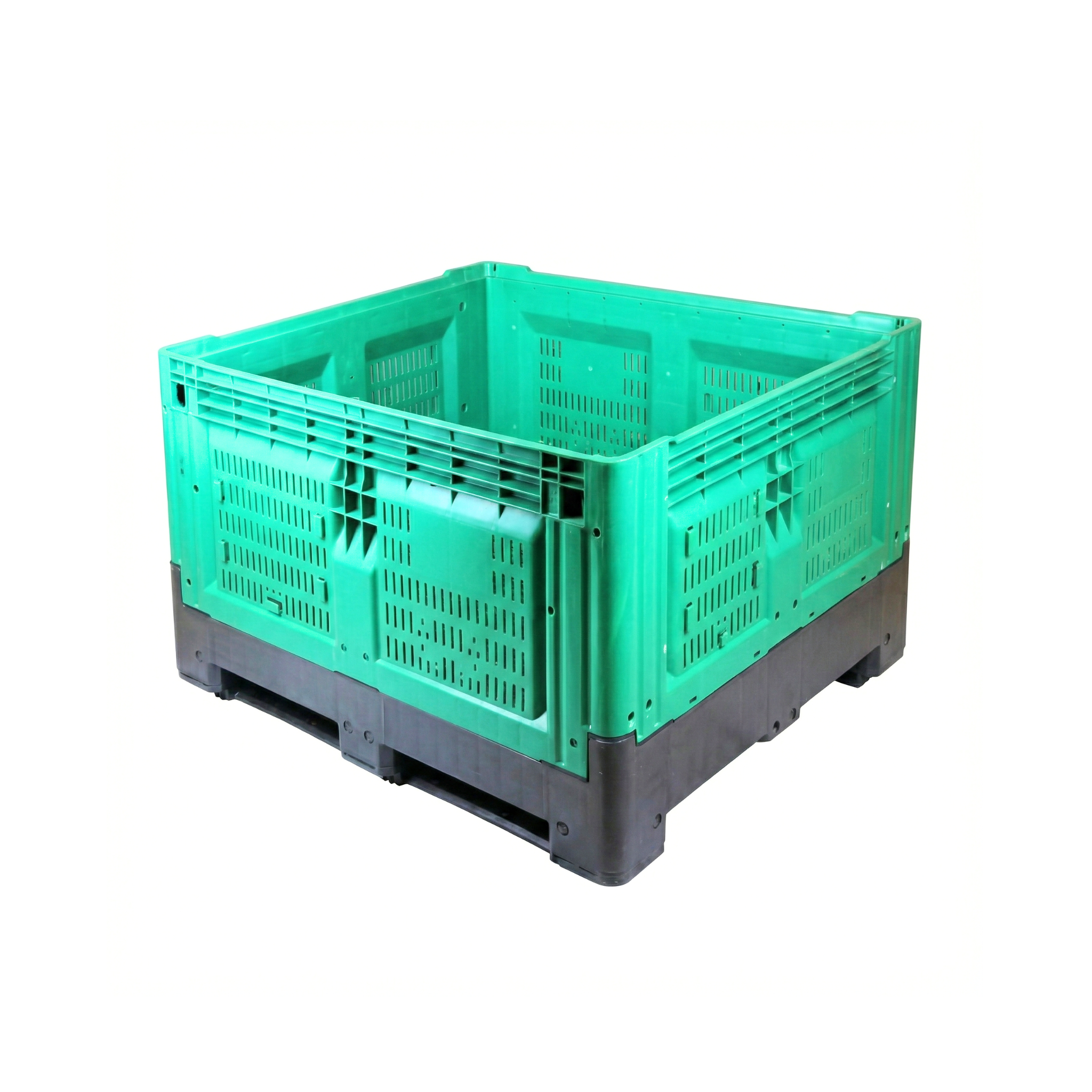
If you operate an intensive crop of delicate fruit (mango, avocado, tomato, cucumber, papaya) that arrives bruised when transported in bags, handle solid bulk (grain, sugar, flour) that needs a structural container instead of multiple bags on a pallet, require stable stacking of full bins without collapse or instability, or want to reduce the logistics return volume to 25% of the rigid version, the collapsible box plastic pallet is the tool designed for those scenarios. Its geometry with deployable walls and a quick manual locking system turns a rigid 120 × 100 × 76 cm unit into a flat piece when it returns empty, multiplying return freight efficiency fourfold compared to a conventional rigid pallet box.
This guide explains how to assemble the bin with the correct manual lock, how to combine the base pallet with the optional lid for structural stacking, how to load bulk without exceeding the allowable lateral pressure, and how to fold the unit at the end of the cycle for logistics return. For large-scale solid bulk with modular accessories (wheels, discharge valve), the right choice is the rigid box pallet; for non-collapsible circuits where the robustness of the rigid body is valuable, the IBC line is the higher-capacity alternative.
Product specifications
The collapsible box pallet is offered in two complementary components: the base pallet with collapsible walls and the optional lid for structural stacking. Both share the American 120 × 100 × 76 cm format in green and grey. The following table lists the complete technical specifications of the two variants:
| Specification | Collapsible base pallet | Lid |
|---|---|---|
| SKU | 373812 | 599111 |
| Material | Virgin HDPE | Virgin HDPE |
| Function | Collapsible structural bin with deployable walls and manual lock | Top closure and structural stacking platform |
| Assembled dimensions | 120 × 100 × 76 cm | 120 × 100 × ~5 cm |
| Folded dimensions | 120 × 100 × ~25 cm (~33% of assembled) | N/A (flat piece) |
| Colour | Green and grey | Green and grey |
| Locking system | Quick manual at each corner (no tools) | Top fit over assembled walls |
| Usable volume | ~700 L | N/A |
| Compatibility | Solid bulk, delicate fruit, vegetables | Structural stacking on the base pallet |
| Washing | Pressure wash with neutral detergent | Pressure wash with neutral detergent |
The base pallet works on its own as an open bin without a lid for operations where the contents are unloaded immediately at the destination (harvest to packing house). The lid is added when the operation requires stacking full bins during intermediate storage or long-distance transport, since the weight of the upper bin is transmitted through the lid to the body of the lower bin without collapsing the collapsible walls. Buy as needed: 1 lid per bin if you are going to stack, none if it is only direct unloading.
Step-by-step instructions
The following procedure covers the complete cycle: assembly, filling, stacking (if applicable), handling and folding for logistics return.
Assembling the bin with the manual lock
Place the folded base pallet in a horizontal position on a flat floor. Deploy the side walls one by one to the vertical position, starting with the long walls (120 cm) and continuing with the short ones (100 cm). Check that each corner has the manual lock fully engaged —you should hear the safety click or, in systems without a click, visually confirm that the locking tongue has fully entered its housing—. Do not force the assembly: if a wall does not fit, take the whole unit apart, open it completely and restart the procedure from flat.
Filling with bulk or product
Fill the bin with the product: solid bulk (grain, sugar, flour) up to the maximum level marked on the inner wall, or delicate fruit (mango, avocado, tomato) without overfilling to avoid bruising the product on top. For delicate fruit, fill in layers with a simple cushioning material (plastic foam, kraft paper) between levels if the bin height allows. The load is distributed evenly over the surface of the base pallet; the walls resist the lateral pressure of the bulk up to the structural limit of the lock, do not exceed the height indicated by the manufacturer.
Lid and stacking (if applicable)
If the operation requires stacking during storage or transport, install the lid over the upper walls, securing the fit at the four corners. The lid redistributes the weight of the upper bin to the walls of the lower bin, preventing the collapsible walls from flexing inward. Stack them up to two or three levels maximum depending on the weight of the contents (heavier = fewer levels). Without a lid, do not stack full bins: the top load can collapse the collapsible walls of the lower bin and ruin both the unit and the contents.
Handling with a forklift
The base pallet has fork entry on all four sides. Insert the forks fully, lift at a moderate speed and check that the unit does not sway. The allowable dynamic capacity depends on the weight of the bulk: as a reference, keep the pallet below 600-700 kg of dynamic load to preserve the manual locking system. To unload, lower the bin to the destination, remove the lid (if used), open the bin's discharge system (folding side door if the unit has one, or direct tipping) and empty the contents at the destination. For fruit, prefer progressive tipping at 30° over a padded hopper, not direct tipping at 90°.
The combination of base pallet plus lid turns the bin into a structural mini-tote ideal for harvesting delicate fruit (mango, avocado, papaya) that arrives intact at the packing house. The fruit is loaded directly from the field into the bin, the lid is placed on the farm, the bins are stacked on the truck for transport and delivered to the plant without handling the product along the way. Zero intermediate transfers = zero handling bruises. Compare with the traditional system of rigid crates stacked without structure: the fruit in the bottom crate always arrives compromised by the compression of the upper weight, whereas with a collapsible pallet + lid the weight is borne by the bin structure, not the fruit on the lower level.
Folding for reverse logistics
After washing and drying, release the manual lock at each corner and fold the walls in reverse order to assembly: first the short ones (100 cm) inward, then the long ones (120 cm) over them. The folded unit ends up at approximately 120 × 100 × 25 cm, which multiplies the load capacity of the return truck three to four times compared to a rigid pallet box. Stack them folded on the truck up to the height allowed by the vehicle's load envelope, secure with strapping or nets and send them back to origin for reuse. The folding capacity is what economically justifies the initial extra cost compared to a conventional rigid box.
Do not partially open or try to "adjust" the side lock during filling to fit extra product. The locking system is a structural stop that holds the lateral pressure of the bulk; opening it partially under load, even by a few millimetres, transfers all the weight to the wall hinges and causes the bin to fail with a complete tipping of the contents. If you need more capacity per unit, do not force the lock: use the rigid box pallet from the same family, designed with fixed walls for heavy bulk, or move to the IBC line if the scenario is liquid or large-scale bulk.
Complementary products
To complement the collapsible box pallet in delicate fruit harvesting, solid bulk and reverse logistics, the following products cover the most common adjacent needs:
The rigid box pallet is the non-collapsible version of the same family for heavy bulk where the full rigidity of the body justifies losing the folding capacity and where the modularity of accessories (wheels, valve) compensates. The 3-runner pallet is the base for conventional palletising when the structural bin does not apply (loads in bags on a flat surface). The big bags with open mouth and flat bottom are a more economical textile alternative for bulk without the need for a reusable structural bin. The manual stretch film consolidates the stacked bins during long-distance transport, especially when the truck is not completely full and the load can sway.
Maintenance and care
Inspect each bin before assembly for cracked hinges, miscalibrated locking systems (that no longer fit with a firm click) and walls with structural cracks. The hinges and locks are the most stressed components of the collapsible pallet; a bin with a defective lock must be removed from the fleet immediately because its failure under load is catastrophic. Pressure wash with neutral detergent after each cycle, especially if it transported fruit or agri-food bulk, and ensure complete drying before folding for return (moisture trapped in the fold causes microorganisms to proliferate during long-distance transport).
For prolonged storage of the fleet, keep the bins folded in a covered area on flat racks, away from direct sunlight. UV exposure on hinges and locks progressively hardens them and increases the risk of fracture during assembly. Keep a record of the batch by number of complete cycles (assembly-use-folding) to schedule preventive retirement when it approaches the service life limit declared by the manufacturer.
Frequently asked questions (FAQ)
How much bulk actually fits in the bin?
The internal usable volume is approximately 700 L with the walls at the maximum height of 76 cm. In terms of mass, this translates to around 600-700 kg of dry solid bulk (grain, sugar, flour) depending on the specific density of the product. For delicate fruit, the practical capacity is lower because it is advisable not to overfill to avoid bruising the product on the upper level. The rule of thumb is to fill to 80-85% of the usable volume with fruit and to 95% with dry solid bulk.
How many levels of full bins can I stack?
With the lid installed, up to two or three levels of full bins depending on the weight of the contents. As a reference: with bins of delicate fruit (~400-500 kg each) you can comfortably stack three levels; with bins of solid bulk (~600-700 kg each) preferably two levels to maintain a structural safety margin. Without a lid, do not stack any full bin: the collapsible walls of the lower bin do not support the direct weight of a full bin on top without the structural redistribution provided by the lid.
Does folding really offset the initial extra cost?
Yes, when the logistics include frequent return to origin (harvest-packing, plant-distribution with packaging return). Folding to ~33% of the assembled volume means that a return truck carries three times more bins than with an equivalent rigid pallet box, reducing the freight cost per returned bin to a third. In operations where the bin does not return (one way) or where the return frequency is low, the extra cost of the collapsible system is not justified and the rigid box pallet from the same family is preferable.
