

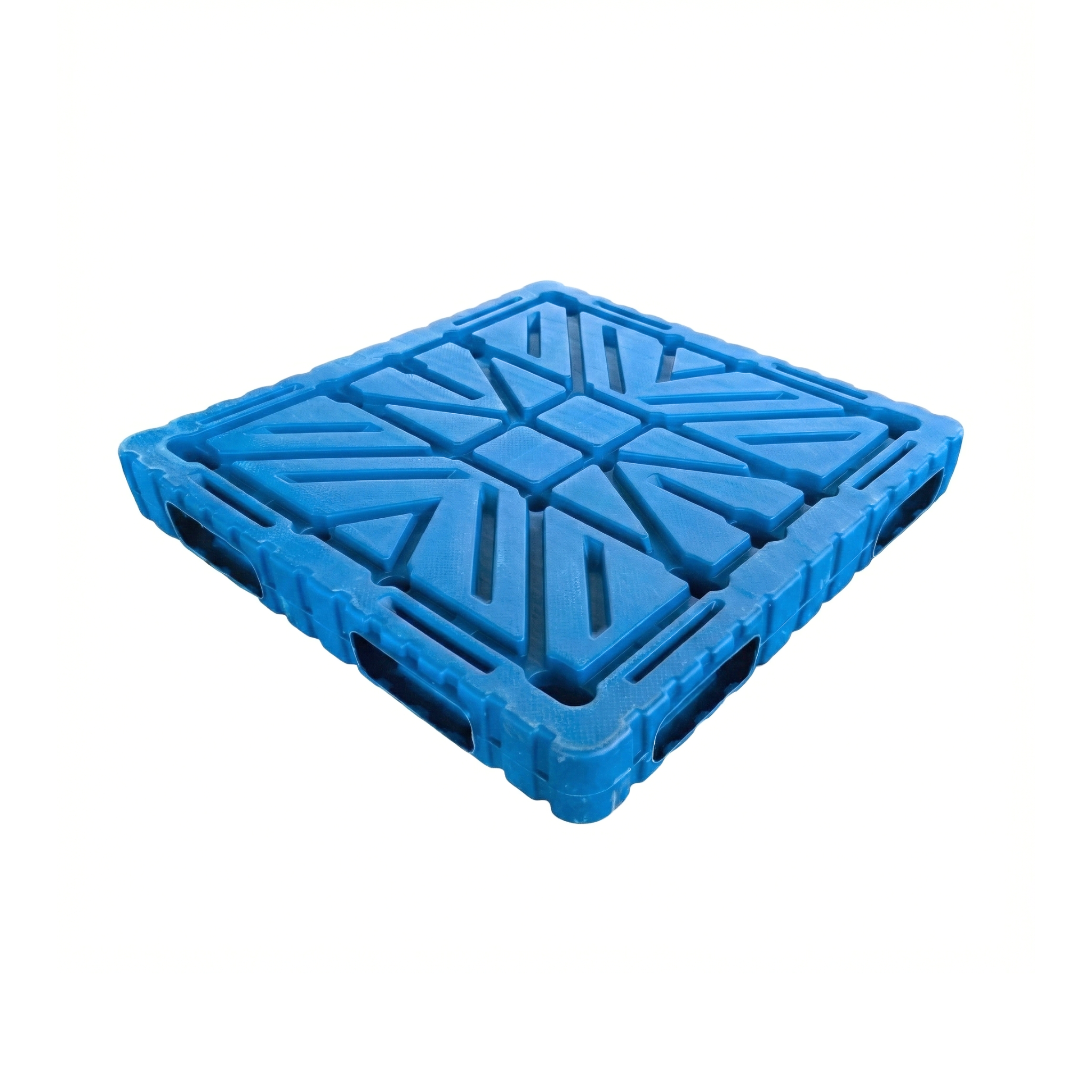
If you operate a closed-loop pallet circuit inside a plant, move bulk bags (sugar, flour, cement, animal feed) that need broad support without deep gaps, work in cold storage where condensation water must drain and not pool, or want to maximize pallet service life by rotating the working face between cycles, the reversible plastic pallet is the tool designed for those scenarios. Its geometry with two identical faces lets you use either side with no functional difference, the anti-slip strips on both faces keep the load from sliding, and the drainage holes manage the moisture typical of cold rooms and wet operations.
The reversible is NOT the best option for every use: for selective rack storage you need the 3-runner pallet with its calibrated stringers; for the food industry with HACCP auditing, the food-grade virgin HDPE hygienic pallet; for non-returnable export, the one way. This guide explains how to take advantage of the two faces to double the real service life, how to orient the unit according to the circuit, and how to wash and drain by taking advantage of the drainage holes.
Product specifications
The CARGOBO reversible plastic pallet is offered in the American format of 120 × 100 cm, blue color. The following table sets out the full technical specifications of the only available variant:
| Specification | Reversible American |
|---|---|
| SKU | 273812 |
| Material | Monobloc virgin HDPE |
| Type | Reversible, two identical faces |
| Dimensions | 120 × 100 cm (American) |
| Color | Blue |
| Geometry | Identical top surface top and bottom |
| Anti-slip | Anti-slip strips on both faces |
| Drainage | Through-holes on the surface |
| Fork entry | 4-way (any side) |
| Recommended applications | Cold storage, bulk bags, closed loop, floor storage |
| Not recommended for | Selective rack (use 3-runner), one-way export (use one way) |
| Static capacity (stacked) | ~4,000 kg |
| Dynamic capacity (forklift) | ~1,250 kg |
Step by step on how to use it
The following procedure covers the full usage cycle of the reversible pallet: from identifying the circuit to washing and rotating between cycles to double the real service life.
Confirm the usage circuit
The reversible performs in three scenarios: cold storage (where drainage manages condensation and defrost water), stacking of bulk bags (sugar, flour, cement, animal feed, where the flat anti-slip surface holds the bags without deep gaps that damage the bag) and internal closed loops without selective rack storage. First confirm that your operation fits one of those scenarios. If you need selective rack, go back to the 3-runner pallet; if you export without return, evaluate the one way; if you handle food with HACCP, step up to the hygienic pallet.
Inspection and palletizing
Since the two faces are identical, there is no «correct face» by design; the decision is based on observed wear. Inspect the pallet for breaks, unstuck anti-slip strips or deformations, and choose as the top face the one showing the least use to distribute wear across the cycles. Center the load on the pallet with a maximum overhang of 5 cm on each side. For bulk bags, alternate the rows in an interlocked pattern to improve stability before wrapping with manual stretch film.
Handling with a forklift
The fork entry is 4-way (any of the four sides accepts the fork), which gives operational flexibility in narrow aisles. Insert the fork all the way until it goes fully under the bottom face —the reversible geometry has no stringers limiting insertion depth—. Lift at a moderate speed and check that the load does not tilt thanks to the bottom anti-slip strips that keep the pallet stuck to the tines. The dynamic capacity of ~1,250 kg covers most industrial and bulk palletizing.
Washing and draining by taking advantage of the drainage
After unloading, pressure-wash with water and neutral detergent or the chemical from your protocol (chlorine 200 ppm, PAA 0.1-0.3% for food, QUATs for non-food). Lean the pallet against a wall in an inclined vertical position «30° off plumb»: the drainage holes let the water run off by gravity without pooling in cavities. The two faces make this easier by not having a complex bottom geometry that retains moisture. Let it air-dry, especially before returning to cold storage where residual water crystallizes and reduces the anti-slip grip.
Alternate the working face between cycles by rotating the pallet 180° each time it returns to operation after washing. This simple practice distributes the wear of the anti-slip strips, the forklift scratches and the surface micro-cracks evenly, going as far as doubling the real service life compared to always using the same face up. To make it systematic, mark the two faces with «A» and «B» labels in a corner and log in a record which face was up in each cycle —this is zero cost and translates directly into additional years of service for the fleet—.
Floor storage (not on rack)
The reversible is stacked on the floor (block stacking) up to the height allowed by the static capacity of ~4,000 kg distributed over the base. Verify that the bottom face of the upper pallet does not rest in direct contact on soft load (loose unwrapped bags) that could sink and compromise stability. For stacking boxes with a base without a barrier, place a thin cardboard sheet or film between the upper pallet and the lower boxes to prevent the anti-slip strips from marking the cardboard. For selective rack storage, this pallet is not the choice: go back to the 3-runner.
Do not use the reversible on selective rack (shelving with separated parallel beams, where the pallet rests only on its ends). The reversible geometry distributes load evenly over a continuous surface, not over separated linear supports; under structural load on rack it progressively flexes, the anti-slip strips separate from the body and over the medium term the pallet fails. For selective rack —the most common option in industrial warehouses— use the 3-runner pallet, designed with calibrated stringers for support on beams. The reversible is reserved for floor stacking, cold storage and circuits where the pallet always rests on a continuous surface.
Complementary products
To complement the reversible pallet in closed loops, cold storage and floor stacking of bulk bags, the following products cover the most common adjacent needs:
The 3-runner pallet is the correct choice when the warehouse uses selective rack and the reversible does not apply. The food-grade virgin HDPE hygienic pallet is the mandatory upgrade when the operation enters an audited HACCP/GMP food circuit. The transparent manual stretch film consolidates bulk bags and mixed loads on the reversible pallet. The big bags with open mouth and flat bottom are the textile alternative when the bulk justifies units of 1,000 kg instead of multiple individual bags on the pallet.
Maintenance and care
Inspect each pallet before loading it for unstuck anti-slip strips, breaks on edges, deformations from heat exposure (closed trucks in the sun for days) and obstructions in the drainage holes (labels, caps, debris). The anti-slip strips are replaceable consumables: if one comes off, remove the entirety of that face with a spatula and a non-aggressive solvent, and replace them with new strips; do not operate the pallet with partial strips because they compromise uniform grip.
For storage of out-of-service pallets, stack them flat on the floor (not on edge, which deforms them) in a covered area, away from direct heat sources. Prolonged exposure to the Caribbean sun degrades the HDPE on the surface and hardens the anti-slip strips; this is not critical if the pallets are rotated in operation, but it is for pallets that remain in the fleet without use for months. Keep a record of the fleet by level of use (face A vs face B in each cycle) to manage the systematic rotation of step 4 and maximize the real service life of the entire batch.
Frequently asked questions (FAQ)
Can I use it in cold storage with a food product?
The reversible is suitable for cold storage thanks to its drainage holes, but it is NOT audited food-grade. If the operation requires an HACCP, GMP certificate or sanitary traceability of the pallet, use the food-grade virgin HDPE hygienic pallet, designed specifically for the food industry with chemical compatibility with chlorine, PAA and QUATs. The reversible is reserved for cold storage with product packaged in secondary packaging (sealed boxes, bags), not in direct contact with exposed food.
Why isn't it suitable for selective rack if it has a dynamic capacity of 1,250 kg?
Dynamic capacity and rack capacity are different things. Dynamic capacity measures how much the pallet supports resting on the forklift tines (continuous support). Rack capacity measures how much the pallet supports resting only on its ends on the rack beams (support on two separate lines with free span in the middle). The reversible distributes load over a continuous surface and flexes when it only rests on its ends; the 3-runner, on the other hand, has calibrated longitudinal runners that act as structural beams and keep the load over the rack beams without flexing.
Does rotating the faces really double the service life?
Under real operating conditions with systematic rotation between cycles, yes: the anti-slip strips, the forklift scratches and the surface micro-cracks are distributed between the two faces instead of concentrating on a single one, and the pallet reaches double the cycles before being withdrawn from the fleet. The condition for this to hold is discipline in the rotation: if in practice the operator always takes the pallet with a specific face up, the advantage is lost. That is why the «A/B» mark in a corner and the record log of step 4 are critical for the theoretical benefit to translate into real additional years.
