

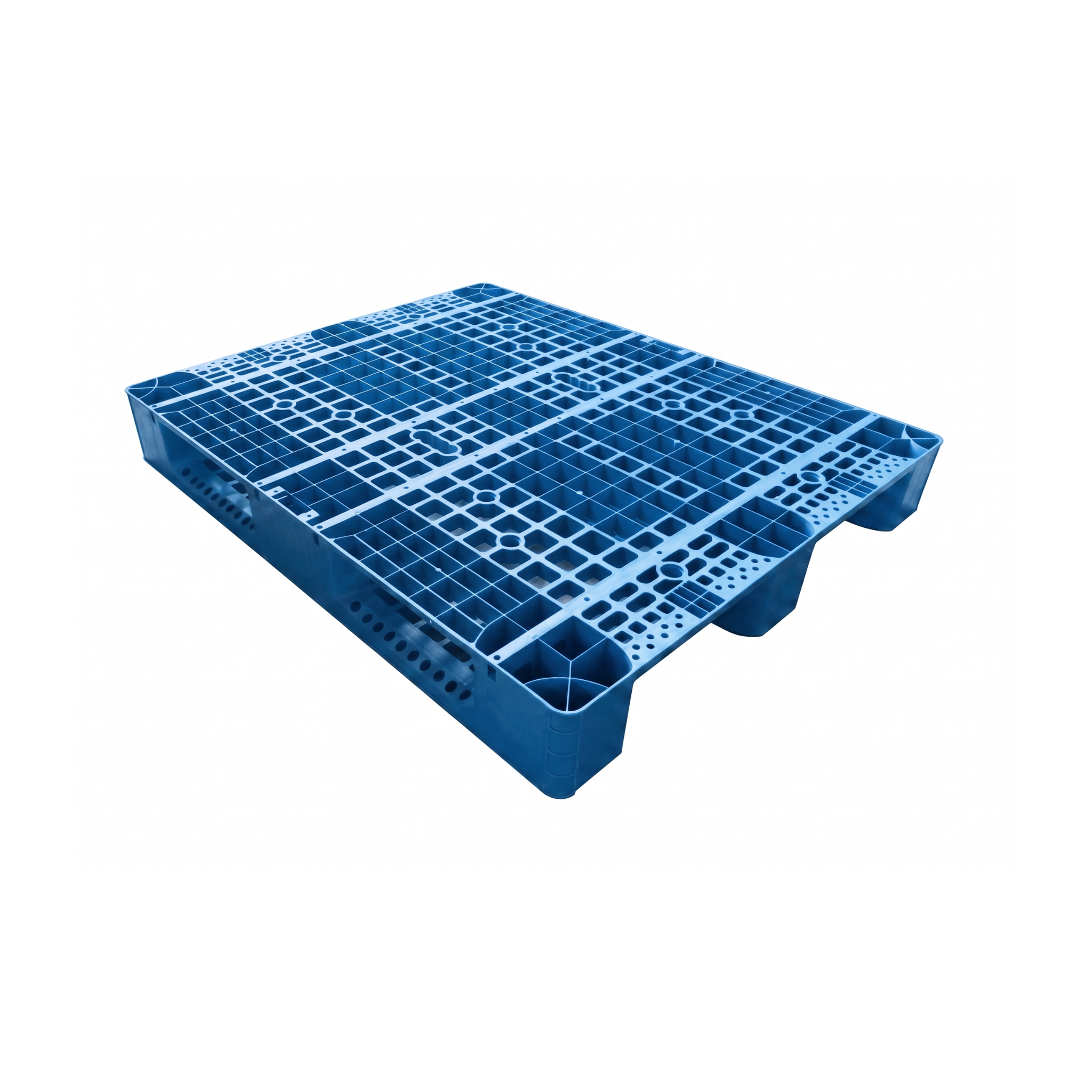
If you operate a warehouse with selective pallet racking, export goods to the USA, Europe or the rest of the Caribbean, move product in cold storage where wood swells from condensation, or process food under HACCP standards where the wooden pallet does not certify, the 3-stringer plastic pallet is the basic component of modern professional palletizing. This guide explains how to choose between the American format (120×100 cm) and the European format (120×80 cm) according to destination, how to palletize and strap the load correctly, how to handle it with a forklift and how to take advantage of the ISPM-15 exemption in international export without a phytosanitary certificate.
The 3-stringer plastic pallet has a key geometric feature: three continuous parallel stringers (“runners”) that distribute the weight longitudinally over the rack beams. This is why it is the right choice for high storage with selective racking and push-back, where a block pallet (resting on 9 points) does not ensure continuous support on the two longitudinal beams and has a greater risk of lateral tipping. If your warehouse uses drive-in or cantilever racking, this pallet is not the right choice and you should review the decision with the warehouse engineer.
Product specifications
The 3-stringer plastic pallet is offered in two standard formats corresponding to the two most widespread international palletizing standards. The choice between one or the other depends mainly on the destination of the goods and the final customer's warehouse system. The following table contains the complete technical specifications of the two available variants:
| Specification | American 120×100 cm | European 120×80 cm |
|---|---|---|
| SKU | 562100 | 654231 |
| Material | 100% virgin polypropylene (PP) | 100% virgin polypropylene (PP) |
| Dimensions | 120×100 cm (48×40 in) | 120×80 cm (48×32 in) |
| Color | Blue | Blue |
| Geometry | 3 parallel stringers | 3 parallel stringers |
| Fork entry | 4-way | 4-way |
| Suitable for selective racking | Yes, with stringers parallel to the beams | Yes, with stringers parallel to the beams |
| ISPM-15 standard | Exempt (does not apply to plastic) | Exempt (does not apply to plastic) |
| Hygiene | Non-porous, pressure-washable | Non-porous, pressure-washable |
| Main market | USA, Mexico, LATAM, Caribbean | Europe, North Africa |
| Estimated service life | Dozens of cycles in a professional circuit | Dozens of cycles in a professional circuit |
The palletizing, strapping and handling steps are common to both variants. The difference between American and European is exclusively dimensional: the American (120×100 cm) is the dominant standard in the USA and most of LATAM and the Caribbean; the European (120×80 cm) is the EUR/EPAL standard for European markets. If your goods travel to multiple destinations, keep both formats in stock.
The sister guides for the hygienic plastic pallet, the one-way plastic pallet, the reversible plastic pallet, the foldable box plastic pallet, the box plastic pallet and the spill-containment plastic pallet cover the other six configurations in the family and help you confirm whether the 3-stringer is the right choice or whether your operation would benefit from a different geometry.
Step-by-step guide to using it
The following procedure covers the complete operating cycle: format selection, loading, strapping, warehouse handling and export preparation. The instructions apply to both variants, with specific notes where the destination or operation changes the technique.
Choosing between American and European
Confirm the format according to the destination: 120×100 cm American for the USA, Mexico, Central America, much of LATAM and the rest of the Caribbean; 120×80 cm European (EUR/EPAL) for Europe and North Africa. For local distribution in the DR, both work but the American is the most widespread in the racks of industrial warehouses and distribution centers. If you export to multiple destinations, keep both formats in stock segregated by warehouse and operation: mixing formats in the same operation complicates the truck cubing and reduces total load capacity.
Palletizing the load
Distribute the load centered on the pallet, without it protruding beyond the perimeter —a box that sticks out rubs against the rack when positioning and gets damaged or destabilizes the stack—. Stack boxes or bags in an interlocked pattern (each level rotated 90° relative to the one below) to distribute the weight and increase stability through friction between levels. The maximum recommended height for a 3-stringer pallet in standard operation is 1.8 m with a light or medium load; for very heavy loads (cement bags, rebar, aggregate) limit it to 1.2 m to keep the center of gravity low.
Strapping and wrapping
Secure the load to the pallet with the standard professional combination: two strapping straps passing through the lower slots of the pallet (vertical in the transverse direction) plus complete wrapping with manual stretch film from the base to the top of the load. The strapping provides structural fastening; the film covers the gaps between boxes and blocks lateral movement. For heavy loads or long transit, increase to three straps and two extra turns of film at the top to prevent lifting from wind during dock handling.
Handling with a forklift and rack positioning
The fork entries are 4-way (all four sides); for heavy loads, preferably use the long 1200 mm sides. Insert the forks all the way in before lifting to distribute the weight over the three stringers. In selective racking, orient the stringers parallel to the rack's longitudinal beams: the three stringers must rest continuously on the two beams. If you orient the stringers perpendicular to the beams, the pallet rests only in the central zone where a stringer meets the beam and the base flexes, a dangerous condition that with heavy loads can cause failure or a fall.
In inter-island Caribbean export, mark each pallet with the exporter's indelible stamp (logo, company code or internal control number) in a visible area of the stringers. Customs at many Caribbean ports still ask for visual verification of the material even though ISPM-15 does not apply to plastic, and a clear mark immediately identifies the pallet as CARGOBO from a known customer, speeding up clearance. The investment in batch numbering for a company that exports weekly pays for itself the first time a container ships on time because the pallet did not end up in the inspection queue.
Preparing for international export
Confirm with your customs agent at the destination that the goods are exported on an ISPM-15-exempt plastic pallet —this is declared in the shipping documentation and eliminates the requirement for fumigation and IPPC marking—. If you export food, consider the hygienic plastic pallet with food-grade virgin polypropylene (PP) instead of this one; if the goods do not return to origin and operate a single trip, evaluate the cost of the one-way plastic pallet, which is significantly more economical and meets export requirements. Photographically document the complete packaging (pallet + load + straps + film + labels) before dispatch as a quality backup.
Do not use the 3-stringer pallet in drive-in racking (where the pallet rests on side profiles, not on longitudinal beams). That system requires a pallet with a continuous perimeter base or a pallet with bottom blocks that rest on the rack's side rails. Forcing a 3-stringer pallet in drive-in causes the pallet to sag between rails, the load to fall to the level below and, in severe cases, the collapse of the entire rack column. If your warehouse is drive-in, consult the warehouse engineer and consider the reversible plastic pallet with a perimeter block base as an alternative.
Complementary products
To complement the 3-stringer plastic pallet in professional palletizing, export and rack warehouse operations, the following products cover the most common adjacent needs:
The manual transparent stretch film is the natural tool for wrapping the load on the pallet and blocking lateral movement during transit. The polypropylene (PP) strapping coil provides structural fastening by passing through the lower slots of the pallet —the film + strapping combination is the professional standard for palletized packaging—. The hygienic plastic pallet covers operations under HACCP/GMP standards where food-grade virgin polypropylene (PP) is a requirement. The one-way plastic pallet is the choice when the pallet does not return to origin and the unit cost must be minimal.
Maintenance and care
The 3-stringer plastic pallet in a closed professional circuit allows dozens of use cycles without specific maintenance beyond periodic cleaning. For operations under sanitary standards, wash with pressurized water plus neutral detergent after each cycle or according to the customer's HACCP protocol; polypropylene (PP) does not degrade with common disinfectants (diluted chlorine, quaternary ammonium, peracetic acid) at service concentrations. Visually inspect each pallet before loading: discard any pallet with a visible crack in the stringers, broken corners or permanent deformation —these signs indicate structural fatigue that can cause collapse under load—.
For storing stock of empty pallets, stack them in towers of up to 15-20 units in a dry area, away from direct heat sources (above 60 °C deforms polypropylene (PP) over time). The 3-stringer pallets are not nestable (they do not fit inside one another like reversible ones), so the towers take up height proportional to the number of units. If rotation is high and space is limited, consider a partial proportion of reversible pallets, which are nestable when empty and reduce empty stock space.
Frequently asked questions (FAQ)
American or European for my export?
The main criterion is the destination: the USA, Mexico, Central America, much of South America and the rest of the Caribbean operate mostly with the American format (120×100 cm), while Europe and North Africa operate with the European EUR/EPAL format (120×80 cm). If your goods reach a final customer who unloads in their warehouse with racks dimensioned to the local standard, arriving with the “wrong” format forces the recipient to transfer the load to their pallets, which costs time and sometimes leads to commercial claims. Confirm with the final customer or the destination customs agent before purchasing the batch.
What load capacity does it hold?
The capacity varies according to how the pallet is loaded: the static load (pallet on the floor, without movement) is the maximum; the dynamic load (pallet moved by a forklift) is typically half or a third of the static; the rack load (pallet resting on beams at height) is the most demanding and specific to each model. For exact data on each format, check the product technical sheet or ask the Dodom team with the weight of the product, the planned load height and the type of warehouse; we guide you to the right pallet without over- or under-sizing.
Why does the plastic pallet not require ISPM-15 like wood?
The international ISPM-15 standard regulates solid wood packaging used in international trade to prevent the transport of wood-boring pests (insects that live in wood) between countries. The regulation requires fumigation with methyl bromide or heat treatment plus IPPC marking with the authorized manufacturer's stamp. The plastic pallet is made of inert polypropylene (PP) that contains no cellulose and harbors no pests, so it does not fall under the regulation and does not need a phytosanitary certificate, marking or treatment. This eliminates the customs holds common with uncertified wooden pallets and simplifies the shipping documentation.
