
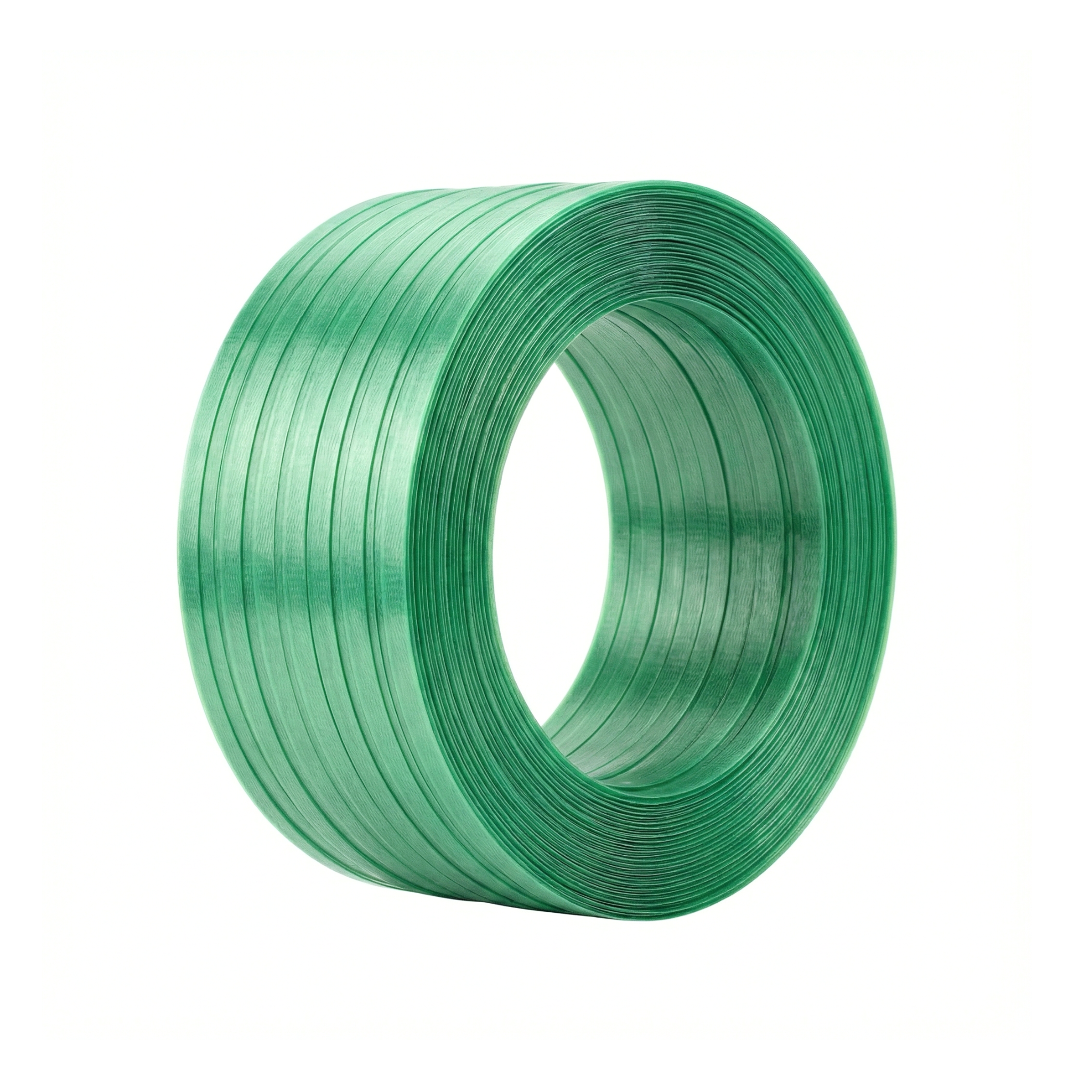
Polyester (PET) strapping comes in four standard coils: 12, 16, 19 and 25 mm wide. All share the same virgin polyester, embossed finish and cardboard core, but each width steps up in break strength —from over 210 kg to over 1100 kg— and calls for a different strapping tool. This comparison helps you choose the width that matches the weight of your load and your equipment.
🎯 Choose the variant in 10 seconds
- If your case is parcels, bundled boxes or light pallets: go to the 12 mm (> 210 kg)
- If your case is the standard warehouse and distribution pallet: go to the 16 mm (> 380 kg)
- If your case is heavy loads such as brick, block, lumber or profiles: go to the 19 mm (> 600 kg)
- If your case is very heavy loads or replacing steel strapping: go to the 25 mm (> 1100 kg)
What to consider before choosing the variant
All four coils share the same material (virgin polyester), embossed finish, green color and cardboard core. The decision comes down to the weight of your load and the tool you strap with. These are the criteria that matter most:
- Weight and break strength: each width steps up in strength: 12 mm exceeds 210 kg, 16 mm exceeds 380 kg, 19 mm exceeds 600 kg and 25 mm exceeds 1100 kg. Choose the one that comfortably covers the real weight of your pallet.
- Strapping tool: PET tensioners and manual sealers cover 13 to 20 mm; the battery-powered strapping tool, 13 to 16 mm. The 25 mm falls outside that range and needs a heavier-duty pneumatic strapping tool.
- Yield per coil: at equal coil weight (18.5 kg net), the narrower the strapping, the more meters it yields: 2300 m in 12 mm versus 500 m in 25 mm. In high-turnover operations, the narrower width reduces coil changes.
- Strap sealing: it can be closed with a metal seal (PET strapping seal) or with a strapping tool that friction-welds without a seal. Use the seal width that matches your coil.
- Sharp corners and edges: on loads with edges (block, profile, lumber), reinforce with a plastic edge protector under the strapping so the tension does not bite into the edge.
12 mm × 2300 m variant: the light width for parcels and light pallets
- 2300 m per coil: the highest yield in the range
- Break strength above 210 kg
- More retained tension than equivalent PP strapping
- Compatible with manual tensioner and battery-powered strapping tool
- Not suitable for heavy loads with sharp edges
- Less clamping surface than the wider widths
The 12 mm is the entry step into PET: when PP strapping falls short on retention but the load is not yet heavy. It yields 2300 m per coil —the most in the range— and exceeds 210 kg of break strength, ideal for bundling boxes, closing parcels and securing light pallets with the retained tension that characterizes polyester.
16 mm × 1080 m variant: the workhorse for the standard pallet
- Break strength above 380 kg
- The most versatile width in the range
- Covered by every manual and battery tool
- Optimal balance between yield and strength
- For truly heavy loads it is better to step up to 19 mm
- 1080 m per coil
The 16 mm is the most versatile reference and the recommended starting point for most standard palletizing operations. It exceeds 380 kg of break strength and is covered by all your PET tools, both manual and battery-powered. It is the width that best balances strength and meters per coil for distribution warehouses and courier operations.
19 mm × 740 m variant: the heavy width for construction and export
- Break strength above 600 kg
- Wide band that distributes tension on dense loads
- Replaces steel strapping on many heavy loads
- Compatible with manual tensioner and sealer (13–20 mm)
- The battery-powered strapping tool (13–16 mm) does not cover it
- 740 m per coil
The 19 mm makes the jump to heavy loads: brick, block, solid lumber, metal profiles and export with rough handling. With over 600 kg of break strength and a wide band that distributes tension better, it replaces steel strapping on most dense loads without its risks. It is applied with a manual tensioner and sealer; pair it with a dispenser cart to reduce operator effort.
25 mm × 500 m variant: the extra-heavy option to replace steel strapping
- Break strength above 1100 kg: the top of the range
- Maximum retention on critical loads
- Safe alternative to steel: no rust or sharp edges
- Requires a pneumatic strapping tool (manual tools reach 20 mm)
- 500 m per coil: the lowest yield in the range
The 25 mm is the maximum-strength reference, designed for very heavy industrial loads where only steel used to qualify: metal coils, large bales and extremely dense goods. It exceeds 1100 kg of break strength. Keep in mind that applying it requires a heavier-duty pneumatic strapping tool, since manual tensioners go up to 20 mm.
Variant comparison table
All four coils share the same material, finish and core. The key differences lie in width, thickness, break strength and meters per coil.
| Feature | 12 mm 2300 m |
16 mm 1080 m |
19 mm 740 m |
25 mm 500 m |
|---|---|---|---|---|
| Ideal use | Parcels | Standard pallet | Heavy loads | Industrial loads |
| SKU | PET-1206 | PET-1608 | PET-1910 | PET-2512 |
| Width | 12 mm | 16 mm | 19 mm | 25 mm |
| Thickness | 0.6 mm | 0.8 mm | 1.0 mm | 1.2 mm |
| Break strength | > 210 kg | > 380 kg | > 600 kg | > 1100 kg |
| Length per coil | 2300 m | 1080 m | 740 m | 500 m |
| Core (mandrel) | Cardboard 406 × 152 mm | Cardboard 406 × 152 mm | Cardboard 406 × 152 mm | Cardboard 406 × 152 mm |
| Net coil weight | 18.5 kg | 18.5 kg | 18.5 kg | 18.5 kg |
| Finish and color | Embossed, green | Embossed, green | Embossed, green | Embossed, green |
| Tool | Manual + battery | Manual + battery | Manual (13–20 mm) | Pneumatic |
Use case → recommended variant matrix
| If your case is… | Recommended variant |
|---|---|
| Bundling boxes, parcels or light pallets | → 12 mm |
| Standard warehouse or distribution pallet | → 16 mm |
| Brick, block, lumber or heavy export | → 19 mm |
| Very heavy industrial loads or replacing steel | → 25 mm |
| Not sure and want a single versatile width | → 16 mm (most versatile) |
Your PET manual tensioner and sealer cover 13–20 mm, so with a single tool you can strap 16 and 19 mm without changing anything. For 12–16 mm, the battery-powered strapping tool gives you the fastest seal-free closure. Reserve the 25 mm only for loads that truly demand it: it requires a pneumatic strapping tool and yields fewer meters per coil.
Do not choose the width out of steel-strapping habit. A 19 mm PET exceeds 600 kg of break strength and more than replaces many thin steel straps, without rusting or leaving sharp edges. Moving up to 25 mm without needing it forces you to buy a pneumatic strapping tool and drops your yield to 500 m per coil. Choose based on the real weight of your load.
Frequently asked questions
Does PET strapping replace steel strapping?
For most loads, yes. PET in 19 and 25 mm reaches break strengths from 600 to over 1100 kg, with a key advantage over steel: its elastic memory keeps the tension despite transport vibration, without rusting the goods or leaving sharp edges. For extremely rigid loads steel keeps its place, but for heavy palletizing, construction and export, PET is the modern standard.
What tool do I need for each width?
PET manual tensioners and sealers cover 13 to 20 mm, so they work for 12, 16 and 19 mm. The battery-powered strapping tool works from 13 to 16 mm and closes by friction weld with no seal. The 25 mm sits above manual tools and requires a pneumatic strapping tool. Confirm the width your equipment accepts before ordering the coil.
Why does a 12 mm coil hold more meters than a 25 mm one?
Because they all weigh the same: 18.5 kg net of polyester. At equal weight, the narrower and thinner the strapping, the more length fits on the coil: 2300 m in 12 mm versus 500 m in 25 mm. That is why the narrow width yields more meters per coil, while the thick width, though it yields less, secures much more load.