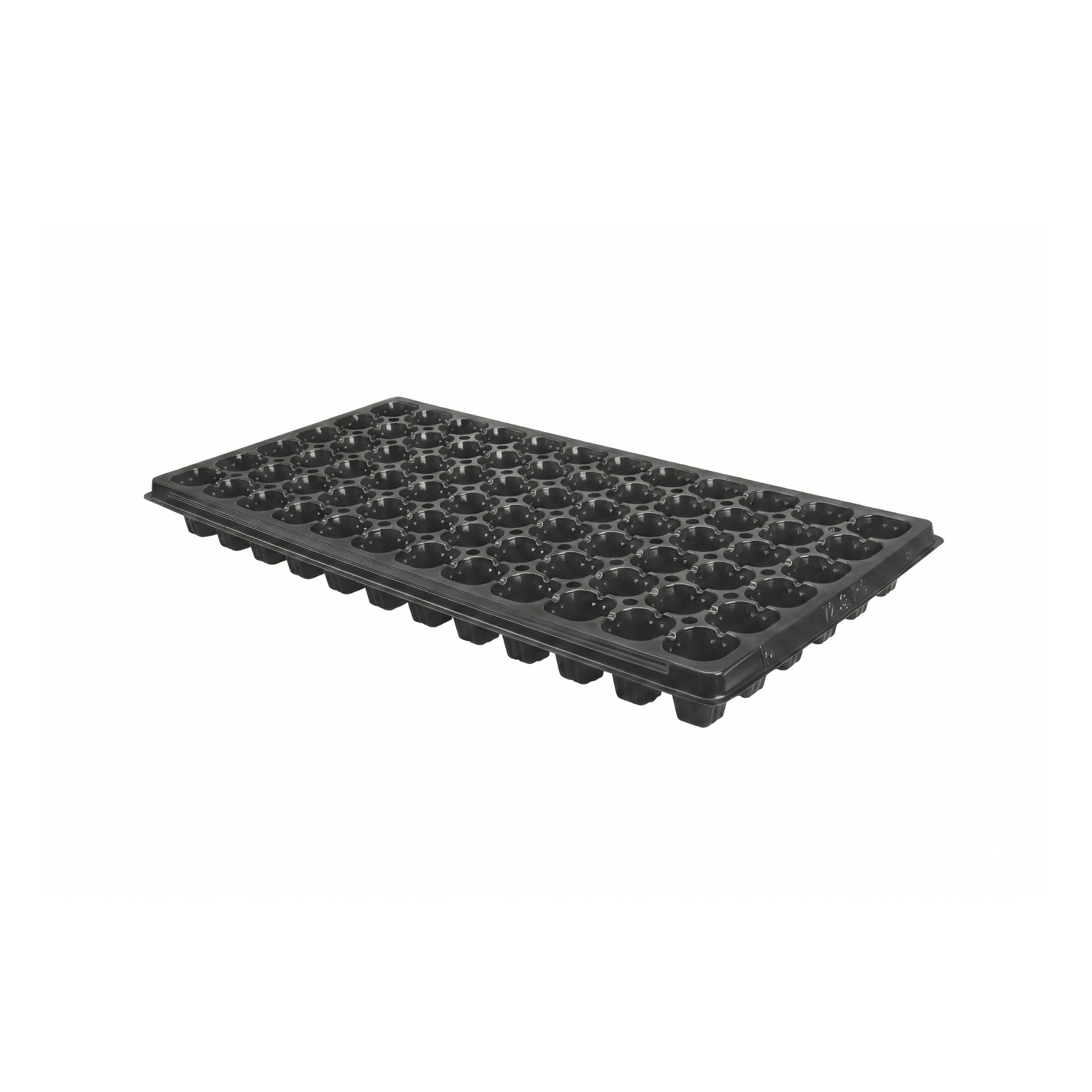
The horticultural and ornamental tray is offered in four formats depending on the number of cells: 72, 128, 200, and 288. All measure the same in plan (54 × 28 cm) and share the same material (black plastic resin), but differ in the size and volume of each cell. More cells per tray means higher seedling density, but less substrate and volume per plant. The choice depends on the seed size, the crop's root system, and the number of days the seedling remains in the tray before transplanting to a pot or field.

Germination Trays

Explore our full range of solutions.

Explore Products

🎯 Choose your variant in 10 seconds

  • If you're dealing with large seeds or robust seedlings (tomato, pepper, watermelon): go for the 72-cell tray
  • If you're dealing with standard vegetables (lettuce, broccoli, cauliflower): go for the 128-cell tray
  • If you're dealing with small vegetables or a commercial nursery (onion, parsley): go for the 200-cell tray
  • If you're dealing with ornamentals or flowers at maximum density (pansy, petunia): go for the 288-cell tray

What to consider before choosing a variant

All four variants share the same tray dimensions (54 × 28 cm), material (plastic resin), and color (black). The difference lies in the size of the cells, their volume, and therefore, the appropriate crop. Here are the criteria for making the right choice:

  • Seed size and initial vigor: Large seeds (tomato, pepper, watermelon, melon, zucchini) need large cells with enough substrate to emerge and develop their first leaves. Small seeds (parsley, onion, ornamentals) work well with small cells.
  • Time in the tray: Seedlings that remain in the tray for 30–40 days need more substrate (larger cells). Fast-growing seedlings (15–25 days) work in small cells. If the recommended time is exceeded, seedlings compete for water and nutrients and develop stress.
  • Crop root system: A taproot or dense root system (tomato, pepper) prefers deep, larger volume cells. A shallow, fibrous root system (lettuce, grass) tolerates smaller cells.
  • Production density per tray: 72 cells yield 72 seedlings/tray; 288 yield 288 seedlings/tray. The difference translates to greenhouse space usage, labor for sowing, and transportation logistics.
  • Volume per cell as a quick guide: 44 cc (72 cells) for large seeds and robust seedlings; 20 cc (128 cells) for standard vegetables; 12 cc (200 cells) for small vegetables or dense commercial nurseries; 8 cc (288 cells) for ornamentals or when the seedling is quickly transplanted. Less volume means more frequent watering.

72-cell tray: the large one for tomato, pepper, and robust seedlings

IDEAL FOR Tomato, pepper, watermelon, melon, zucchini, and robust seedlings
✓ Pros
  • Volume per cell: 44 cc
  • Large and robust root ball upon transplant
  • Suitable for up to 30–40 days in the tray
  • Ideal for large seeds
✕ Cons to consider
  • Only 72 seedlings per tray
  • Higher substrate usage per seedling
  • Less efficient in greenhouse space

The 72-cell tray is the standard choice for producing robust vegetable seedlings: tomato, pepper, eggplant, watermelon, melon, zucchini, and, in general, large seeds that need volume to germinate and develop their first leaves. Its 3.9 × 3.9 cm cells at the top and 44 cc volume produce seedlings with a large, well-formed root ball, ready for transplanting to the field or a larger pot. It is the preferred option in commercial nurseries when seedlings need to remain in the tray for 30–40 days until transplanting.

128-cell tray: the standard for lettuce, broccoli, and medium-sized vegetables

IDEAL FOR Lettuce, broccoli, cauliflower, cabbage, and medium-sized vegetables
✓ Pros
  • Volume per cell: 20 cc
  • Balance between density and vigor
  • 128 seedlings per tray
  • Suitable for 20–30 days in the tray
✕ Cons to consider
  • Insufficient for tomato or pepper
  • Not suitable for very large seeds

The 128-cell tray is the most versatile option for medium-sized vegetables: lettuce, broccoli, cauliflower, cabbage, spinach, chard, kale, and similar. Its 3 × 3 cm cells and 20 cc produce compact seedlings with enough root volume to withstand transplanting without significant stress. It is the standard choice in leafy vegetable horticulture, where the combination of reasonable density (128 seedlings per tray) and adequate vigor optimizes greenhouse usage.

200-cell tray: the dense option for commercial nurseries and small vegetables

IDEAL FOR Onion, parsley, celery, aromatic herbs, and commercial nurseries
✓ Pros
  • Volume per cell: 12 cc
  • 200 seedlings per tray
  • Optimizes greenhouse space
  • Suitable for small seeds
✕ Cons to consider
  • More frequent watering than large cells
  • Seedling must be transplanted before 25 days
  • Box of 140 trays (not 160)

The 200-cell tray is the commercial nursery's choice when the crop allows it and the goal is to optimize greenhouse space to the maximum. Its 2.4 × 2.4 cm cells and 12 cc are suitable for small vegetables such as onion, garlic, parsley, celery, aromatic herbs (basil, cilantro, oregano), and, in general, crops with a shallow fibrous root system. The packaging in boxes of 140 trays (instead of 160) reflects the slight adjustment to facilitate logistics with this density.

288-cell tray: maximum density for ornamentals and flowers

IDEAL FOR Pansy, petunia, lobularia, alyssum, and ornamentals at maximum density
✓ Pros
  • Volume per cell: 8 cc
  • 288 seedlings per tray
  • Maximum space efficiency
  • Ideal for delicate ornamentals
✕ Cons to consider
  • Very frequent or automatic watering needed
  • Seedling must be transplanted in 15–20 days
  • Not suitable for standard vegetables

The 288-cell tray is the choice for ornamental nurseries when working with garden flowers and bedding plants: pansy, petunia, lobularia, alyssum, begonia, ageratum, salvia, and similar. Its 2.1 × 2.1 cm cells and 8 cc produce compact seedlings for quick transplanting to small pots or planters. The maximum density per tray (288 seedlings) optimizes greenhouse utilization but requires frequent watering or an automatic system, and transplanting within a short period (15–20 days) before plants compete excessively for water and light.

Comparative table of variants

All four variants share the same material, color, and tray dimensions (54 × 28 cm). The difference lies in the number of cells, the size of each cell, its volume, and the box.

Feature 72 cells 128 cells 200 cells 288 cells
Ideal use Tomato and pepper Lettuce and broccoli Onion and aromatics Ornamentals and flowers
SKU 589231 623230 730212 123423
Tray dimensions 54 × 28 × 4.6 cm 54 × 28 × 4 cm 54 × 28 × 4 cm 54 × 28 × 3.4 cm
Top cell 3.9 × 3.9 cm 3 × 3 cm 2.4 × 2.4 cm 2.1 × 2.1 cm
Bottom cell 2 × 2 cm 1.4 × 1.4 cm 1 × 1 cm 0.9 × 0.9 cm
Volume per cell 44 cc 20 cc 12 cc 8 cc
Volume per tray 3.2 L 2.6 L 2.4 L 2.3 L
Trays per box 160 160 140 160
Volume per box506 L (134 gal) 416 L (110 gal) 336 L (89 gal) 368 L (97 gal)
Seedlings per box 11,520 20,480 28,000 46,080

Use case matrix → recommended variant

If your case is... Recommended variant
Tomato, chili pepper, eggplant seedlings (30–40 days) → 72 cells
Watermelon, melon, zucchini, cucumber → 72 cells
Lettuce, spinach, chard, kale → 128 cells
Broccoli, cauliflower, cabbage, collard greens → 128 cells
Onion, garlic, parsley, celery → 200 cells
Basil, cilantro, oregano, aromatic herbs → 200 cells
Pansy, petunia, lobularia, alyssum → 288 cells
Begonia, ageratum, ornamental salvia → 288 cells
💡 Expert Dodom Tip:

Combine trays of different formats depending on the crops you are producing at the same time. A typical commercial nursery keeps a mix of 72-cell trays for robust vegetables, 128-cell trays for medium vegetables, and 200-cell trays for aromatic herbs, adjusting proportions according to demand. For substrate, use a specific germination mix: coco coir pith with 20–30% fine perlite and 10–20% fine vermiculite. This combination retains moisture near the seed, provides aeration, and gradually releases nutrients.

⚠️ Common mistake to avoid:

Do not exceed the recommended time for seedlings to remain in the tray. When a seedling stays too long in its cell, the roots form a "chignon" or curl at the base of the cell, which reduces transplant vigor and can hinder final development in the field. If you anticipate a delayed transplant, move up one format (from 200 to 128, from 128 to 72) to provide more root volume and avoid this problem. Pay special attention to sensitive crops such as tomatoes and chili peppers.

What tray format do you need?

Tell us what you will be producing, how many seedlings per season, and the expected days of permanence before transplant. You will receive the exact combination of formats and the number of boxes to cover your production.

Frequently asked questions

Can the trays be reused?

Yes, plastic trays are reusable for several seasons if handled with care. After each use, wash with pressurized water to remove substrate residue and disinfect with a 1–2% hypochlorite solution or steam for 30 minutes to prevent the transmission of soil pathogens between batches. Store in a dry, covered area to avoid degradation from UV radiation. The typical lifespan with good management is 4–6 years.

How are trays filled with substrate?

For manual filling, spread the substrate over the tray, press lightly with a ruler or board to fill each cell, and scrape off the excess. For mechanical filling (commercial nursery), there are automatic fillers that dispense and compact the substrate uniformly. After filling, water lightly before sowing so that the substrate settles and the seed is at the correct depth.

What substrate works best in germination trays?

The preferred substrate is a mix based on coco coir pith (medium granulometry) with 20–30% fine perlite and, optionally, 10–20% fine vermiculite. This combination retains moisture near the seed, provides aeration, and creates a warm, stable environment for homogeneous germination. Ensure the substrate is pathogen-free and, ideally, sterilized.