

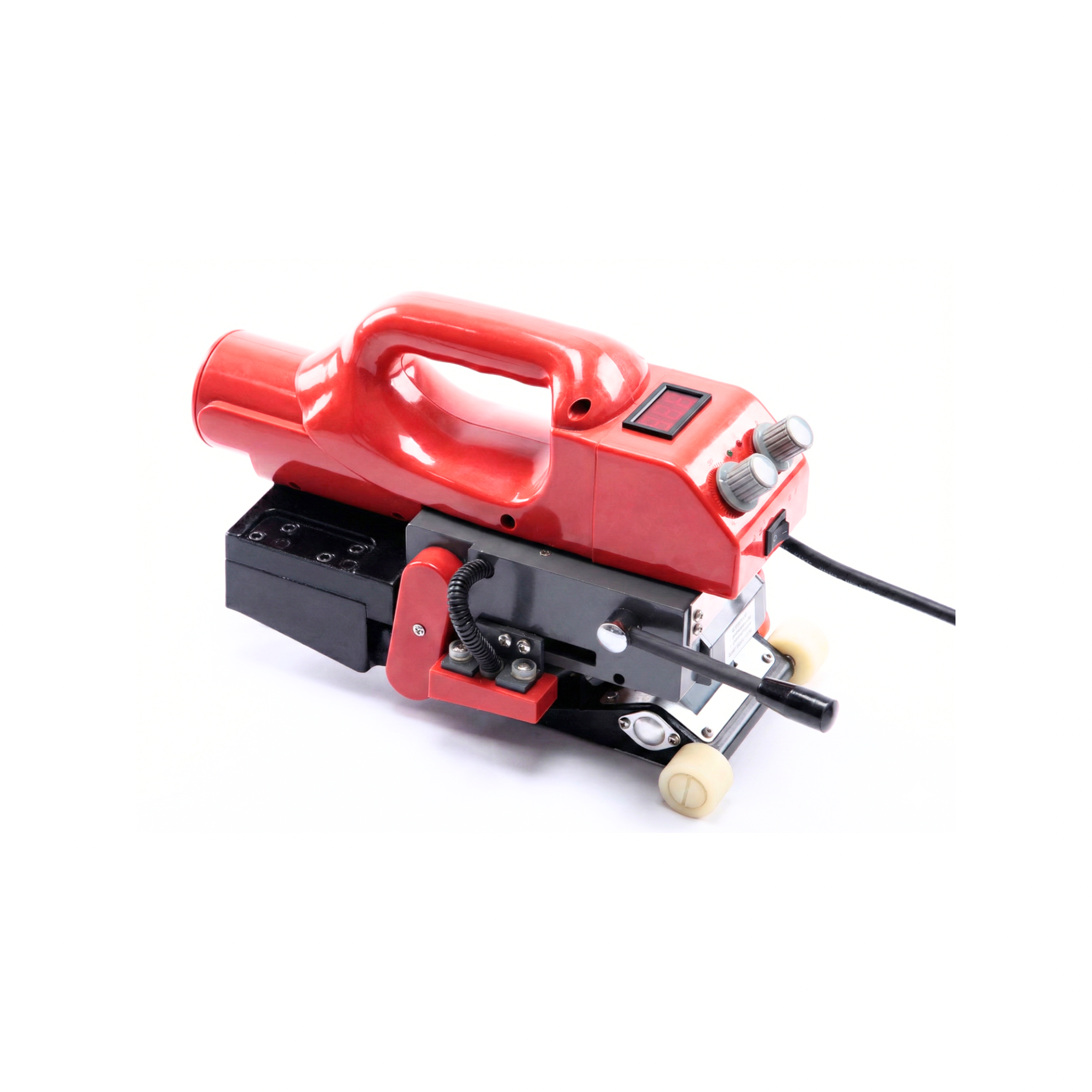
The hot wedge welding machine comes in two power ratings: 800 W and 1800 W. The difference is not only in electrical power: each model is sized to weld materials within a different thickness range. The 800 W works with thin films and geomembranes (0.2 to 1.0 mm) and produces a 12.5 mm wide seam. The 1800 W works with thick materials (0.8 to 4.0 mm) and produces an 18 mm wide seam. Both share heating temperature (0-450 °C), welding speed (0.5-5 m/min) and seam strength (≥85% of the base material). The choice comes down to the thickness of the material you are going to weld and the scale of your project.
🎯 Choose the variant in 10 seconds
What to consider before choosing the variant
The two machines share heating temperature, welding speed, overlap width and seam strength. They differ in power, allowable material thickness, inner cavity width, width of the seam produced, dimensions and weight. These are the criteria for choosing well:
- Thickness of the material to be welded: the decisive factor. The 800 W covers 0.2-1.0 mm: thin greenhouse films, tarpaulins, lightweight geomembranes (0.5 mm), liners for small pools. The 1800 W covers 0.8-4.0 mm: industrial-grade HDPE geomembrane (0.75-2.0 mm), landfill waterproofing sheets, large-capacity reservoirs. There is overlap at 0.8-1.0 mm: in that range either one works.
- Scale of the project: small or medium projects with thin material → 800 W (lighter, portable, easy to handle). Industrial or large-scale projects with thick material → 1800 W (more robust, wider and stronger seam, greater durability under intensive use).
- Width of the seam produced: 12.5 mm × 2 (800 W) vs 18 mm × 2 (1800 W). A wider seam provides more bonding surface and greater mechanical strength against tension and vibration. For geomembranes in critical waterproofing (landfills, industrial ponds), the wide seam of the 1800 W is preferable.
- Inner cavity: 12 mm (800 W) vs 16 mm (1800 W). It determines the maximum sheet thickness that passes between the rollers. If you work with geomembrane of 1.5 mm or more, you need the 1800 W.
- Voltage and frequency: both run at 220-230 V (standard Dominican and industrial mains). The 1800 W specifies 50/60 Hz. Check your project's mains supply and, if you work with a generator on site, size it appropriately: the 1800 W requires a generator of at least 2.5 kW running steady.
- Class II insulation: the 800 W is rated Class II (double insulation, no earthing required). For use on wet sites or on conductive surfaces, this detail is relevant to operator safety.
800 W variant: the portable one for thin materials
- Light and portable (5 kg)
- Compact: 40 × 25 × 28 cm
- Class II insulation
- Standard 220-230 V voltage
- Thickness 0.2-1.0 mm
- Narrower seam: 12.5 mm × 2
- Do not weld geomembrane ≥1.0 mm
- Inner cavity 12 mm
The 800 W machine is the choice for contractors and professionals working with thin films and lightweight geomembranes. Its 5 kg weight and compact dimensions (40 × 25 × 28 cm) allow it to be carried to the site by hand or in a small vehicle, and its Class II insulation provides safety when working outdoors or in wet areas. It is the standard option for waterproofing small residential or commercial roofs, welding tarpaulins, installing greenhouse films, liners for small pools or ponds, and similar work with material less than 1 mm thick.
1800 W variant: the robust one for industrial geomembrane
- Thickness 0.8-4.0 mm
- Wider seam: 18 mm × 2
- Inner cavity 16 mm
- Suitable for intensive site use
- Universal 50/60 Hz frequency
- Heavier: 13 kg net
- Higher power consumption
- Oversized for thin films
- Requires a larger generator on sites without mains
The 1800 W machine is the choice for professional welding of HDPE geomembrane on industrial sites: landfills, retention ponds, large-capacity reservoirs, tunnel waterproofing, industrial agricultural reservoirs, waste landfills. Its allowable thickness range (up to 4.0 mm) covers the thickest geomembranes on the market, and the wide 18 mm seam provides mechanical strength superior to the 800 W, which is critical in applications where joint integrity is fundamental to the waterproofing function. Its more robust structure and greater weight (13 kg net) make it suitable for intensive and prolonged use on industrial sites.
Variant comparison table
The two variants share heating temperature, welding speed, base voltage and seam strength. They differ in power, allowable thickness, seam width, inner cavity, dimensions and weight.
| Feature | 800 W | 1800 W |
|---|---|---|
| Ideal use | Thin films | Industrial geomembrane |
| SKU | 983422 | 232412 |
| Power | 800 W | 1800 W |
| Voltage | 220-230 V | 220 V |
| Frequency | — | 50/60 Hz |
| Material thickness | 0.2-1.0 mm | 0.8-4.0 mm |
| Welding speed | 0.5-5 m/min | 0.5-5 m/min |
| Temperature | 0-450 °C | 0-450 °C |
| Seam width | 12.5 mm × 2 | 18 mm × 2 |
| Inner cavity | 12 mm | 16 mm |
| Overlap width | 10 cm (3.94 in) | 100 mm (3.94 in) |
| Seam strength | ≥ 85% base material | ≥ 85% base material |
| Dimensions | 40 × 25 × 28 cm | 46 × 32 × 45 cm |
| Weight | 5 kg / 10 kg | 13 kg net / 20 kg gross |
| Insulation | Class II | — |
Use case → recommended variant matrix
| If your case is… | Recommended variant |
|---|---|
| Welding greenhouse film | → 800 W |
| Welding tarpaulins or plastic for construction | → 800 W |
| Liner for pool, small pond or hot tub | → 800 W |
| 0.5 mm HDPE geomembrane for light waterproofing | → 800 W |
| 1.0-2.0 mm HDPE geomembrane for landfill or pond | → 1800 W |
| Industrial agricultural reservoir or water tank | → 1800 W |
| Tunnel or underground works waterproofing | → 1800 W |
| Intensive professional use with thick material | → 1800 W |
Before starting to weld each batch, run a seam test on a coupon of the same material to calibrate temperature and speed according to ambient conditions. The hot wedge works best with clean, dry material at moderate ambient temperature. Evaluate the seam with the manual peel test and, on critical sites (landfills, ponds), with an air pressure or vacuum test. If you work on a site without mains supply, size the generator appropriately: 1.5 kW steady for the 800 W and 2.5-3 kW steady for the 1800 W (startup peak may be higher). Keep the wedge and rollers clean at the end of each working day to avoid build-up that ruins later seams.
Do not use the 800 W machine to weld geomembrane thicker than 1.0 mm. The inner cavity (12 mm) and the power (800 W) are not sufficient to reach the uniform heat needed in thick sheets, which produces cold seams with strength below the rated value. The joint may look correct to the eye but fail under stress or over time, with serious consequences in critical waterproofing applications (landfills, industrial ponds). Always check the material thickness before choosing a machine and, when in doubt, opt for the 1800 W.
Frequently asked questions
What materials can it weld?
This machine welds thermoplastic materials by hot wedge fusion: HDPE geomembrane, LDPE geomembrane, polyethylene (PE) film, polypropylene (PP) and other compatible thermoplastics within its temperature range (up to 450 °C). It is not suitable for materials such as rigid PVC (which requires another process) or for non-thermoplastic materials (vulcanized rubber, tarpaulins with synthetic textile netting). Check compatibility with the technical data sheet of the specific material before welding.
What does a dual-track seam (12.5 mm × 2 or 18 mm × 2) mean?
The hot wedge produces two parallel welding lines separated by an air channel. This allows a pressure test by introducing air into the central channel after welding: if the pressure holds for a set period, the seam is sealed. It is the standard quality control method on critical waterproofing sites (landfills, industrial ponds). Each track is 12.5 mm (800 W) or 18 mm (1800 W) wide, which gives the total effective welding width.
Does it require specific maintenance?
Yes. After each working day, clean the wedge and rollers with a non-abrasive bristle brush to remove residues of melted material. Periodically grease the roller shafts with grease suitable for high temperature. Check the power cable for damaged insulation before each use. Consult the manufacturer's manual for the inspection intervals of the thermostat and the drive system. Geomembrane welding machines are professional equipment that deliver a long service life with regular maintenance but can fail prematurely without it.
