
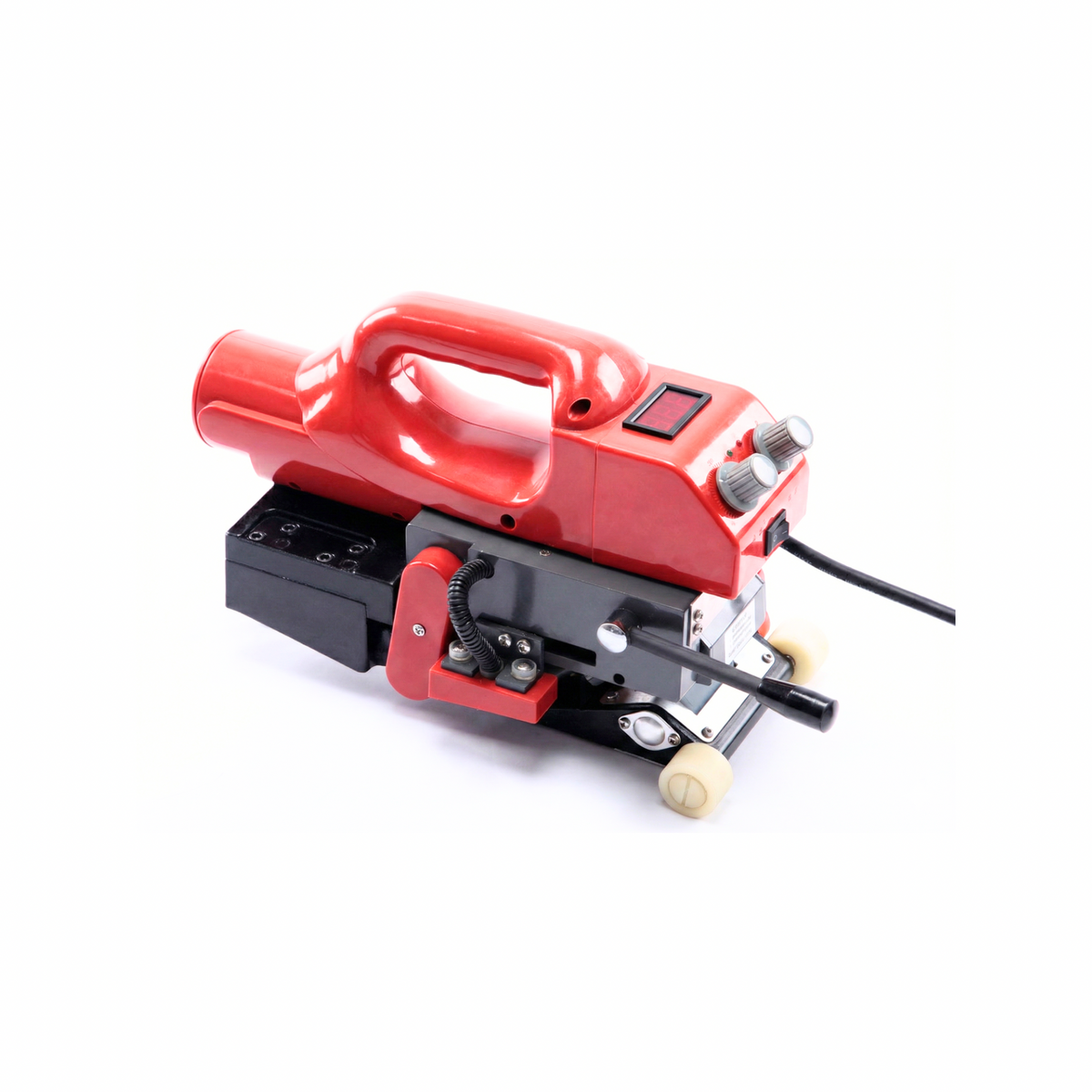
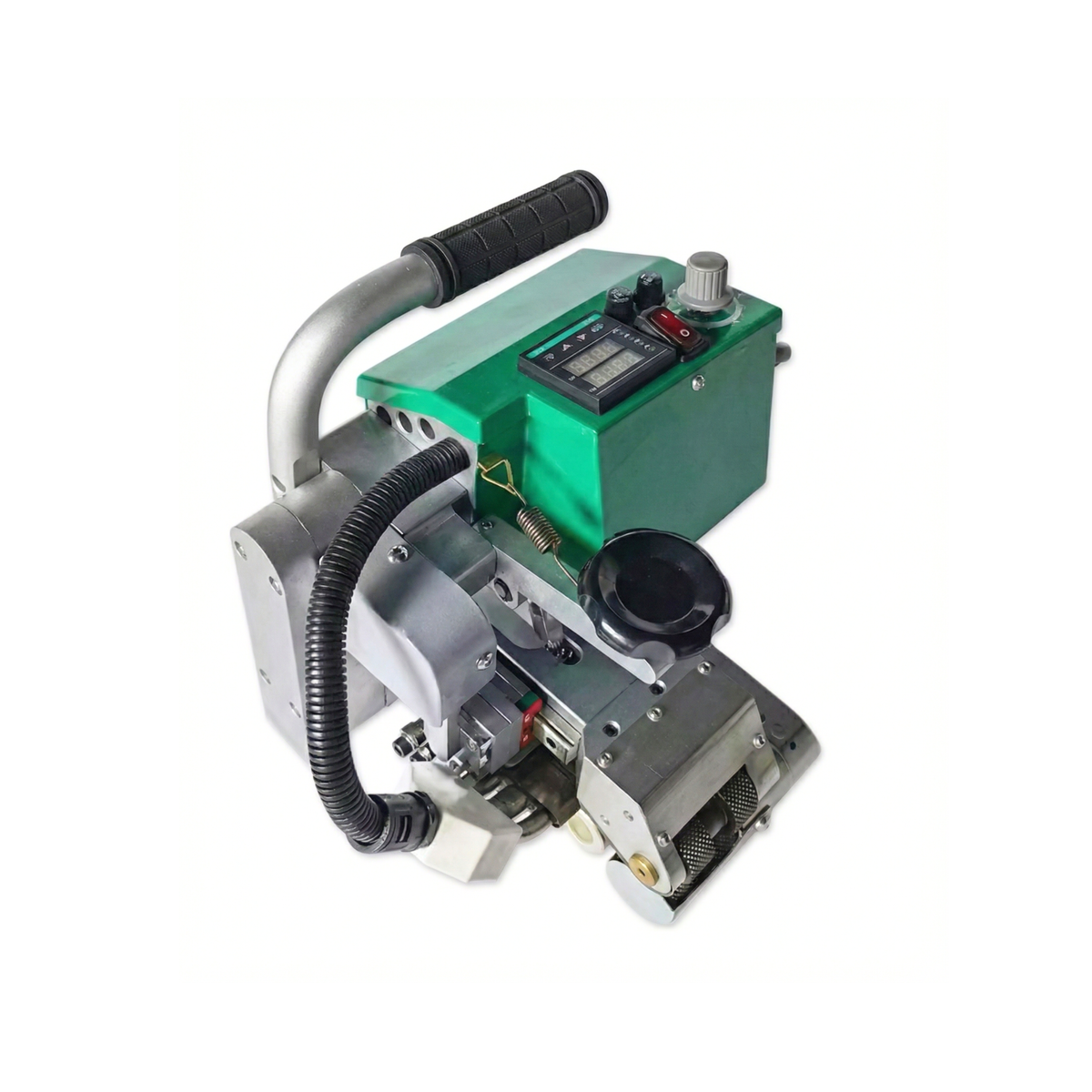
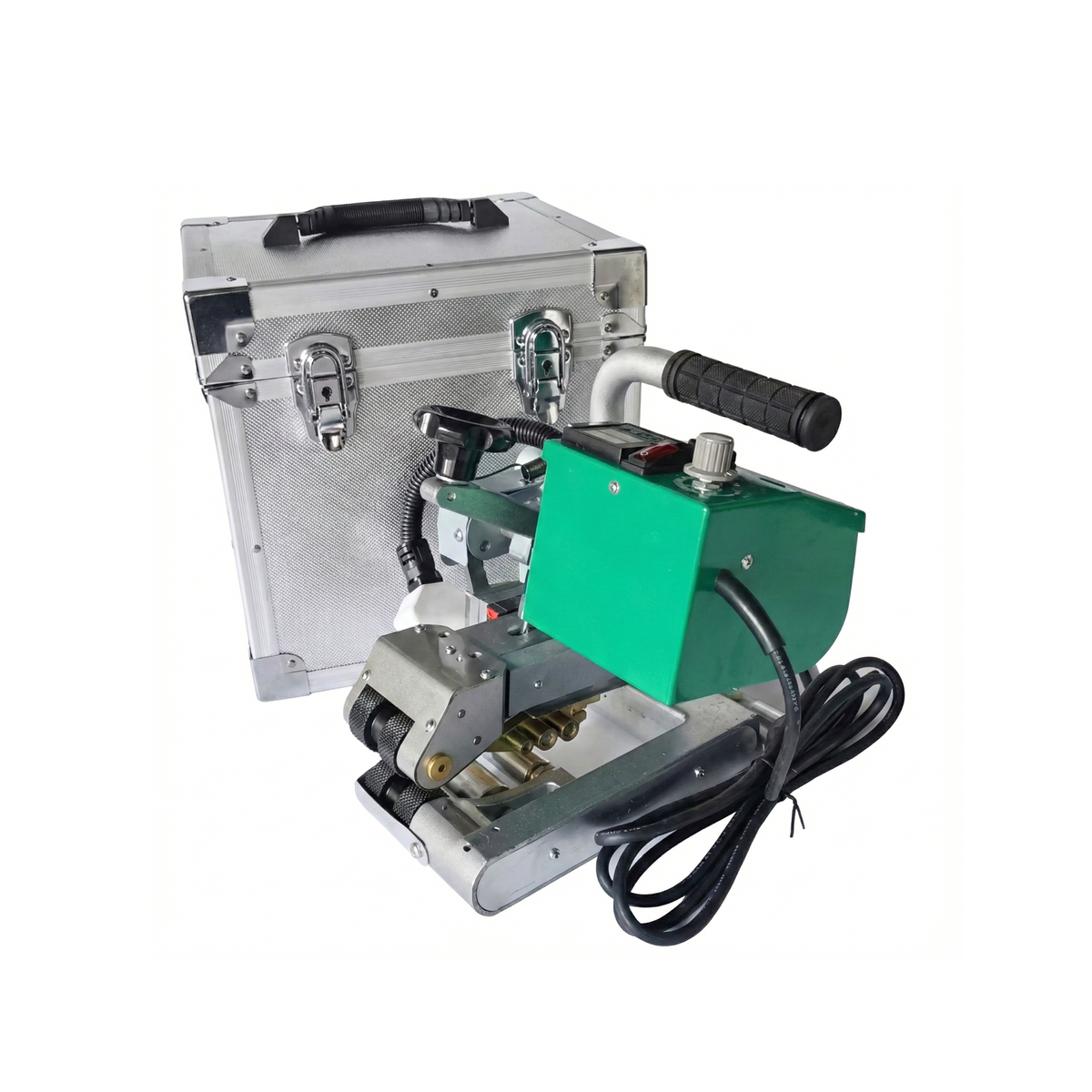
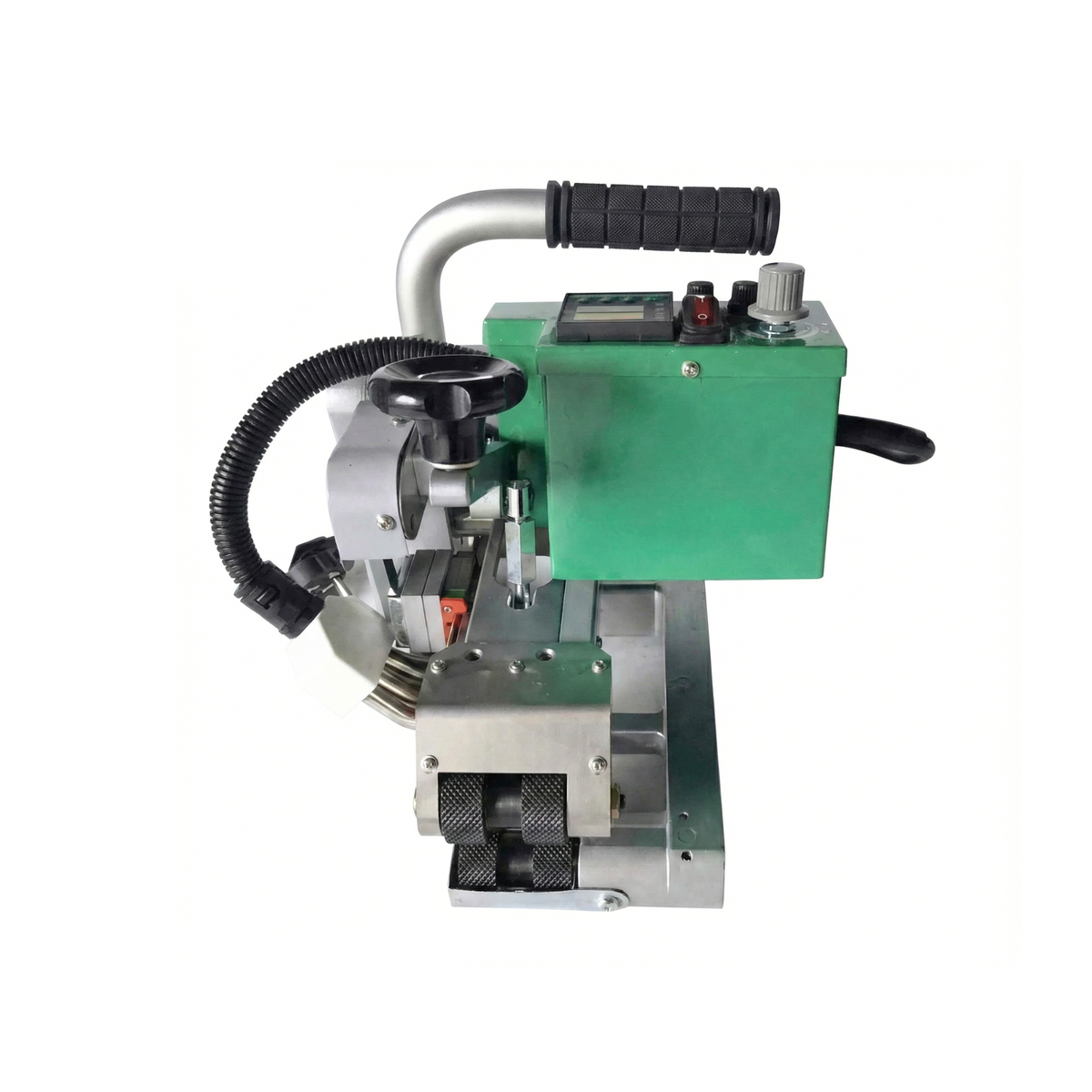
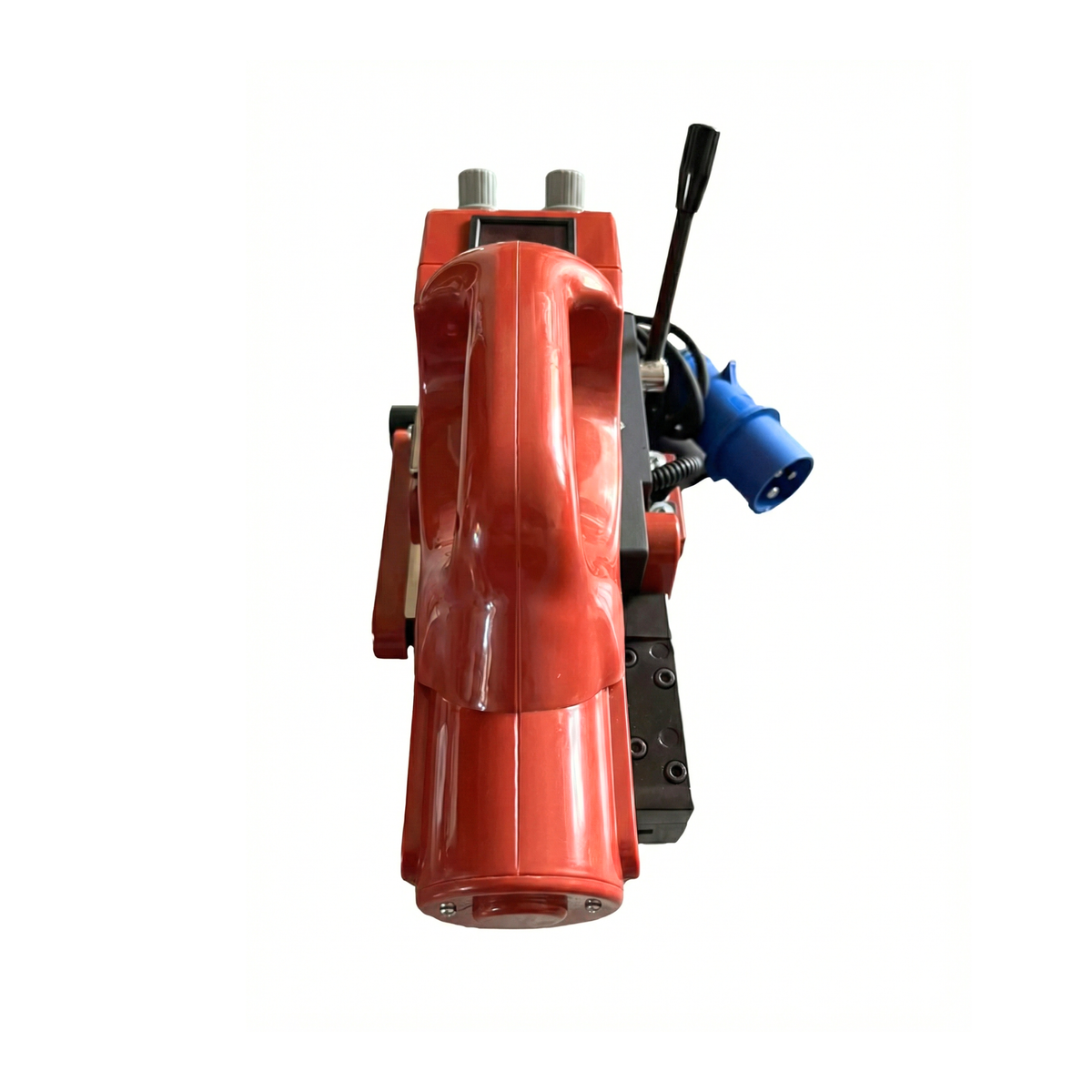
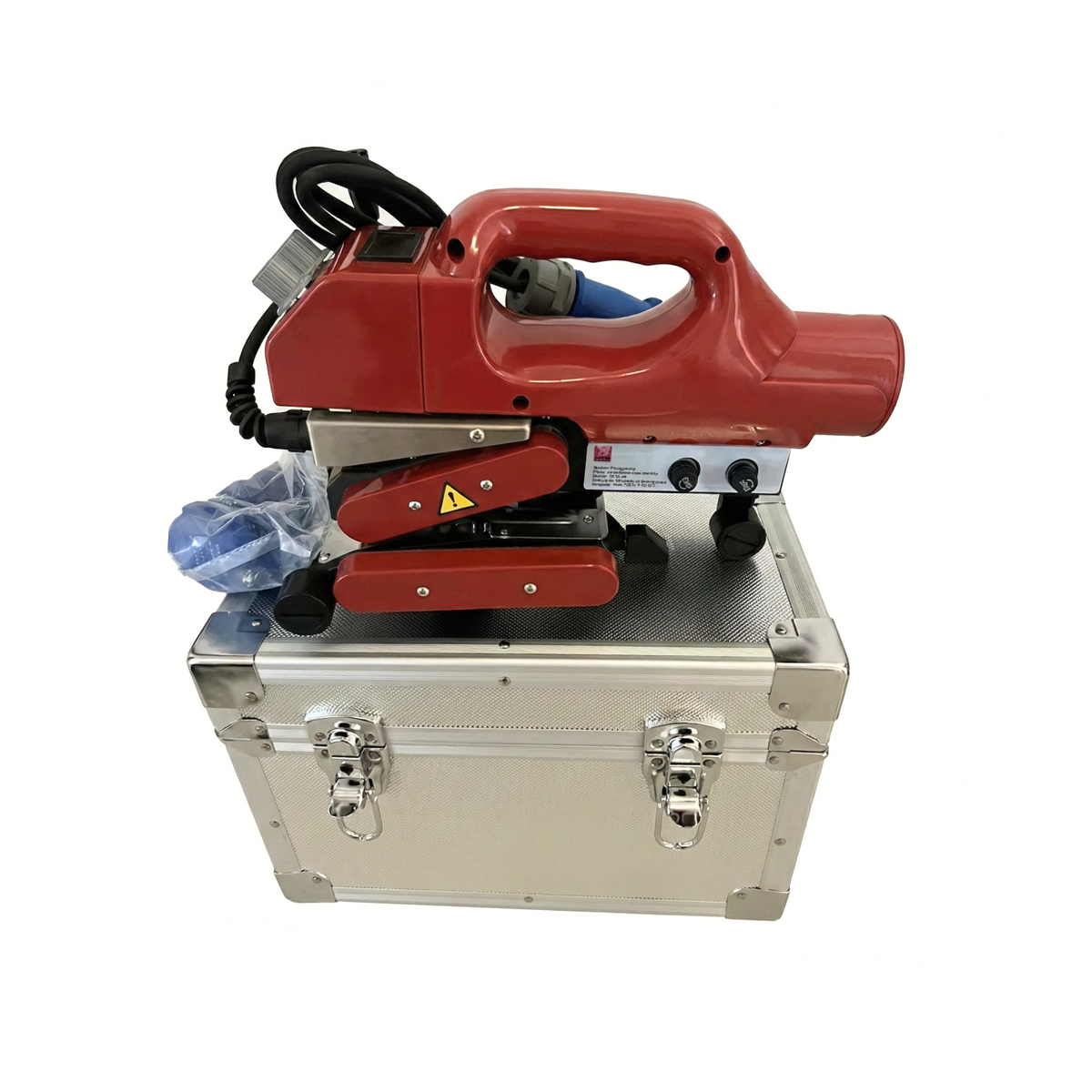


Welding HDPE or LLDPE geomembranes in large-scale waterproofing projects where the watertight integrity of every meter of seam is audited with pressure testing and required by contractual specification, without resorting to manual sealing with a hot air gun that wastes days on large plots, requires a hot wedge welder with motorized traction, calibrated thermal control, and an air channel for subsequent testing. This hot wedge welding machine—also known as a hot wedge welder, double seam welder, or traction heat fuser—is manufactured by KORWINS in two power ratings (800 W and 1800 W), designed for geosynthetic contractors, professional waterproofers, and hydraulic projects with watertightness auditing.
Key Benefits
- Double seam with air channel for auditing: the wedge melts two parallel lines, leaving a central channel that is subsequently pressurized with a needle manometer to verify the watertightness of the entire seam, a condition audited in professional hydraulic projects and contracts with mining companies or environmental authorities.
- Motorized constant advance traction: the roller system pulls the machine over the geomembrane at a uniform calibrated speed, ensuring homogeneous thermal exposure and eliminating human speed variability, a condition for consistent quality welding.
- Digital or analog thermal control: calibrated system to maintain wedge temperature within the melting range of the specific material (HDPE 2-2.5 mm requires a different range than thin LLDPE), a critical condition for joints with mechanical resistance of the original sheet.
- Robust construction for field work: resistant alloy casing against dust, ambient humidity, and rough handling in quarries or landfills, sized for years of continuous intensive use.
- Two power ratings for project scale: 800 W for welding light geomembrane (1-1.5 mm in agricultural applications and small reservoirs) and 1800 W for heavy structural HDPE (2-2.5 mm in dams, landfills, and mining).
Typical Applications and Uses
- Installation of geomembrane in dams, agricultural reservoirs, artificial lakes, and large-scale water storage.
- Sealing of sanitary landfills and landfill cells with environmental auditing.
- Waterproofing of tunnels, wet foundations, and underground hydraulic retention works.
- Covering green roofs, landscaping, and industrial pools with large-format membrane.
Quality and Durability
An economical wedge welder fails in two areas: the wedge temperature is not stable during advancement (which produces areas with insufficient melting that fail the pressure test) and the motorized traction system gives out after a few months of use (which forces the operator back to manual advancement with inconsistent quality). KORWINS works with calibrated thermal control and robust motorized traction, which separates an auditable project hot wedge welder from a generic machine that produces dubious seams.
Equivalences
Equivalent to these other-brand references:
- 800 W
- WELDY miniwelder geo2RBK Builds Geomembrane Welding Machines – hot wedge (RD family)
- 1800 W
- Lesite LST900RBK Builds Geomembrane Welding Machines – hot wedge (RD family)
Brands and references mentioned belong to their respective owners; cited only for comparison and compatibility.
What types of projects make this machine essential compared to manual welding?
What conditions must the material meet for a sound weld?
How does performance differ between the 800 W and 1800 W models?
Still have questions?
Ask us and we will gladly help you with whatever you need.
| Dimensions and format | |
|---|---|
| Weight | 5 kg / 10 kg (11.02 lb / 22.05 lb) |
| Overlap width | 10 cm (3.94 in) |
| Weld width | 12.5 mm x 2 (0.49 in x 2) |
| Inner cavity | 12 mm (0.47 in) |
| Product dimensions | 40 x 25 x 28 cm (15.75 x 9.84 x 11.02 in) |
| Strength and performance | |
| Seam strength | ≥85% of base material |
| Electrical system and motor | |
| Voltage | 220V-230V |
| Power | 800W |
| Insulation class | Class II |
| Heating temperature | 0-450°C (32-842°F) |
| Welding speed | 0.5-5 m/min (1.64-16.4 ft/min) |
| Compatibility and use | |
| Material thickness to weld | 0.2 mm-1.0 mm (0.008 in-0.039 in) |
| Machine: Width | 40.0 cm (15.75 in) |
|---|---|
| Machine: Height | 25.0 cm (9.84 in) |
| Machine: Depth | 28.0 cm (11.02 in) |
| Machine: Weight | 5.0 kg |
Official KORWINS warranty
What's covered
Confirmed defect: replacement or refund of the amount paid.
What's not covered
Payment & Security

