

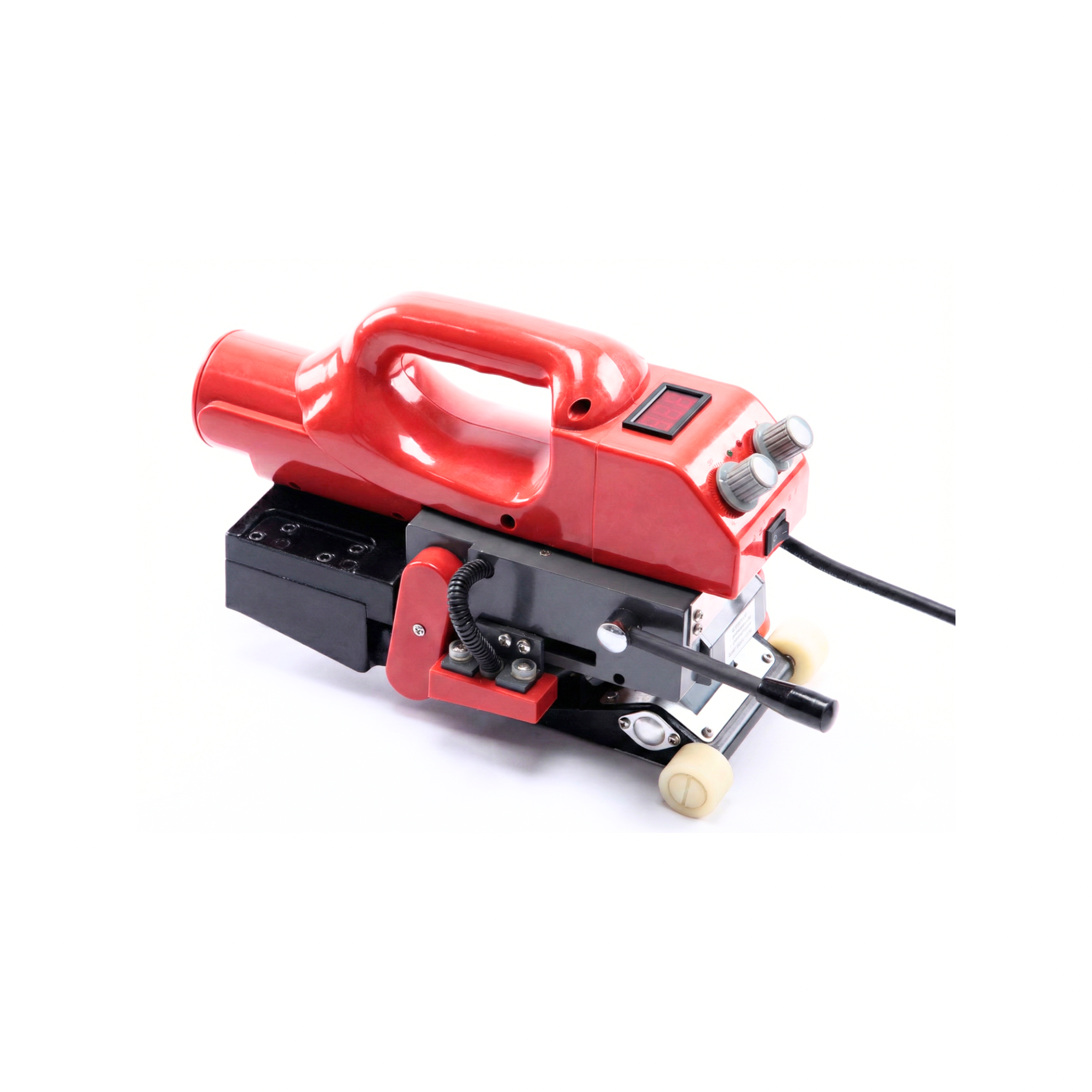
This guide covers operating the hot wedge welding machine: sheet overlap and alignment, heating with speed adjustment, test strip with destructive testing, starting the on-site weld and air channel pressure test. Follow these steps to produce the main on-site geomembrane weld with a dual track and air channel for subsequent verification.
Product specifications
The hot wedge advances automatically over the overlap between two sheets. A heated metal wedge in the center simultaneously melts the facing surfaces, and two motorized rollers press them together creating two parallel beads with an air channel between them. We offer two variants: 800 W for short runs and thin sheets, and 1800 W for large areas and heavy geomembranes.
| Specification | 800 W wedge | 1800 W wedge |
|---|---|---|
| SKU | 983422 | 232412 |
| Power | 800 W | 1800 W |
| Voltage | 220 V | 220 V |
| Weld type | Dual bead with channel | Dual bead with channel |
| Recommended thickness | 0.5 – 1.0 mm | 1.0 – 2.5 mm |
| Application | Small and medium sites | Large sites (ponds, landfills) |
Step-by-step guide to using it
The hot wedge is an automatic machine: once calibrated and started, it advances on its own over the overlap. Its great strength is the reproducibility of the joint. Its requirement: calibrate well at the start of the day and keep the rollers clean.
Overlap and align the sheets
Overlap the two sheets to be joined by 12 to 15 cm (5 to 6 in). Vacuum or blow the overlap area to remove dust. The hot wedge does not forgive contamination: if sand gets between the rollers, the joint is scratched and becomes unusable.
Heat the machine and adjust the speed
Connect and set the temperature: 380-420 °C (716-788 °F) for standard HDPE. Feed speed between 1.5 and 2.5 m/min (5 to 8 ft/min) depending on thickness. Wait 5 minutes for it to stabilize. The machine must reach operating temperature before you start welding the real site.
The 800 W variant works in lower ranges (350-380 °C) and lower speeds (1.0-1.5 m/min). The 1800 W variant delivers twice the power, which allows higher speed without losing temperature: 2.0-2.5 m/min with thick sheets. Always calibrate with a test strip; the published values are indicative.
Test strip and destructive testing
Weld 1 meter (3.3 ft) of test seam on offcuts of the same material. Wait for it to cool and perform a T-peel test and a shear test. Both beads must fail through the base material, not through the joint. If it peels off, raise by 10 °C or reduce speed. Note the parameters that worked on the machine or in your site notebook.
Starting the on-site weld
Position the machine at the start of the overlap, insert the wedge between the two sheets and start the feed. The machine will walk on its own following the overlap line. Accompany it, watching that the sheets enter straight, without folds. Stop the feed at any irregularity.
Air channel pressure test
Once the joint is cold (15 minutes), seal one end of the channel between the two beads and inject air through the other end at 25-30 psi (1.7-2.0 bar) with a needle pressure gauge. Hold for 5 minutes: the pressure should not drop by more than 10 %. If it drops more, there is a leak: locate it and weld it with an extruder.
The pressure test of the channel between beads is the greatest strength of the hot wedge and at the same time the step that is most neglected. Document each run with a photo of the gauge at the start and end of the test, note on the site drawing which run corresponds to which test, and file it. That traceability is what distinguishes a site accepted without reservations from one with problems at final acceptance.
Do not start welding before the machine has reached a stable operating temperature. The first 10-20 cm of welding are usually out of parameters and, if you integrate them into the site joint, the entire run may fail the pressure test. Always start with a lead-in section over sacrificial material and then splice into the real sheet.
Complementary products
The hot wedge never works alone. It needs the base material, the auxiliary machines for details and the quality control tool.
The HDPE geomembrane is the base material. The extrusion welding machine is the indispensable companion for resolving details, corners and repairs that the wedge cannot perform. The needle pressure gauge is the verification tool: without it you cannot perform the channel pressure test and you lose the main advantage of the hot wedge over any other welding technique.
Maintenance and care
The hot wedge is the most demanding machine in terms of maintenance in the welding kit:
- Daily cleaning of the wedge and rollers: at the end of each day, while still hot, wipe the metal wedge with a cotton cloth to remove molten plastic. When it cools, brush the rollers with a bronze brush.
- Roller tightening: check weekly that the pressure between rollers is calibrated. A machine with loose rollers makes a joint with lower adhesion and fails the test.
- Temperature sensors: every 100 hours of use, verify with an independent thermometer that the display reading matches the real temperature of the wedge. If they differ by more than 10 °C, call technical service.
- Battery and feed motor: lubricate every 50 hours with lithium grease. A dry motor skips speed and ruins the entire day of welding.
- Storage: store it in its original case with the wedge cold and clean. Never lying down with the wedge resting on the ground.
Frequently asked questions
What productivity can I expect?
Under normal conditions, the 1800 W variant welds between 700 and 1000 linear meters of joint per 8-hour day, including calibrations, stops and pressure testing. The 800 W variant is around 400-600 linear meters per day. Higher productivity is possible with two machines working in parallel and a crew of four operators.
Why does my weld fail the pressure test?
The usual causes are: overlap contamination (dust, moisture), insufficient temperature (the wedge does not melt the sheet well), excessive speed (no time to melt), wrinkles in the sheet before entering the rollers. Before thinking of a material defect, repeat the test with the joint clean and the machine recalibrated.
What do I do if I discover a leak in a joint welded days ago?
Locate the exact leak point (narrowing down the channel with movable plugs until you detect the area losing pressure). Mark it with a permanent marker and repair with an extruder: clean, grind and weld a bead over the defective joint. After cooling, test under pressure again. The extruder is always ready to correct what the wedge leaves imperfect.
