

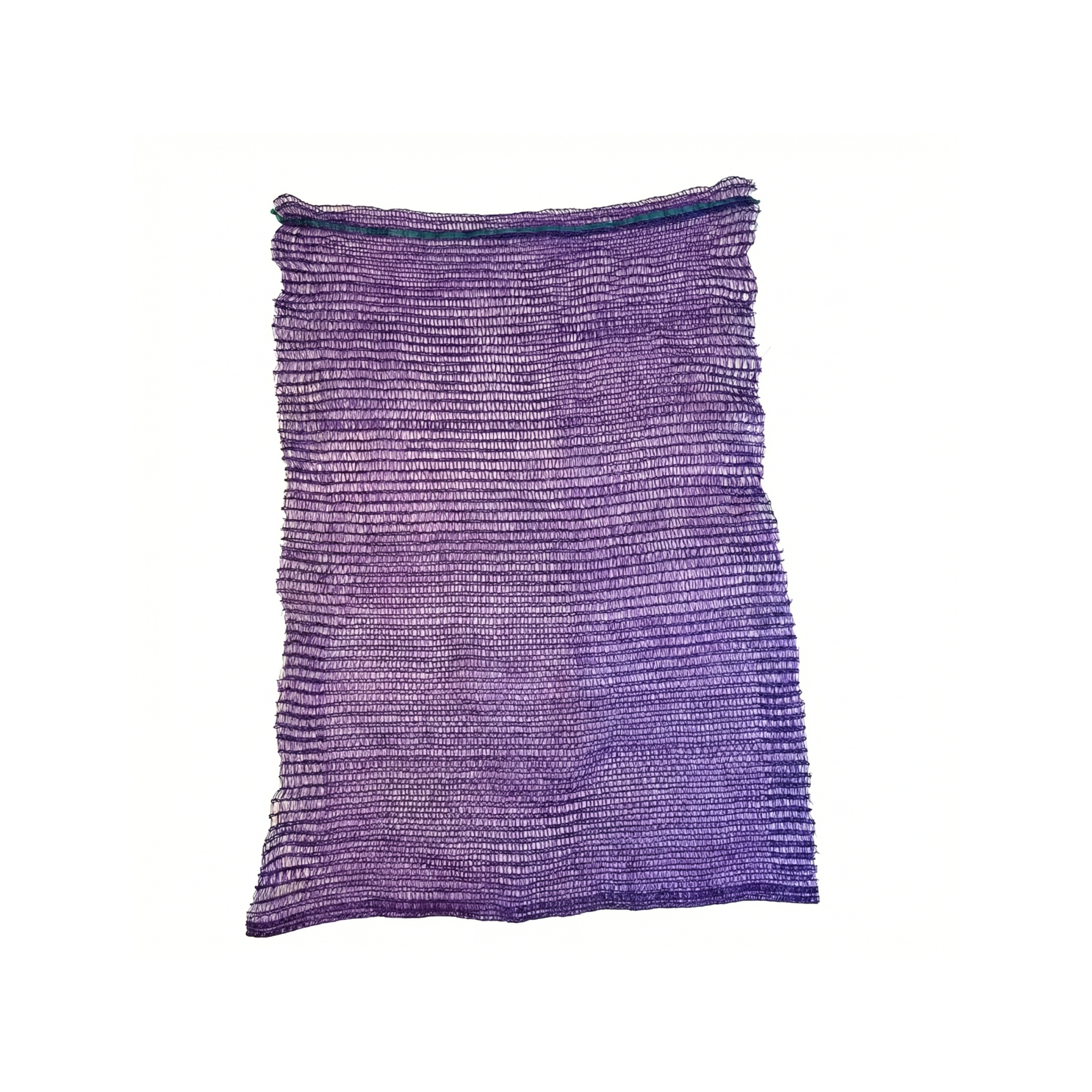
Choosing the right size of plastic net bag determines the cost per packed unit, ease of handling, and the final presentation to the customer. These bags —also called plastic mesh bags, onion bags, or agricultural nets— are available in five sizes and four colors, all with the same Raschel knitted weave in virgin HDPE and an integrated drawstring. The difference between one and another is not the quality of the bag, but the format: how much product it holds, what use it withstands, and which channel it is aimed at.
🎯 Choose your variant in 10 seconds
- If you sell to the end consumer in retail or a gourmet supermarket: go to the 30 × 45 cm (5 lb)
- If you display product on the shelf of a neighborhood market or retail store: go to the 35 × 55 cm (10 lb)
- If you distribute in a wholesale market or trading company: go to the 40 × 60 cm (25 lb)
- If you harvest in the field and transport to a collection center: go to the 50 × 80 cm (50 lb)
- If you operate in bulk in agribusiness or export: go to the 60 × 100 cm (100 lb)
What to consider before choosing the variant
The five sizes share the same material, weave, and manufacturing standard. The choice does not depend on the quality of the bag, but on the logistics format. Keep these five criteria in mind before buying:
- Actual load capacity: 5, 10, 25, 50, or 100 nominal pounds (2.3 to 45.4 kg). In the Dominican Republic, weighing in pounds is standard for potatoes, onions, and citrus; weigh a typical unit of your product and calculate how many you want per bag.
- Sales channel: retail to the end consumer, wholesale market, trading company, or bulk transport. The small format is displayed on the shelf; the large one is loaded onto a truck.
- Manual or mechanical handling: from 50 lb (22.7 kg) onward, the bag becomes heavy for continuous handling by a single person. Assess whether your team can handle it by hand or whether you need a cart and forklift.
- Color and product association: the four colors (purple, red, green, yellow) are available in all sizes and are chosen by the visual convention of the crop. Red for red onion or red citrus, green for limes and avocados, yellow for potatoes and yellow citrus, purple for garlic and beets.
- Purchase volume and unit cost: all formats come in a pack of 100 bags. The cost per bag rises with size, but the cost per kilo packed is optimized in the large formats.
30 × 45 cm | 5 lb: the format for retail to the end consumer
- Convenient size for the end customer to carry by hand
- Premium presentation with a drawstring of the same color
- Allows selling selected product at a higher price
- Cost per kilo packed higher than the large formats
- Not efficient for moving wholesale volume
Bag of 30 × 45 cm (12 × 18 in) with a nominal capacity of 5 lb (2.3 kg). Raschel knitted weave in virgin HDPE, mesh opening of 10 × 10 mm, and a braided polyethylene drawstring matching the color of the bag. Sold in a pack of 100 bags, available in purple, red, green, and yellow. It is the format designed to reach the consumer's shelf directly: onion, garlic, chili peppers, small mandarins, or bags prepared for premium markets and agro-stores that sell selected product.
35 × 55 cm | 10 lb: the shelf and retail store presentation
- Intermediate size easy to handle by a single person
- Practical quantity for weekly or biweekly household use
- Good balance between presentation and unit cost
- Small for wholesale distribution
- Limited volume for farms or field harvesting
Intermediate bag of 35 × 55 cm (14 × 22 in) with a nominal capacity of 10 lb (4.5 kg). The favorite format of neighborhood markets, retail stores, and supermarkets that offer prepared bags for the end customer to take home without repackaging. Same Raschel HDPE weave, same mesh opening, and same drawstring as the rest of the range, in a pack of 100 bags and the four standard colors.
40 × 60 cm | 25 lb: the standard wholesale distribution format
- Most rotated format in Dominican wholesale markets
- Manageable by hand without injuring the operator on repeated loads
- Good ratio between packed volume and cost per bag
- Too large for presentation to the end consumer
- Insufficient for intensive bulk operation
Bag of 40 × 60 cm (16 × 24 in) and 25 lb (11.3 kg) capacity. It is the most versatile format and the one with the highest turnover in trading companies, wholesale markets such as Merca Santo Domingo, and agro-centers: large enough to amortize the logistics cost, manageable enough for one person to carry it several times a day without injury. The standard chosen by professionals in the wholesale channel in the Dominican Republic.
50 × 80 cm | 50 lb: harvest and agricultural transport
- Capacity designed for direct filling in the furrow or the plantation
- Cost per kilo packed much lower than the small formats
- Weave and seam dimensioned for 50 lb without tearing
- Requires two operators or a cart for comfortable handling
- Too large for retail to the end consumer
Large bag of 50 × 80 cm (20 × 32 in) with a capacity of 50 lb (22.7 kg). Designed for direct filling in the field during harvest and for transport to collection centers. From this size onward, handling becomes a task for two people or a cart; in compensation, the cost per kilo packed begins to drop noticeably compared to the small formats, which is the reason why cooperatives and medium-sized trading companies tend to opt for this size.
If your operation combines wholesale sale with presentation to the end consumer, request two formats in different colors: the 40 × 60 (25 lb) in a neutral color for the wholesale channel and the 30 × 45 (5 lb) in the color associated with your main crop for the shelf. The chromatic distinction prevents dispatch errors in the warehouse and reinforces brand identity at the point of sale.
60 × 100 cm | 100 lb: bulk operations and agribusiness
- Maximum efficiency in cost per kilo packed
- Weave and bottom seam dimensioned for 100 lb with a 5:1 safety factor
- Reduces the number of units to handle in large batches
- Mechanical handling recommended: cart or forklift
- Not suitable for sale to the end consumer
The largest bag in the range: 60 × 100 cm (24 × 40 in) with a nominal capacity of 100 lb (45.4 kg). A format for agribusiness, regional export, and operations where potatoes, onions, citrus, or firewood are packed in large quantities. It requires mechanical handling —cart, forklift, or conveyor belt— and a team experienced with heavy loads. The Raschel weave and the double bottom seam line are dimensioned with a 5:1 safety factor over the nominal capacity precisely for this intensive operation.
Comparison table of the five sizes
Quick comparison of the attributes that change between sizes. Material, weave (Raschel knitted virgin HDPE), mesh opening (10 × 10 mm), integrated drawstring, UV-HALS additive, food suitability (FDA 21 CFR 177.1520), and presentation in a pack of 100 bags are common to the entire range and that is why they are not repeated in the table.
| Characteristic | 30 × 45 cm | 35 × 55 cm | 40 × 60 cm | 50 × 80 cm | 60 × 100 cm |
|---|---|---|---|---|---|
| SKU (Purple) | 412508 | 528341 | 745234 | 999312 | 777771 |
| Dimensions | 30 × 45 cm (12 × 18 in) |
35 × 55 cm (14 × 22 in) |
40 × 60 cm (16 × 24 in) |
50 × 80 cm (20 × 32 in) |
60 × 100 cm (24 × 40 in) |
| Nominal capacity | 5 lb (2.3 kg) | 10 lb (4.5 kg) | 25 lb (11.3 kg) | 50 lb (22.7 kg) | 100 lb (45.4 kg) |
| Ideal use | Premium retail | Retail store | Wholesale distribution | Harvest and transport | Bulk agribusiness |
| Main channel | End consumer | Supermarket and neighborhood market | Wholesale market | Field harvesting | Collection centers and export |
| Handling | Light manual | Light manual | Standard manual | Heavy manual or cart | Mechanical recommended |
| Cost per kilo packed | High | Medium-high | Balanced | Low | Minimal |
The SKU in the column corresponds to the purple color; each of the other three colors has its own 6-digit SKU within the same size. If you need the exact reference for a specific color, it is visible when selecting the variant on the product page.
Matrix: use case → recommended variant
| If your case is… | Recommended variant |
|---|---|
| Selling garlic or selected onion in a gourmet market or agro-store | → 30 × 45 cm (5 lb) |
| Packing potatoes or limes for a supermarket shelf and neighborhood market | → 35 × 55 cm (10 lb) |
| Distributing in Merca Santo Domingo or selling to the urban wholesale channel | → 40 × 60 cm (25 lb) |
| Harvesting potato or onion in the field and transporting to a collection center | → 50 × 80 cm (50 lb) |
| Operating regional export or agribusiness with mechanical handling | → 60 × 100 cm (100 lb) |
| Collecting live shellfish or bivalves in a fishing operation | → 35 × 55 cm (10 lb) or 40 × 60 cm |
Do not buy the 60 × 100 cm (100 lb) bag if your operation loads by hand. Although the weave withstands the load, the problem is not the bag but the operator: lifting 45 kg of potatoes with a bent back causes cumulative lower-back injuries. For continuous manual handling, the recommended limit is the 40 × 60 (25 lb), and for 50 lb (22.7 kg) a cart is already worth considering. Take care of the team's health before the cost per kilo.
Frequently asked questions
Can I mix sizes and colors in a single purchase?
Yes. Each SKU is independent: the five sizes and the four colors are purchased separately in packs of 100 bags. It is common for an agricultural operation to combine the 40 × 60 in a neutral color for the wholesale channel and the 30 × 45 or the 35 × 55 in the crop's color for presentation to the end customer. If you buy more than one size in a single order, indicate it when reviewing the cart so the warehouse separates the batches at dispatch.
Which size is most profitable per kilo packed?
The cost per kilo packed drops as the size of the bag increases. The 60 × 100 cm (100 lb) offers the minimum cost per kilo, followed by the 50 × 80 (50 lb). However, that advantage is only realized if the operation handles enough volume and has a cart or forklift; in manual operations with little flow, the 40 × 60 (25 lb) is usually the optimal point between cost and safe handling.
Is the nominal capacity the maximum load limit of the bag?
No. The indicated capacity (5, 10, 25, 50, or 100 lb) is the recommended service load for continuous use. The weave and the bottom seam are dimensioned with a 5:1 safety factor over the nominal capacity, so the bag does not tear if it is exceeded occasionally. What does change with overload is the service life of the seam and the risk of injury to the operator, so respect the nominal capacity for daily use.
