
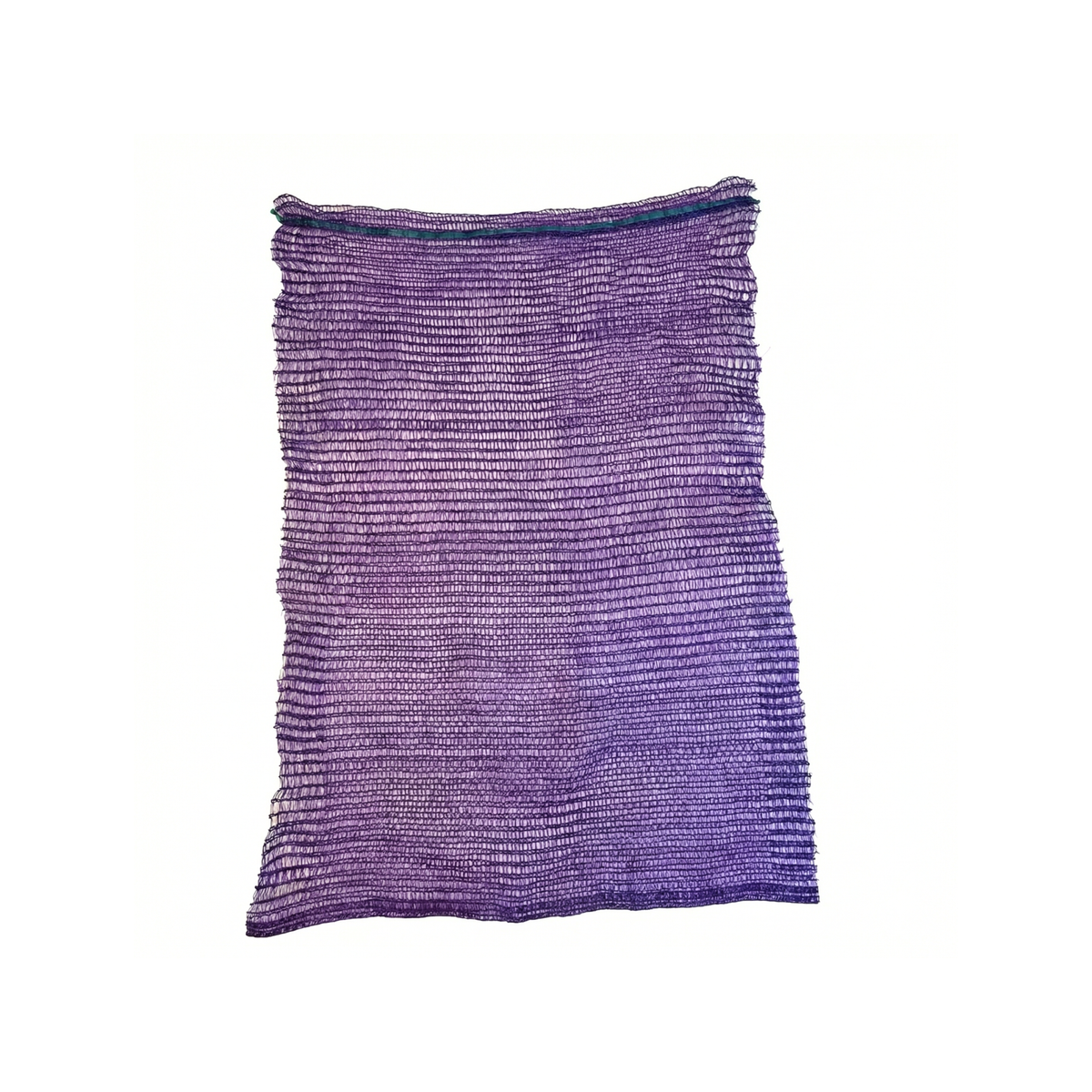
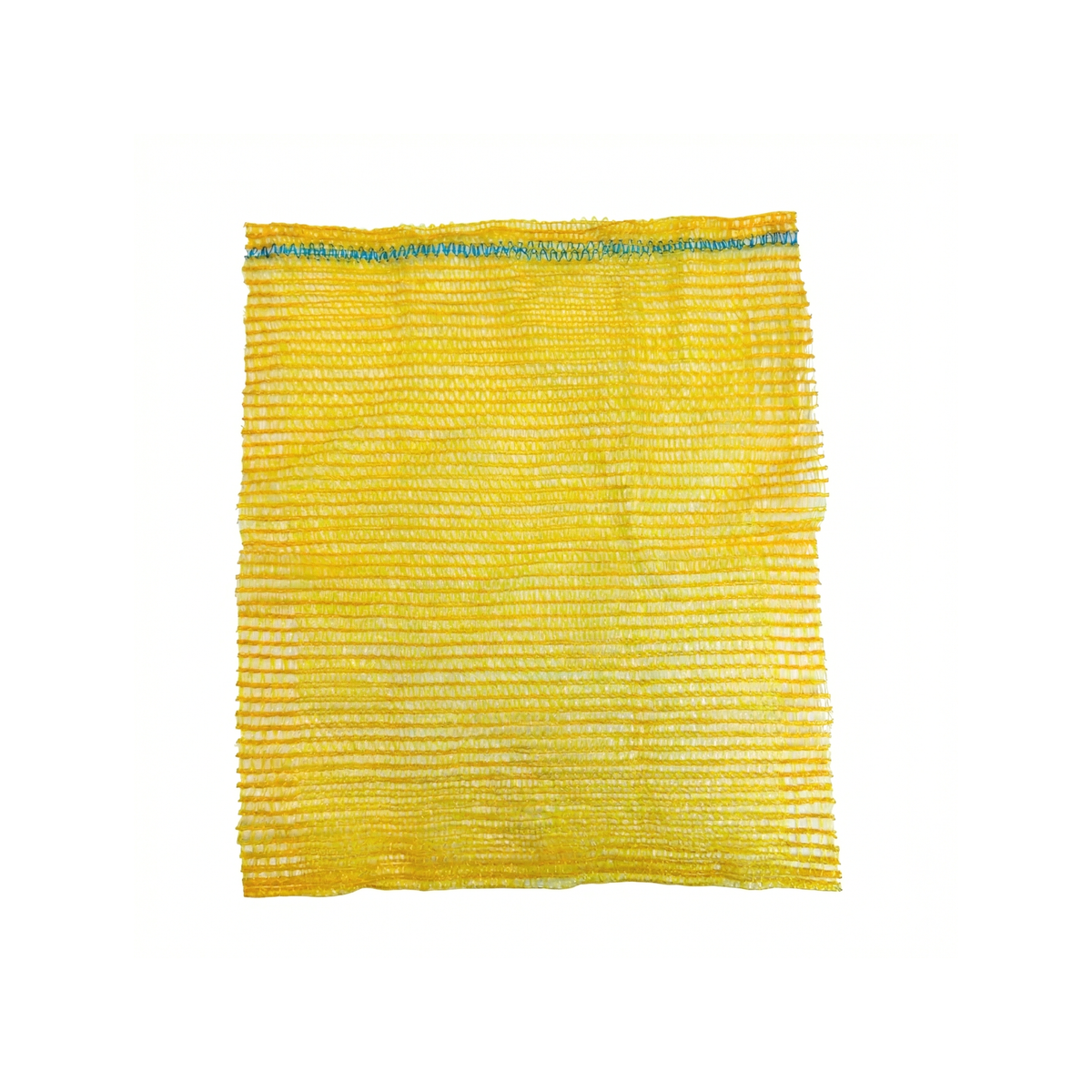
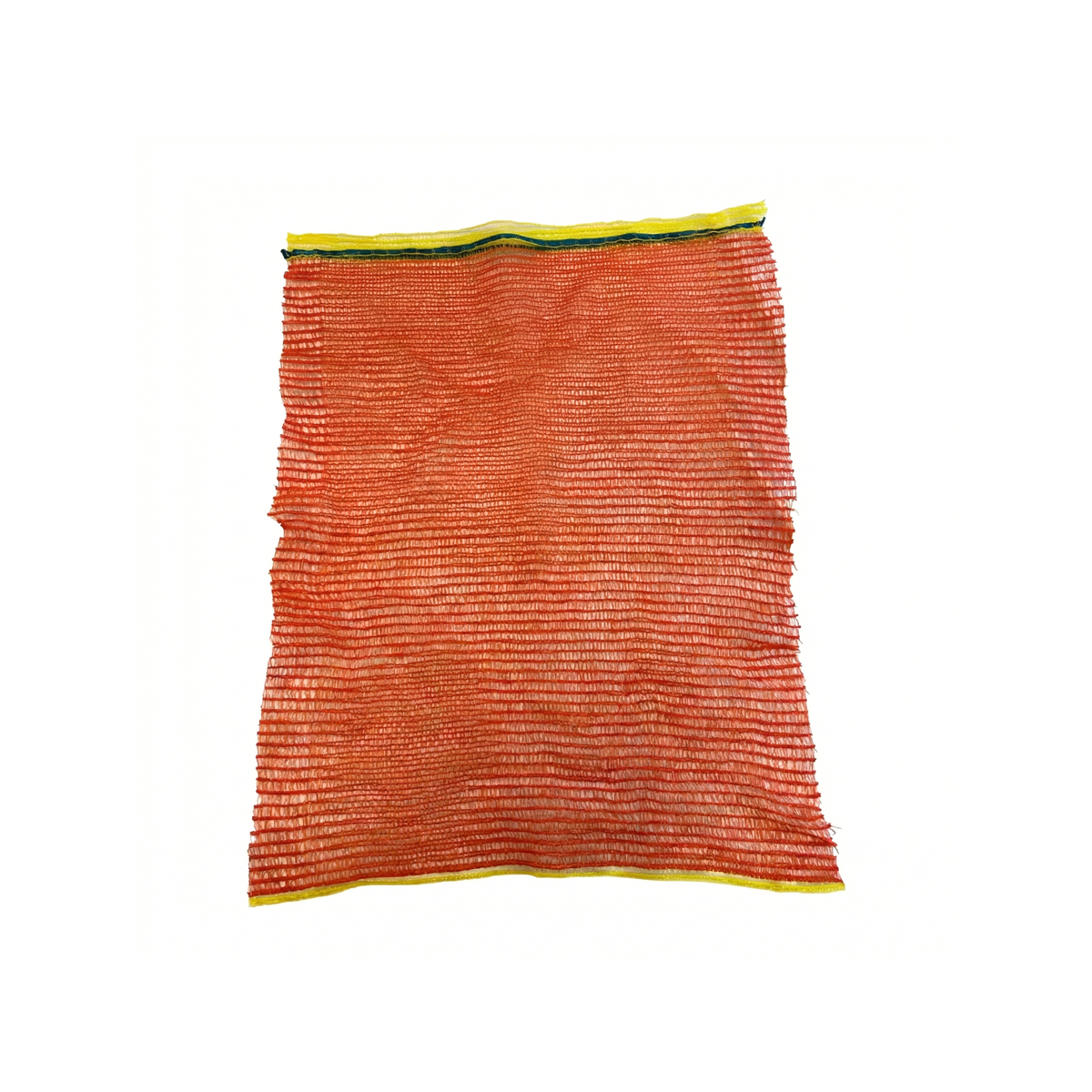
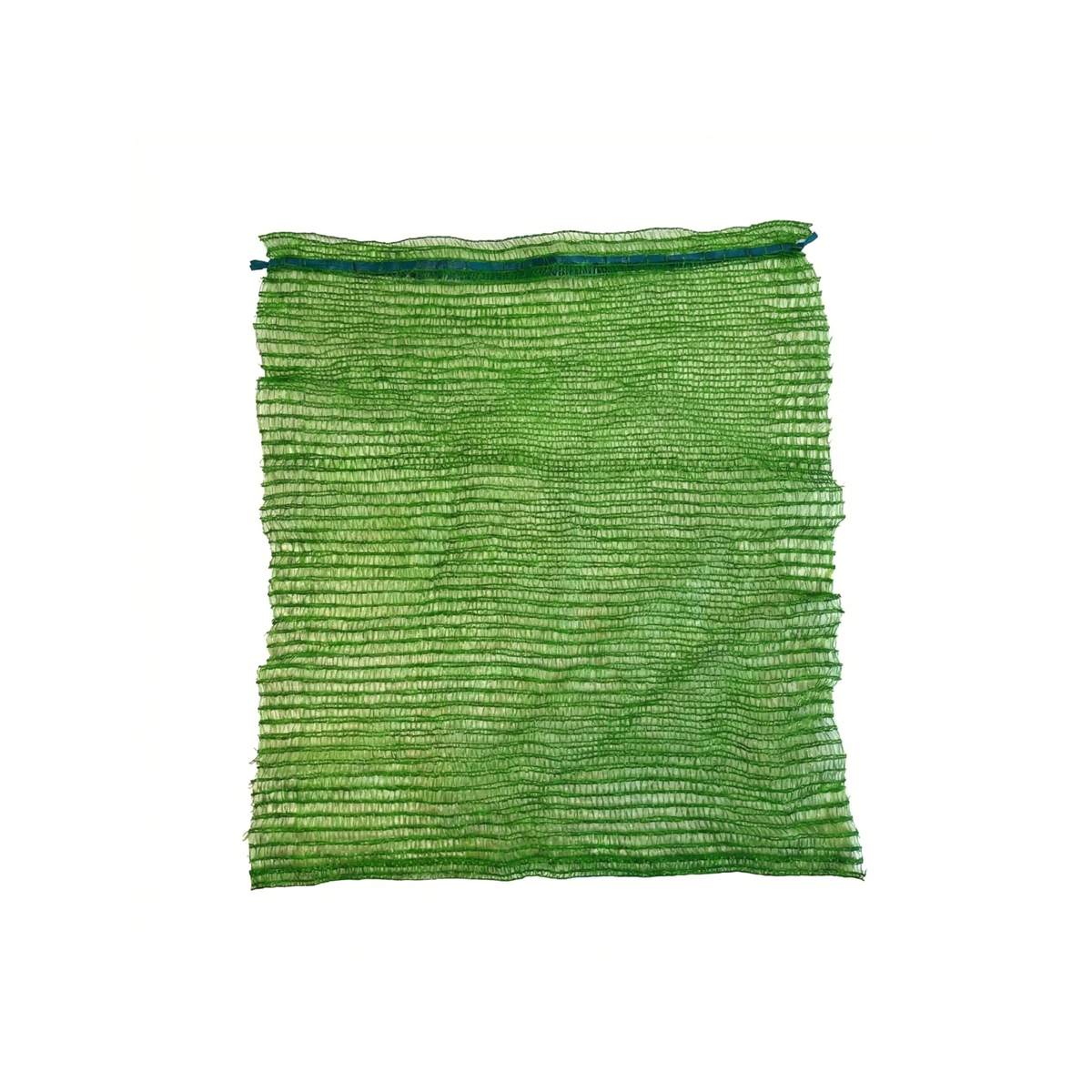


Moving potatoes, onions, citrus, and other vegetables from the field to the end customer without moisture and fungi building up during storage requires a sack that breathes, not a closed container. This plastic mesh bag—also called plastic burlap, onion sack, or agricultural net—is manufactured with virgin professional-grade polyethylene woven in Raschel knitted, designed for professional packaging of agricultural products, nurseries, and food distributors that demand constant ventilation in perishable loads.
Key benefits
- Raschel knitted weave with high breathability: the open net allows constant air circulation around the goods, preventing moisture and fungal growth in tubers and vegetables, and lets the product be seen without breaking seals.
- Virgin professional-grade HDPE: virgin polyethylene filaments with no recycled content, woven in a controlled process, that withstand filling, stowing, and manual or mechanical handling without tearing. The difference between a premium net and a market bag shows up on the first heavy load.
- Integrated matching drawstring: braided cord in the same color as the sack, ready for fast and secure tying without needing a portable stitcher or additional staples.
- UV stabilization for Caribbean sun: UV-HALS additive and antioxidant incorporated to withstand prolonged exposure without becoming brittle during harvest, transport, or outdoor display.
- Lightweight and logistics-efficient: adds minimal weight to the shipment, facilitating fast handling in warehouses, wholesale markets, and distribution routes.
Typical applications and uses
- Packaging of potatoes, onions, garlic, citrus, carrots, and other root and bulb vegetables.
- Harvest, transport, and display in wholesale markets, agri-centers, and food distributors.
- Handling of firewood, charcoal, and forestry products that require ventilation during storage.
- Collection of live shellfish, mollusks, and bivalves in fishing and aquaculture operations.
Quality and durability
An economical agricultural net bag fails at two points: the filament is recycled polyethylene with uneven tension and tears on the first lift, and the weave loses its opening after a few use cycles. This reference works with virgin polymer in controlled production processes, with resin compliant with FDA 21 CFR 177.1520 for direct contact with fresh food. That careful manufacturing sets a serious mesh sack apart from a market onion bag that breaks and leaves the harvest on the ground.
Is it suitable for contact with fresh food?
The resin used is virgin high-density polyethylene compliant with FDA 21 CFR 177.1520 for direct contact with food products. You can pack potatoes, onions, garlic, citrus, carrots and other vegetables without risk of chemical transfer to the product. It is not designed for liquid, fatty or hot foods (soups, oils or cooked products), which would require a resin with a different certification.
What is the real difference from a common market onion sack?
The difference is in the raw material and the additives. A budget onion sack is made from recycled polyethylene without uniform tension and without UV stabilizers, so it tears on the first lift and fades in the sun within weeks. This reference uses professional-grade virgin polymer with UV-HALS additive, keeping a stable mesh opening and consistent strength batch after batch. It is not the same sack and does not last the same.
Does it withstand the Caribbean sun on open-air display?
It is stabilized with UV-HALS additive and a primary antioxidant to withstand prolonged sun exposure during harvest, transport and display at agro-centers. It keeps its strength and color under normal Dominican sun conditions. For permanent storage in the sun for months we recommend rotating stock like any plastic product. It is not designed for permanent structural outdoor use without protection.
Is it recyclable and what about the drawstring?
Yes. It is made of pure high-density polyethylene (HDPE), identified with recycling code number 2. It can join standard HDPE plastic recycling streams. The drawstring is the same material as the sack, so there is no need to separate it before recycling. We recommend cleaning off soil or product residue before handing it over to a collection point.
Can I close the sack without a portable bag stitcher?
Yes. Each sack comes with a braided drawstring built into the mouth, the same color as the sack, for quick closing by hand tying. You need no metal staples or portable industrial stitcher to secure the load. If your operation requires extra security for long transport or export, you can combine the drawstring with additional stitching or a security seal to prevent tampering.
Still have questions?
Ask us and we will gladly help you with whatever you need.
| Material and construction | |
|---|---|
| Material | 100% virgin extruded high-density polyethylene (HDPE) |
| Color | Purple (bag for red onion, garlic or beetroot) |
| Mesh opening | 10 × 10 mm (nominal opening) |
| Bottom seam | Heat-knotted + double row of PE multifilament thread |
| Filament denier | 600 D × 600 D (HDPE monofilament) |
| Structure | Continuous tubular, no side seams |
| Gusset | No gusset (flat bag) |
| Closure type | Braided polyethylene drawstring, matching color |
| Fabric type | Circular knitted Raschel (leno-type net), high tenacity |
| Strength and performance | |
| Maximum recommended load | Safety factor 5:1 over nominal capacity |
| Durability and protection | |
| Recyclability | Recyclable, resin identification code 2 (HDPE) |
| UV resistance | ≥6 months under Caribbean sun (≥800 h QUV) |
| Physicochemical properties | |
| Additives | 0.3% UV-HALS stabilizer + primary antioxidant |
| Compatibility and use | |
| Food-grade suitability | Virgin HDPE resin compliant with FDA 21 CFR 177.1520 (direct contact with fresh food) |
| Recommended use | Harvest, transport and display of potatoes, onions, garlic, citrus, carrots, firewood and charcoal. For products requiring constant ventilation. |
| Presentation and packaging | |
| Presentation | Pack of 100 sacks |
| Standards and certifications | |
| Reference standard | ASTM D5260 — Standard practice for fiber-coated mesh produce bags |
| Material and construction | |
|---|---|
| Material | 100% virgin extruded high-density polyethylene (HDPE) |
| Color | Red (bag for red onion or red citrus) |
| Mesh opening | 10 × 10 mm (nominal opening) |
| Bottom seam | Heat-knotted + double row of PE multifilament thread |
| Filament denier | 600 D × 600 D (HDPE monofilament) |
| Structure | Continuous tubular, no side seams |
| Gusset | No gusset (flat bag) |
| Closure type | Braided polyethylene drawstring, matching color |
| Fabric type | Circular knitted Raschel (leno-type net), high tenacity |
| Strength and performance | |
| Maximum recommended load | Safety factor 5:1 over nominal capacity |
| Durability and protection | |
| Recyclability | Recyclable, resin identification code 2 (HDPE) |
| UV resistance | ≥6 months under Caribbean sun (≥800 h QUV) |
| Physicochemical properties | |
| Additives | 0.3% UV-HALS stabilizer + primary antioxidant |
| Compatibility and use | |
| Food-grade suitability | Virgin HDPE resin compliant with FDA 21 CFR 177.1520 (direct contact with fresh food) |
| Recommended use | Harvest, transport and display of potatoes, onions, garlic, citrus, carrots, firewood and charcoal. For products requiring constant ventilation. |
| Presentation and packaging | |
| Presentation | Pack of 100 sacks |
| Standards and certifications | |
| Reference standard | ASTM D5260 — Standard practice for fiber-coated mesh produce bags |
| Material and construction | |
|---|---|
| Material | 100% virgin extruded high-density polyethylene (HDPE) |
| Color | Green (bag for lemons, avocados or firewood) |
| Mesh opening | 10 × 10 mm (nominal opening) |
| Bottom seam | Heat-knotted + double row of PE multifilament thread |
| Filament denier | 600 D × 600 D (HDPE monofilament) |
| Structure | Continuous tubular, no side seams |
| Gusset | No gusset (flat bag) |
| Closure type | Braided polyethylene drawstring, matching color |
| Fabric type | Circular knitted Raschel (leno-type net), high tenacity |
| Strength and performance | |
| Maximum recommended load | Safety factor 5:1 over nominal capacity |
| Durability and protection | |
| Recyclability | Recyclable, resin identification code 2 (HDPE) |
| UV resistance | ≥6 months under Caribbean sun (≥800 h QUV) |
| Physicochemical properties | |
| Additives | 0.3% UV-HALS stabilizer + primary antioxidant |
| Compatibility and use | |
| Food-grade suitability | Virgin HDPE resin compliant with FDA 21 CFR 177.1520 (direct contact with fresh food) |
| Recommended use | Harvest, transport and display of potatoes, onions, garlic, citrus, carrots, firewood and charcoal. For products requiring constant ventilation. |
| Presentation and packaging | |
| Presentation | Pack of 100 sacks |
| Standards and certifications | |
| Reference standard | ASTM D5260 — Standard practice for fiber-coated mesh produce bags |
| Material and construction | |
|---|---|
| Material | 100% virgin extruded high-density polyethylene (HDPE) |
| Color | Yellow (bag for potatoes, yellow onion or citrus) |
| Mesh opening | 10 × 10 mm (nominal opening) |
| Bottom seam | Heat-knotted + double row of PE multifilament thread |
| Filament denier | 600 D × 600 D (HDPE monofilament) |
| Structure | Continuous tubular, no side seams |
| Gusset | No gusset (flat bag) |
| Closure type | Braided polyethylene drawstring, matching color |
| Fabric type | Circular knitted Raschel (leno-type net), high tenacity |
| Strength and performance | |
| Maximum recommended load | Safety factor 5:1 over nominal capacity |
| Durability and protection | |
| Recyclability | Recyclable, resin identification code 2 (HDPE) |
| UV resistance | ≥6 months under Caribbean sun (≥800 h QUV) |
| Physicochemical properties | |
| Additives | 0.3% UV-HALS stabilizer + primary antioxidant |
| Compatibility and use | |
| Food-grade suitability | Virgin HDPE resin compliant with FDA 21 CFR 177.1520 (direct contact with fresh food) |
| Recommended use | Harvest, transport and display of potatoes, onions, garlic, citrus, carrots, firewood and charcoal. For products requiring constant ventilation. |
| Presentation and packaging | |
| Presentation | Pack of 100 sacks |
| Standards and certifications | |
| Reference standard | ASTM D5260 — Standard practice for fiber-coated mesh produce bags |
| Material and construction | |
|---|---|
| Material | 100% virgin extruded high-density polyethylene (HDPE) |
| Color | Purple (bag for red onion, garlic or beetroot) |
| Mesh opening | 10 × 10 mm (nominal opening) |
| Bottom seam | Heat-knotted + double row of PE multifilament thread |
| Filament denier | 600 D × 600 D (HDPE monofilament) |
| Structure | Continuous tubular, no side seams |
| Gusset | No gusset (flat bag) |
| Closure type | Braided polyethylene drawstring, matching color |
| Fabric type | Circular knitted Raschel (leno-type net), high tenacity |
| Strength and performance | |
| Maximum recommended load | Safety factor 5:1 over nominal capacity |
| Durability and protection | |
| Recyclability | Recyclable, resin identification code 2 (HDPE) |
| UV resistance | ≥6 months under Caribbean sun (≥800 h QUV) |
| Physicochemical properties | |
| Additives | 0.3% UV-HALS stabilizer + primary antioxidant |
| Compatibility and use | |
| Food-grade suitability | Virgin HDPE resin compliant with FDA 21 CFR 177.1520 (direct contact with fresh food) |
| Recommended use | Harvest, transport and display of potatoes, onions, garlic, citrus, carrots, firewood and charcoal. For products requiring constant ventilation. |
| Presentation and packaging | |
| Presentation | Pack of 100 sacks |
| Standards and certifications | |
| Reference standard | ASTM D5260 — Standard practice for fiber-coated mesh produce bags |
| Material and construction | |
|---|---|
| Material | 100% virgin extruded high-density polyethylene (HDPE) |
| Color | Red (bag for red onion or red citrus) |
| Mesh opening | 10 × 10 mm (nominal opening) |
| Bottom seam | Heat-knotted + double row of PE multifilament thread |
| Filament denier | 600 D × 600 D (HDPE monofilament) |
| Structure | Continuous tubular, no side seams |
| Gusset | No gusset (flat bag) |
| Closure type | Braided polyethylene drawstring, matching color |
| Fabric type | Circular knitted Raschel (leno-type net), high tenacity |
| Strength and performance | |
| Maximum recommended load | Safety factor 5:1 over nominal capacity |
| Durability and protection | |
| Recyclability | Recyclable, resin identification code 2 (HDPE) |
| UV resistance | ≥6 months under Caribbean sun (≥800 h QUV) |
| Physicochemical properties | |
| Additives | 0.3% UV-HALS stabilizer + primary antioxidant |
| Compatibility and use | |
| Food-grade suitability | Virgin HDPE resin compliant with FDA 21 CFR 177.1520 (direct contact with fresh food) |
| Recommended use | Harvest, transport and display of potatoes, onions, garlic, citrus, carrots, firewood and charcoal. For products requiring constant ventilation. |
| Presentation and packaging | |
| Presentation | Pack of 100 sacks |
| Standards and certifications | |
| Reference standard | ASTM D5260 — Standard practice for fiber-coated mesh produce bags |
| Material and construction | |
|---|---|
| Material | 100% virgin extruded high-density polyethylene (HDPE) |
| Color | Green (bag for lemons, avocados or firewood) |
| Mesh opening | 10 × 10 mm (nominal opening) |
| Bottom seam | Heat-knotted + double row of PE multifilament thread |
| Filament denier | 600 D × 600 D (HDPE monofilament) |
| Structure | Continuous tubular, no side seams |
| Gusset | No gusset (flat bag) |
| Closure type | Braided polyethylene drawstring, matching color |
| Fabric type | Circular knitted Raschel (leno-type net), high tenacity |
| Strength and performance | |
| Maximum recommended load | Safety factor 5:1 over nominal capacity |
| Durability and protection | |
| Recyclability | Recyclable, resin identification code 2 (HDPE) |
| UV resistance | ≥6 months under Caribbean sun (≥800 h QUV) |
| Physicochemical properties | |
| Additives | 0.3% UV-HALS stabilizer + primary antioxidant |
| Compatibility and use | |
| Food-grade suitability | Virgin HDPE resin compliant with FDA 21 CFR 177.1520 (direct contact with fresh food) |
| Recommended use | Harvest, transport and display of potatoes, onions, garlic, citrus, carrots, firewood and charcoal. For products requiring constant ventilation. |
| Presentation and packaging | |
| Presentation | Pack of 100 sacks |
| Standards and certifications | |
| Reference standard | ASTM D5260 — Standard practice for fiber-coated mesh produce bags |
| Material and construction | |
|---|---|
| Material | 100% virgin extruded high-density polyethylene (HDPE) |
| Color | Yellow (bag for potatoes, yellow onion or citrus) |
| Mesh opening | 10 × 10 mm (nominal opening) |
| Bottom seam | Heat-knotted + double row of PE multifilament thread |
| Filament denier | 600 D × 600 D (HDPE monofilament) |
| Structure | Continuous tubular, no side seams |
| Gusset | No gusset (flat bag) |
| Closure type | Braided polyethylene drawstring, matching color |
| Fabric type | Circular knitted Raschel (leno-type net), high tenacity |
| Strength and performance | |
| Maximum recommended load | Safety factor 5:1 over nominal capacity |
| Durability and protection | |
| Recyclability | Recyclable, resin identification code 2 (HDPE) |
| UV resistance | ≥6 months under Caribbean sun (≥800 h QUV) |
| Physicochemical properties | |
| Additives | 0.3% UV-HALS stabilizer + primary antioxidant |
| Compatibility and use | |
| Food-grade suitability | Virgin HDPE resin compliant with FDA 21 CFR 177.1520 (direct contact with fresh food) |
| Recommended use | Harvest, transport and display of potatoes, onions, garlic, citrus, carrots, firewood and charcoal. For products requiring constant ventilation. |
| Presentation and packaging | |
| Presentation | Pack of 100 sacks |
| Standards and certifications | |
| Reference standard | ASTM D5260 — Standard practice for fiber-coated mesh produce bags |
| Material and construction | |
|---|---|
| Material | 100% virgin extruded high-density polyethylene (HDPE) |
| Color | Purple (bag for red onion, garlic or beetroot) |
| Mesh opening | 10 × 10 mm (nominal opening) |
| Bottom seam | Heat-knotted + double row of PE multifilament thread |
| Filament denier | 600 D × 600 D (HDPE monofilament) |
| Structure | Continuous tubular, no side seams |
| Gusset | No gusset (flat bag) |
| Closure type | Braided polyethylene drawstring, matching color |
| Fabric type | Circular knitted Raschel (leno-type net), high tenacity |
| Dimensions and format | |
| Dimensions | 40 × 60 cm (16 × 24 in) |
| Capacity | 11.3 kg (25 lb) |
| Strength and performance | |
| Maximum recommended load | Safety factor 5:1 over nominal capacity |
| Durability and protection | |
| Recyclability | Recyclable, resin identification code 2 (HDPE) |
| UV resistance | ≥6 months under Caribbean sun (≥800 h QUV) |
| Physicochemical properties | |
| Additives | 0.3% UV-HALS stabilizer + primary antioxidant |
| Compatibility and use | |
| Food-grade suitability | Virgin HDPE resin compliant with FDA 21 CFR 177.1520 (direct contact with fresh food) |
| Recommended use | Harvest, transport and display of potatoes, onions, garlic, citrus, carrots, firewood and charcoal. For products requiring constant ventilation. |
| Presentation and packaging | |
| Presentation | Pack of 100 sacks |
| Standards and certifications | |
| Reference standard | ASTM D5260 — Standard practice for fiber-coated mesh produce bags |
| Material and construction | |
|---|---|
| Material | 100% virgin extruded high-density polyethylene (HDPE) |
| Color | Red (bag for red onion or red citrus) |
| Mesh opening | 10 × 10 mm (nominal opening) |
| Bottom seam | Heat-knotted + double row of PE multifilament thread |
| Filament denier | 600 D × 600 D (HDPE monofilament) |
| Structure | Continuous tubular, no side seams |
| Gusset | No gusset (flat bag) |
| Closure type | Braided polyethylene drawstring, matching color |
| Fabric type | Circular knitted Raschel (leno-type net), high tenacity |
| Dimensions and format | |
| Dimensions | 40 × 60 cm (16 × 24 in) |
| Capacity | 11.3 kg (25 lb) |
| Strength and performance | |
| Maximum recommended load | Safety factor 5:1 over nominal capacity |
| Durability and protection | |
| Recyclability | Recyclable, resin identification code 2 (HDPE) |
| UV resistance | ≥6 months under Caribbean sun (≥800 h QUV) |
| Physicochemical properties | |
| Additives | 0.3% UV-HALS stabilizer + primary antioxidant |
| Compatibility and use | |
| Food-grade suitability | Virgin HDPE resin compliant with FDA 21 CFR 177.1520 (direct contact with fresh food) |
| Recommended use | Harvest, transport and display of potatoes, onions, garlic, citrus, carrots, firewood and charcoal. For products requiring constant ventilation. |
| Presentation and packaging | |
| Presentation | Pack of 100 sacks |
| Standards and certifications | |
| Reference standard | ASTM D5260 — Standard practice for fiber-coated mesh produce bags |
| Material and construction | |
|---|---|
| Material | 100% virgin extruded high-density polyethylene (HDPE) |
| Color | Green (bag for lemons, avocados or firewood) |
| Mesh opening | 10 × 10 mm (nominal opening) |
| Bottom seam | Heat-knotted + double row of PE multifilament thread |
| Filament denier | 600 D × 600 D (HDPE monofilament) |
| Structure | Continuous tubular, no side seams |
| Gusset | No gusset (flat bag) |
| Closure type | Braided polyethylene drawstring, matching color |
| Fabric type | Circular knitted Raschel (leno-type net), high tenacity |
| Dimensions and format | |
| Dimensions | 40 × 60 cm (16 × 24 in) |
| Capacity | 11.3 kg (25 lb) |
| Strength and performance | |
| Maximum recommended load | Safety factor 5:1 over nominal capacity |
| Durability and protection | |
| Recyclability | Recyclable, resin identification code 2 (HDPE) |
| UV resistance | ≥6 months under Caribbean sun (≥800 h QUV) |
| Physicochemical properties | |
| Additives | 0.3% UV-HALS stabilizer + primary antioxidant |
| Compatibility and use | |
| Food-grade suitability | Virgin HDPE resin compliant with FDA 21 CFR 177.1520 (direct contact with fresh food) |
| Recommended use | Harvest, transport and display of potatoes, onions, garlic, citrus, carrots, firewood and charcoal. For products requiring constant ventilation. |
| Presentation and packaging | |
| Presentation | Pack of 100 sacks |
| Standards and certifications | |
| Reference standard | ASTM D5260 — Standard practice for fiber-coated mesh produce bags |
| Material and construction | |
|---|---|
| Material | 100% virgin extruded high-density polyethylene (HDPE) |
| Color | Yellow (bag for potatoes, yellow onion or citrus) |
| Mesh opening | 10 × 10 mm (nominal opening) |
| Bottom seam | Heat-knotted + double row of PE multifilament thread |
| Filament denier | 600 D × 600 D (HDPE monofilament) |
| Structure | Continuous tubular, no side seams |
| Gusset | No gusset (flat bag) |
| Closure type | Braided polyethylene drawstring, matching color |
| Fabric type | Circular knitted Raschel (leno-type net), high tenacity |
| Dimensions and format | |
| Dimensions | 40 × 60 cm (16 × 24 in) |
| Capacity | 11.3 kg (25 lb) |
| Strength and performance | |
| Maximum recommended load | Safety factor 5:1 over nominal capacity |
| Durability and protection | |
| Recyclability | Recyclable, resin identification code 2 (HDPE) |
| UV resistance | ≥6 months under Caribbean sun (≥800 h QUV) |
| Physicochemical properties | |
| Additives | 0.3% UV-HALS stabilizer + primary antioxidant |
| Compatibility and use | |
| Food-grade suitability | Virgin HDPE resin compliant with FDA 21 CFR 177.1520 (direct contact with fresh food) |
| Recommended use | Harvest, transport and display of potatoes, onions, garlic, citrus, carrots, firewood and charcoal. For products requiring constant ventilation. |
| Presentation and packaging | |
| Presentation | Pack of 100 sacks |
| Standards and certifications | |
| Reference standard | ASTM D5260 — Standard practice for fiber-coated mesh produce bags |
| Material and construction | |
|---|---|
| Material | 100% virgin extruded high-density polyethylene (HDPE) |
| Color | Purple (bag for red onion, garlic or beetroot) |
| Mesh opening | 10 × 10 mm (nominal opening) |
| Bottom seam | Heat-knotted + double row of PE multifilament thread |
| Filament denier | 600 D × 600 D (HDPE monofilament) |
| Structure | Continuous tubular, no side seams |
| Gusset | No gusset (flat bag) |
| Closure type | Braided polyethylene drawstring, matching color |
| Fabric type | Circular knitted Raschel (leno-type net), high tenacity |
| Dimensions and format | |
| Dimensions | 50 × 80 cm (20 × 32 in) |
| Capacity | 22.7 kg (50 lb) |
| Strength and performance | |
| Maximum recommended load | Safety factor 5:1 over nominal capacity |
| Durability and protection | |
| Recyclability | Recyclable, resin identification code 2 (HDPE) |
| UV resistance | ≥6 months under Caribbean sun (≥800 h QUV) |
| Physicochemical properties | |
| Additives | 0.3% UV-HALS stabilizer + primary antioxidant |
| Compatibility and use | |
| Food-grade suitability | Virgin HDPE resin compliant with FDA 21 CFR 177.1520 (direct contact with fresh food) |
| Recommended use | Harvest, transport and display of potatoes, onions, garlic, citrus, carrots, firewood and charcoal. For products requiring constant ventilation. |
| Presentation and packaging | |
| Presentation | Pack of 100 sacks |
| Standards and certifications | |
| Reference standard | ASTM D5260 — Standard practice for fiber-coated mesh produce bags |
| Material and construction | |
|---|---|
| Material | 100% virgin extruded high-density polyethylene (HDPE) |
| Color | Red (bag for red onion or red citrus) |
| Mesh opening | 10 × 10 mm (nominal opening) |
| Bottom seam | Heat-knotted + double row of PE multifilament thread |
| Filament denier | 600 D × 600 D (HDPE monofilament) |
| Structure | Continuous tubular, no side seams |
| Gusset | No gusset (flat bag) |
| Closure type | Braided polyethylene drawstring, matching color |
| Fabric type | Circular knitted Raschel (leno-type net), high tenacity |
| Dimensions and format | |
| Dimensions | 50 × 80 cm (20 × 32 in) |
| Capacity | 22.7 kg (50 lb) |
| Strength and performance | |
| Maximum recommended load | Safety factor 5:1 over nominal capacity |
| Durability and protection | |
| Recyclability | Recyclable, resin identification code 2 (HDPE) |
| UV resistance | ≥6 months under Caribbean sun (≥800 h QUV) |
| Physicochemical properties | |
| Additives | 0.3% UV-HALS stabilizer + primary antioxidant |
| Compatibility and use | |
| Food-grade suitability | Virgin HDPE resin compliant with FDA 21 CFR 177.1520 (direct contact with fresh food) |
| Recommended use | Harvest, transport and display of potatoes, onions, garlic, citrus, carrots, firewood and charcoal. For products requiring constant ventilation. |
| Presentation and packaging | |
| Presentation | Pack of 100 sacks |
| Standards and certifications | |
| Reference standard | ASTM D5260 — Standard practice for fiber-coated mesh produce bags |
| Material and construction | |
|---|---|
| Material | 100% virgin extruded high-density polyethylene (HDPE) |
| Color | Green (bag for lemons, avocados or firewood) |
| Mesh opening | 10 × 10 mm (nominal opening) |
| Bottom seam | Heat-knotted + double row of PE multifilament thread |
| Filament denier | 600 D × 600 D (HDPE monofilament) |
| Structure | Continuous tubular, no side seams |
| Gusset | No gusset (flat bag) |
| Closure type | Braided polyethylene drawstring, matching color |
| Fabric type | Circular knitted Raschel (leno-type net), high tenacity |
| Dimensions and format | |
| Dimensions | 50 × 80 cm (20 × 32 in) |
| Capacity | 22.7 kg (50 lb) |
| Strength and performance | |
| Maximum recommended load | Safety factor 5:1 over nominal capacity |
| Durability and protection | |
| Recyclability | Recyclable, resin identification code 2 (HDPE) |
| UV resistance | ≥6 months under Caribbean sun (≥800 h QUV) |
| Physicochemical properties | |
| Additives | 0.3% UV-HALS stabilizer + primary antioxidant |
| Compatibility and use | |
| Food-grade suitability | Virgin HDPE resin compliant with FDA 21 CFR 177.1520 (direct contact with fresh food) |
| Recommended use | Harvest, transport and display of potatoes, onions, garlic, citrus, carrots, firewood and charcoal. For products requiring constant ventilation. |
| Presentation and packaging | |
| Presentation | Pack of 100 sacks |
| Standards and certifications | |
| Reference standard | ASTM D5260 — Standard practice for fiber-coated mesh produce bags |
| Material and construction | |
|---|---|
| Material | 100% virgin extruded high-density polyethylene (HDPE) |
| Color | Yellow (bag for potatoes, yellow onion or citrus) |
| Mesh opening | 10 × 10 mm (nominal opening) |
| Bottom seam | Heat-knotted + double row of PE multifilament thread |
| Filament denier | 600 D × 600 D (HDPE monofilament) |
| Structure | Continuous tubular, no side seams |
| Gusset | No gusset (flat bag) |
| Closure type | Braided polyethylene drawstring, matching color |
| Fabric type | Circular knitted Raschel (leno-type net), high tenacity |
| Dimensions and format | |
| Dimensions | 50 × 80 cm (20 × 32 in) |
| Capacity | 22.7 kg (50 lb) |
| Strength and performance | |
| Maximum recommended load | Safety factor 5:1 over nominal capacity |
| Durability and protection | |
| Recyclability | Recyclable, resin identification code 2 (HDPE) |
| UV resistance | ≥6 months under Caribbean sun (≥800 h QUV) |
| Physicochemical properties | |
| Additives | 0.3% UV-HALS stabilizer + primary antioxidant |
| Compatibility and use | |
| Food-grade suitability | Virgin HDPE resin compliant with FDA 21 CFR 177.1520 (direct contact with fresh food) |
| Recommended use | Harvest, transport and display of potatoes, onions, garlic, citrus, carrots, firewood and charcoal. For products requiring constant ventilation. |
| Presentation and packaging | |
| Presentation | Pack of 100 sacks |
| Standards and certifications | |
| Reference standard | ASTM D5260 — Standard practice for fiber-coated mesh produce bags |
| Material and construction | |
|---|---|
| Material | 100% virgin extruded high-density polyethylene (HDPE) |
| Color | Purple (bag for red onion, garlic or beetroot) |
| Mesh opening | 10 × 10 mm (nominal opening) |
| Bottom seam | Heat-knotted + double row of PE multifilament thread |
| Filament denier | 600 D × 600 D (HDPE monofilament) |
| Structure | Continuous tubular, no side seams |
| Gusset | No gusset (flat bag) |
| Closure type | Braided polyethylene drawstring, matching color |
| Fabric type | Circular knitted Raschel (leno-type net), high tenacity |
| Dimensions and format | |
| Dimensions | 60 × 100 cm (24 × 40 in) |
| Capacity | 45.4 kg (100 lb) |
| Strength and performance | |
| Maximum recommended load | Safety factor 5:1 over nominal capacity |
| Durability and protection | |
| Recyclability | Recyclable, resin identification code 2 (HDPE) |
| UV resistance | ≥6 months under Caribbean sun (≥800 h QUV) |
| Physicochemical properties | |
| Additives | 0.3% UV-HALS stabilizer + primary antioxidant |
| Compatibility and use | |
| Food-grade suitability | Virgin HDPE resin compliant with FDA 21 CFR 177.1520 (direct contact with fresh food) |
| Recommended use | Harvest, transport and display of potatoes, onions, garlic, citrus, carrots, firewood and charcoal. For products requiring constant ventilation. |
| Presentation and packaging | |
| Presentation | Pack of 100 sacks |
| Standards and certifications | |
| Reference standard | ASTM D5260 — Standard practice for fiber-coated mesh produce bags |
| Material and construction | |
|---|---|
| Material | 100% virgin extruded high-density polyethylene (HDPE) |
| Color | Red (bag for red onion or red citrus) |
| Mesh opening | 10 × 10 mm (nominal opening) |
| Bottom seam | Heat-knotted + double row of PE multifilament thread |
| Filament denier | 600 D × 600 D (HDPE monofilament) |
| Structure | Continuous tubular, no side seams |
| Gusset | No gusset (flat bag) |
| Closure type | Braided polyethylene drawstring, matching color |
| Fabric type | Circular knitted Raschel (leno-type net), high tenacity |
| Dimensions and format | |
| Dimensions | 60 × 100 cm (24 × 40 in) |
| Capacity | 45.4 kg (100 lb) |
| Strength and performance | |
| Maximum recommended load | Safety factor 5:1 over nominal capacity |
| Durability and protection | |
| Recyclability | Recyclable, resin identification code 2 (HDPE) |
| UV resistance | ≥6 months under Caribbean sun (≥800 h QUV) |
| Physicochemical properties | |
| Additives | 0.3% UV-HALS stabilizer + primary antioxidant |
| Compatibility and use | |
| Food-grade suitability | Virgin HDPE resin compliant with FDA 21 CFR 177.1520 (direct contact with fresh food) |
| Recommended use | Harvest, transport and display of potatoes, onions, garlic, citrus, carrots, firewood and charcoal. For products requiring constant ventilation. |
| Presentation and packaging | |
| Presentation | Pack of 100 sacks |
| Standards and certifications | |
| Reference standard | ASTM D5260 — Standard practice for fiber-coated mesh produce bags |
| Material and construction | |
|---|---|
| Material | 100% virgin extruded high-density polyethylene (HDPE) |
| Color | Green (bag for lemons, avocados or firewood) |
| Mesh opening | 10 × 10 mm (nominal opening) |
| Bottom seam | Heat-knotted + double row of PE multifilament thread |
| Filament denier | 600 D × 600 D (HDPE monofilament) |
| Structure | Continuous tubular, no side seams |
| Gusset | No gusset (flat bag) |
| Closure type | Braided polyethylene drawstring, matching color |
| Fabric type | Circular knitted Raschel (leno-type net), high tenacity |
| Dimensions and format | |
| Dimensions | 60 × 100 cm (24 × 40 in) |
| Capacity | 45.4 kg (100 lb) |
| Strength and performance | |
| Maximum recommended load | Safety factor 5:1 over nominal capacity |
| Durability and protection | |
| Recyclability | Recyclable, resin identification code 2 (HDPE) |
| UV resistance | ≥6 months under Caribbean sun (≥800 h QUV) |
| Physicochemical properties | |
| Additives | 0.3% UV-HALS stabilizer + primary antioxidant |
| Compatibility and use | |
| Food-grade suitability | Virgin HDPE resin compliant with FDA 21 CFR 177.1520 (direct contact with fresh food) |
| Recommended use | Harvest, transport and display of potatoes, onions, garlic, citrus, carrots, firewood and charcoal. For products requiring constant ventilation. |
| Presentation and packaging | |
| Presentation | Pack of 100 sacks |
| Standards and certifications | |
| Reference standard | ASTM D5260 — Standard practice for fiber-coated mesh produce bags |
| Material and construction | |
|---|---|
| Material | 100% virgin extruded high-density polyethylene (HDPE) |
| Color | Yellow (bag for potatoes, yellow onion or citrus) |
| Mesh opening | 10 × 10 mm (nominal opening) |
| Bottom seam | Heat-knotted + double row of PE multifilament thread |
| Filament denier | 600 D × 600 D (HDPE monofilament) |
| Structure | Continuous tubular, no side seams |
| Gusset | No gusset (flat bag) |
| Closure type | Braided polyethylene drawstring, matching color |
| Fabric type | Circular knitted Raschel (leno-type net), high tenacity |
| Dimensions and format | |
| Dimensions | 60 × 100 cm (24 × 40 in) |
| Capacity | 45.4 kg (100 lb) |
| Strength and performance | |
| Maximum recommended load | Safety factor 5:1 over nominal capacity |
| Durability and protection | |
| Recyclability | Recyclable, resin identification code 2 (HDPE) |
| UV resistance | ≥6 months under Caribbean sun (≥800 h QUV) |
| Physicochemical properties | |
| Additives | 0.3% UV-HALS stabilizer + primary antioxidant |
| Compatibility and use | |
| Food-grade suitability | Virgin HDPE resin compliant with FDA 21 CFR 177.1520 (direct contact with fresh food) |
| Recommended use | Harvest, transport and display of potatoes, onions, garlic, citrus, carrots, firewood and charcoal. For products requiring constant ventilation. |
| Presentation and packaging | |
| Presentation | Pack of 100 sacks |
| Standards and certifications | |
| Reference standard | ASTM D5260 — Standard practice for fiber-coated mesh produce bags |
Official MAXTENS warranty
What's covered
Confirmed defect: replacement or refund of the amount paid.
What's not covered
Pago & Seguridad

