

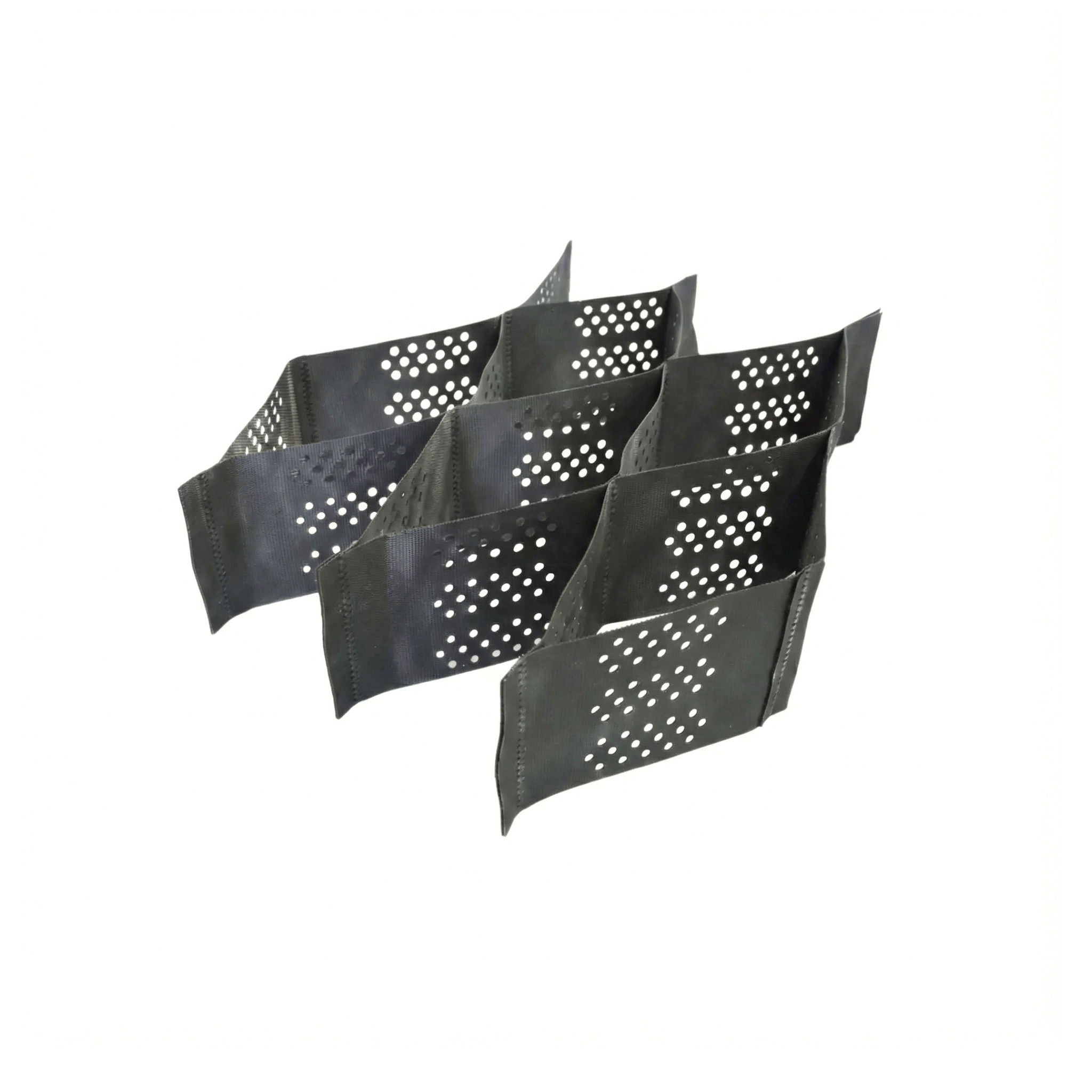
The polyethylene (PE) geocell is available in two heights: 10 cm and 15 cm, both textured and perforated, in expanded panels of 4 × 6 m. Both share the same material (HDPE), sheet thickness (1.5–1.7 mm), and weld spacing (44.5 cm). The height determines the depth of cellular confinement and, with it, the load-bearing capacity of the system. This comparison guide helps you decide which height suits your project: surface stabilization of slopes and light roadways, or deep reinforcement under heavier loads.
🎯 Choose your variant in 10 seconds
- If your application is slope protection, surface erosion control, or pedestrian pathways: go to the 10 cm height variant
- If your application is subbase reinforcement, vehicular roadways, or vegetated retaining walls: go to the 15 cm height variant
What to consider before choosing a variant
Both variants share the same material (HDPE), sheet thickness (1.5–1.7 mm), weld spacing (44.5 cm), color (black), high UV protection, and expanded panel format (4 × 6 m). The decision comes down to confinement depth and the type of infill used. These are the most important criteria:
- Primary function: surface erosion control calls for lower heights; subbase stabilization and load-bearing reinforcement require greater heights. The general rule is that the cell height must be at least equal to the maximum aggregate diameter of the infill.
- Infill type: topsoil and grass work well with 10 cm; 1–2 in gravel or subbase aggregate requires 15 cm to properly confine the particle and take advantage of the arching effect.
- Surface load: pedestrian use and occasional vehicles with 10 cm; permanent roadways, parking areas, and site access with 15 cm. Greater height better confines the aggregate and distributes the load over the subsoil.
- Terrain slope: on slopes steeper than 30%, step up to 15 cm to improve infill anchorage and reduce the risk of washout from heavy runoff.
- Complete system: beneath the geocell it is advisable to install nonwoven geotextile as a separator-filter layer, especially on soft or rocky soils. The geocell provides confinement; the geotextile prevents layer mixing.
10 cm height variant: the lightweight option for erosion control and pedestrian use
- Ideal surface confinement for topsoil and grass
- 2-person handling: lighter to transport and install
- Sheet thickness 1.5–1.7 mm: robust structure
- Yield strength ≥ 20 MPa per sheet and weld strength ≥ 100 N/cm
- Insufficient for permanent vehicular traffic
- Inadequate depth to confine aggregate larger than 1 in
The 10 cm format is the standard option for surface erosion control on garden slopes, parks, and landscaping projects. It performs very well with topsoil and grass, where the system becomes invisible once vegetation establishes. It is also used on pedestrian paths and occasional-use areas, where loads are low and the priority is surface stabilization.
15 cm height variant: the deep option for reinforcement and vehicular roadways
- Deep confinement: ideal for subbase gravel
- Joint peel strength: 2,130 N
- Suitable for vehicular roadways and outdoor parking
- Better performance on slopes steeper than 30%
- Greater infill volume per m² than the 10 cm version
- Oversized for garden slopes with grass cover
- Heavier expanded panel to handle
The 15 cm format is the specification for projects where the geocell acts as structural reinforcement: vehicular roadway subbase, outdoor gravel-filled parking areas, medium-traffic site access roads, or vegetated retaining walls with granular infill. The greater height takes better advantage of the arching effect between cells and distributes the load over the subsoil, reducing the required subbase thickness compared to a solution without a geocell.
Variant comparison table
Both variants are identical in material, thickness, weld spacing, color, UV protection, and panel format. The difference lies in panel height and, consequently, in confinement depth.
| Feature | 10 cm height | 15 cm height |
|---|---|---|
| Ideal use | Erosion control and pedestrian pathways | Reinforcement and vehicular roadways |
| SKU | 671265 | 747867 |
| Material | HDPE | HDPE |
| Panel height | 10 cm (4 in) | 15 cm (6 in) |
| Sheet thickness | 1.5–1.7 mm | 1.5–1.7 mm |
| Weld spacing | 44.5 cm | 44.5 cm |
| Spot weld strength | ≥ 100 N/cm | ≥ 100 N/cm |
| Cell joint strength | 120 N/cm | 120 N/cm |
| Sheet yield strength | ≥ 20 MPa | ≥ 20 MPa |
| Joint peel strength | — | 2,130 N |
| Finish | Textured and perforated | Textured and perforated |
| Color | Black | Black |
| UV protection | Yes (high) | Yes (high) |
| Expanded panel | 4 × 6 m | 4 × 6 m |
Use case matrix → recommended variant
| If your application is… | Recommended variant |
|---|---|
| Garden slope with grass or vegetative cover | → 10 cm |
| Pedestrian path or occasional-use area | → 10 cm |
| Surface erosion control on canal banks or drainage channels | → 10 cm |
| Subbase reinforcement for light to medium traffic roads | → 15 cm |
| Outdoor gravel-filled parking area | → 15 cm |
| Vegetated retaining wall or slope steeper than 30% | → 15 cm |
Before deciding on height, look at your infill aggregate. The practical rule is that cell height must be equal to or greater than the maximum aggregate diameter: if you are filling with 1 in (25 mm) gravel, the 10 cm cell is sufficient; if you are using 2 in (50 mm) gravel or larger, step up to 15 cm. If the cell is shorter than the particle, the particle protrudes above the top and you lose the confinement effect — which is the entire reason the geocell exists.
Do not install geocell directly on soft or fine-grained soil without geotextile underneath. Without the separator layer, fines from the subsoil migrate into the granular infill, contaminate it, and the geocell loses its load-bearing capacity within a few months. The investment in nonwoven geotextile under the geocell is small compared to the difference it makes in the system's service life.
Frequently asked questions
How many m² does one expanded panel cover?
Each expanded panel covers 24 m² (4 m × 6 m). The number of panels depends on the total area and overlaps. As a practical reference, calculate the projected area (m²) and add 5–10% for overlaps and cuts at irregular edges; for slopes with steep gradients, increase the factor to 12–15%.
What infill is best for each height?
For 10 cm: topsoil with grass, fine gravel (5–10 mm), or lightweight aggregates for pathways. For 15 cm: 1–2 in (25–50 mm) gravel, SUB-1 type subbase aggregate, or stabilized soil for roadways. Compact the infill to the top edge of the cell; do not allow it to overflow, as this eliminates the confinement effect.
Does it need to be anchored to the ground?
Yes, especially on slopes. Anchoring is done with fiberglass rods and anchor caps, driven through the perimeter cells and with an internal pattern based on the slope: every 1–1.5 m on gentle slopes and every 0.5–0.75 m on slopes steeper than 30%. On flat roadways, the weight of the infill is usually sufficient; on vegetated retaining walls, intermediate ties between panels are also used.
