
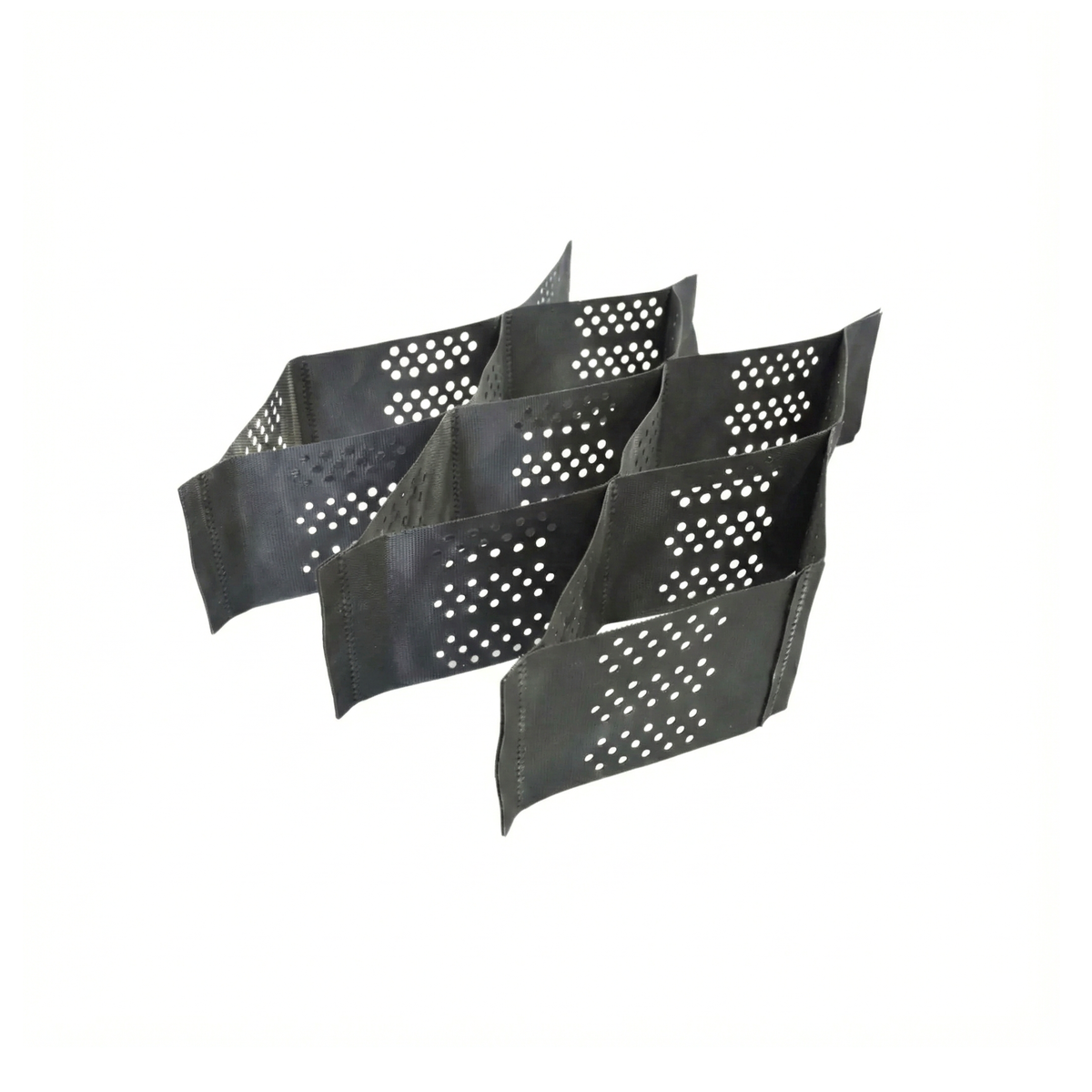
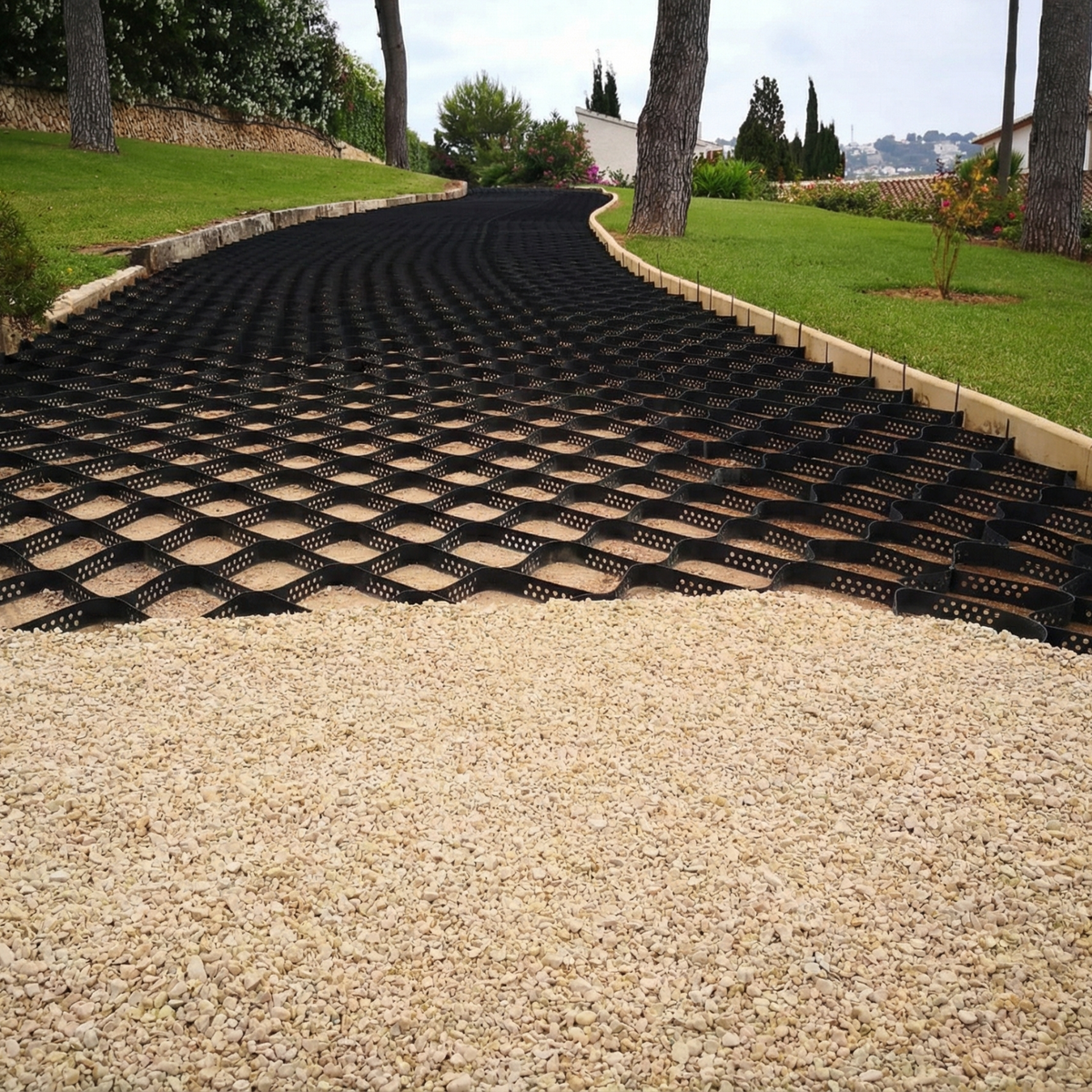
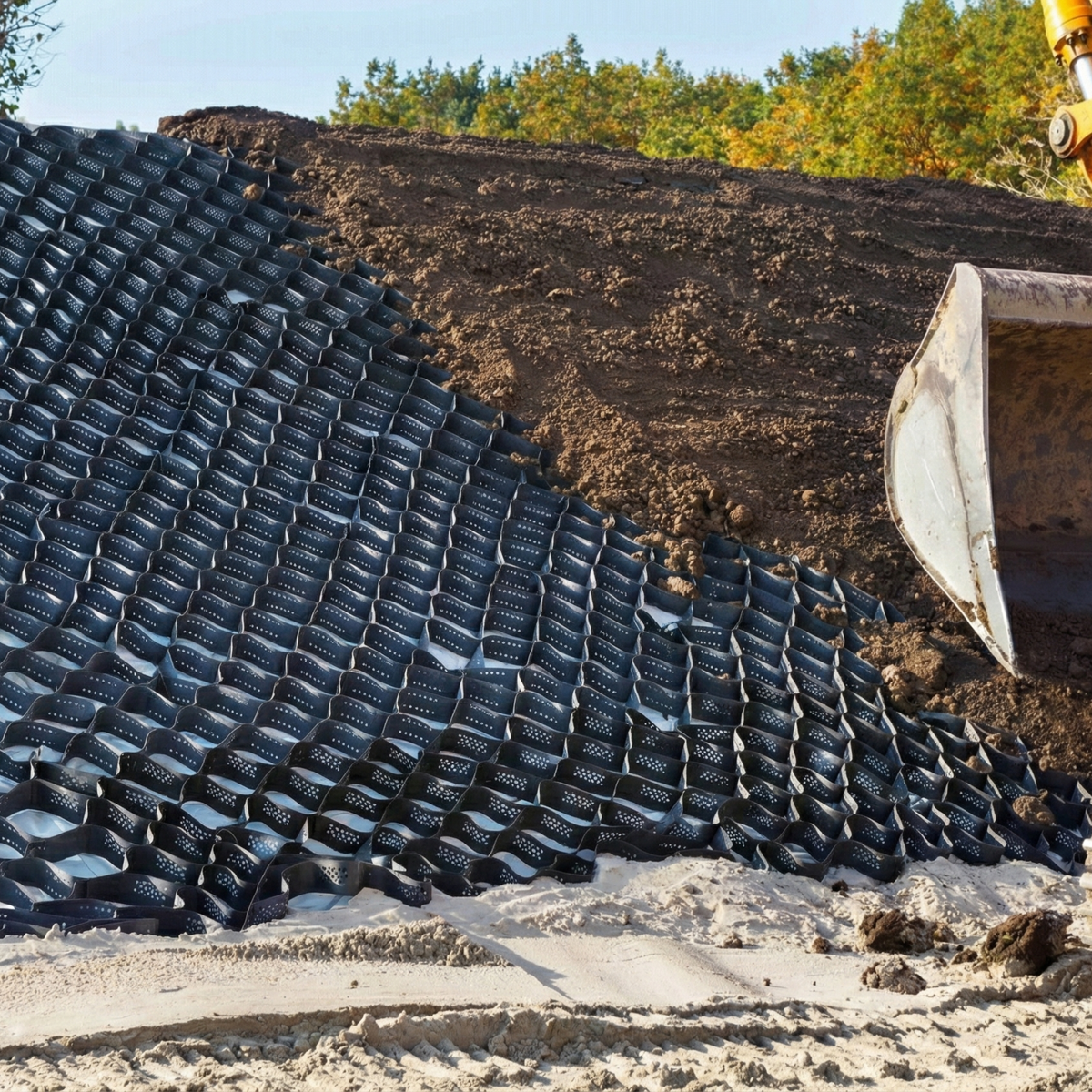


Stabilizing residential driveways and gravel parking areas where the aggregate migrates under vehicle traffic, forming potholes and ruts every few months; controlling erosion on steep slopes without resorting to reinforced concrete; or building green walls with reinforced soil for revegetation, calls for a three-dimensional polyethylene geocell with textured, perforated walls for mechanical confinement of the fill. This polyethylene (PE) geocell —also called a geocell, cellular confinement system or reinforcement honeycomb— is manufactured by MOLTEXO from textured, perforated HDPE, in two heights (10 cm and 15 cm) with a 44.5 cm weld spacing, a 4×6 m expanded panel, designed for light infrastructure, landscaping, erosion control and residential civil works.
Key benefits
- Three-dimensional cellular confinement: the honeycomb structure confines each portion of the fill within its cell, preventing horizontal displacement under vehicle load or slope, the mechanism that sets an effective geocell apart from a decorative plastic grid.
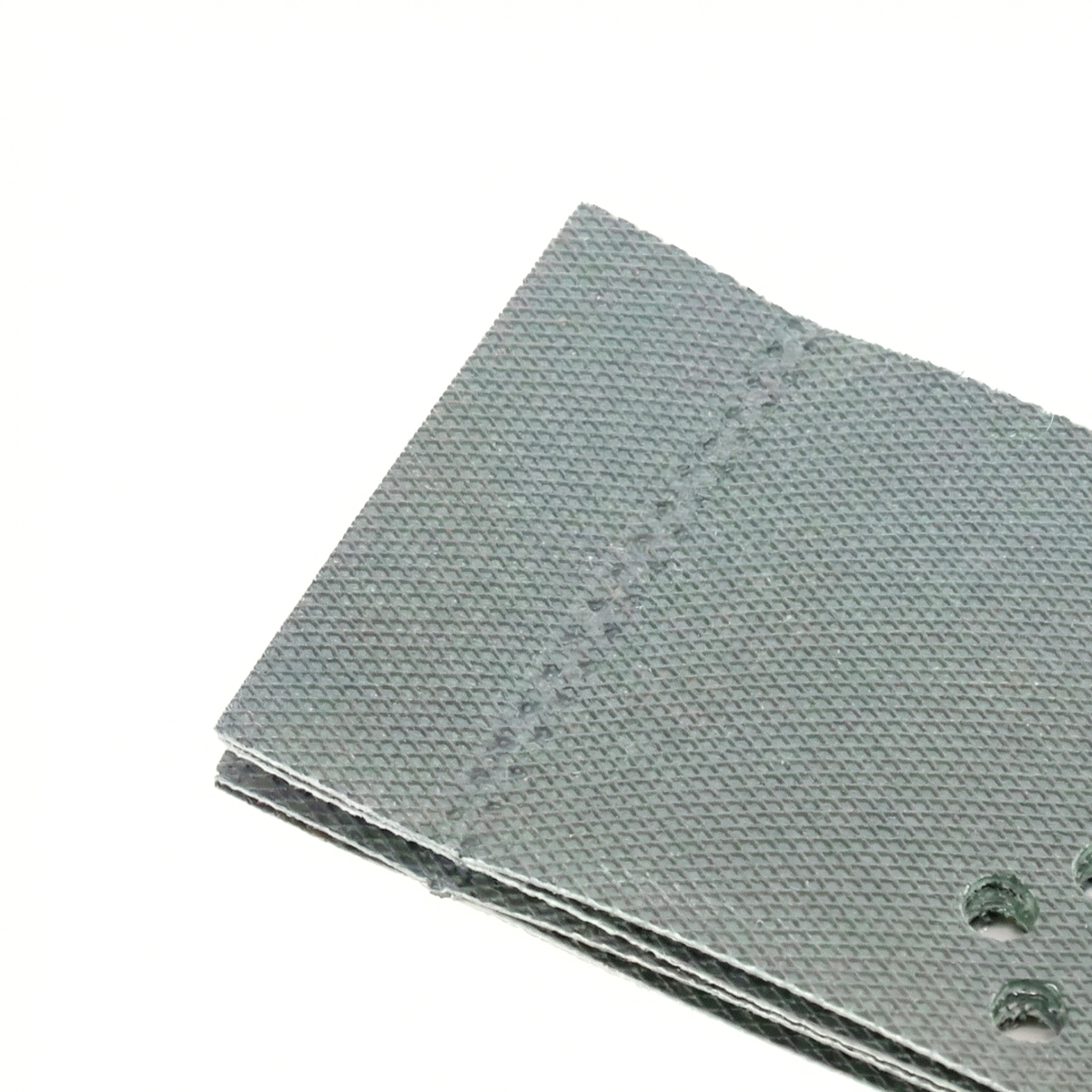
- Textured and perforated for friction: the textured surface of the cell walls increases friction with the fill material, improving interlock; the perforations allow water to flow between cells, avoiding buildup and keeping the system permeable.
- HDPE with UV additive: the polyethylene incorporates a UV-HALS stabilizer that withstands direct Caribbean radiation without crystallizing or becoming brittle, a condition for installations with partial fill or left uncovered where the cell remains visible.
- Fill versatility by use: angular gravel for parking areas and roads, topsoil for slopes and revegetation, concrete for rigid permanent structures and gravity walls, expanding applications with the same base system.
- Fast accordion-type deployment: the panel expands from a closed to an extended configuration on site, which lets you cover large areas with minimal layout time and reduces transport logistics cost (folded panels take up little volume).
Applications and typical uses
- Stabilization of residential vehicle entrances, farm roads and parking areas with gravel or compacted caliche.
- Erosion control on slopes, hillsides and canal banks with topsoil fill and subsequent revegetation.
- Construction of gravity retaining walls (green walls) for structural support with granular or plant fill.
- Load support in industrial yards, equipment storage areas and platforms with light traffic.
An alternative to riprap (rock armor)
The geocell is one of the recognized alternatives to riprap (rock armor or rock fill) for protecting banks, slopes and canals against erosion and scour. Filled with angular gravel, topsoil or concrete, it confines the material within its three-dimensional structure and lets small particle sizes perform like larger rocks, avoiding the cost of extracting, crushing and transporting large-class stone. Compared with traditional riprap, it offers lower weight, installation without heavy lifting machinery, the possibility of revegetating the slope and reduced transport emissions. For high or turbulent flows it is usually combined with a separation geotextile underneath and, optionally, a mat over the cell; in all cases it is advisable for an experienced professional to validate the design according to the site's hydraulic conditions.
Quality and durability
A cheap geocell fails at two points: the welds between cell walls give way under load (which lets the cells open and the fill migrate, losing the expected confinement) and the polyethylene lacks a proper UV additive (which causes embrittlement and cracking after just a few seasons in the sun). MOLTEXO works with UV-stabilized HDPE and controlled welds, which sets apart a professional jobsite geocell from a generic decorative panel that loses its structure in the first rainy season.
Equivalences
Equivalent to these other-brand references:
- Textured and perforated · 10 cm (4 in) high and 44.5 cm (17.5 in) weld spacing · 4 m (13 ft) wide and 6 m (20 ft) long panel [Extended]
- Presto GEOWEB 100 mm (4 in)PRS Neoloy Geocell 100 mm (4 in)Geo Products EnviroGrid 100 mm (4 in)Maccaferri MacWeb 100 mmPavco Wavin Geocelda 100 mmECOSEA Geocell 10 cmLAKA LK-Cells (family)RBK Builds Geocell (family)MYR Serviplast Dominicana Geocells (DR family)
- Textured and perforated · 15 cm (6 in) high and 44.5 cm (17.5 in) weld spacing · 4 m (13 ft) wide and 6 m (20 ft) long panel [Extended]
- Presto GEOWEB 150 mm (6 in)PRS Neoloy Geocell 150 mm (6 in)Geo Products EnviroGrid 150 mm (6 in)Maccaferri MacWeb 150 mmPavco Wavin Geocelda 150 mmECOSEA Geocelda 15 cmLAKA LK-Cells (family)RBK Builds Geoceldas Geocell (family)MYR Serviplast Dominicana Geoceldas (RD family)
Brands and references mentioned belong to their respective owners; cited only for comparison and compatibility.
What materials should the geocell be filled with depending on use?
Is it necessary to install geotextile under the geocell?
How does this geocell help in gravel parking lots or residential driveways?
Can it be cut to size on site?
Does it withstand the intense UV radiation of the Dominican Republic?
Still have questions?
Ask us and we will gladly help you with whatever you need.
| Material and construction | |
|---|---|
| Material | High-density polyethylene (HDPE) |
| Color | Black |
| Dimensions and format | |
| Thickness | 1.5–1.7 mm (0.059–0.067 in) |
| Strength and performance | |
| Yield tensile strength of each sheet | ≥20 MPa (≥2,901 psi) |
| Welded points tensile strength | ≥100 N/cm (≥57.1 lbf/in) |
| Cell-to-cell weld tensile strength | 120 N/cm (≥68.5 lbf/in) |
| Durability and protection | |
| UV protection | Yes (high) |
| Presentation and packaging | |
| Presentation | Panel 4 m (13 ft) wide × 6 m (20 ft) long [Extended] |
| Panel: Width | 110.0 cm (43.31 in) |
|---|---|
| Panel: Height | 10.0 cm (3.94 in) |
| Panel: Depth | 45.0 cm (17.72 in) |
| Panel: Weight | 24.0 kg |
Official MOLTEXO warranty
What's covered
Confirmed defect: replacement or refund of the amount paid.
What's not covered
Payment & Security

