

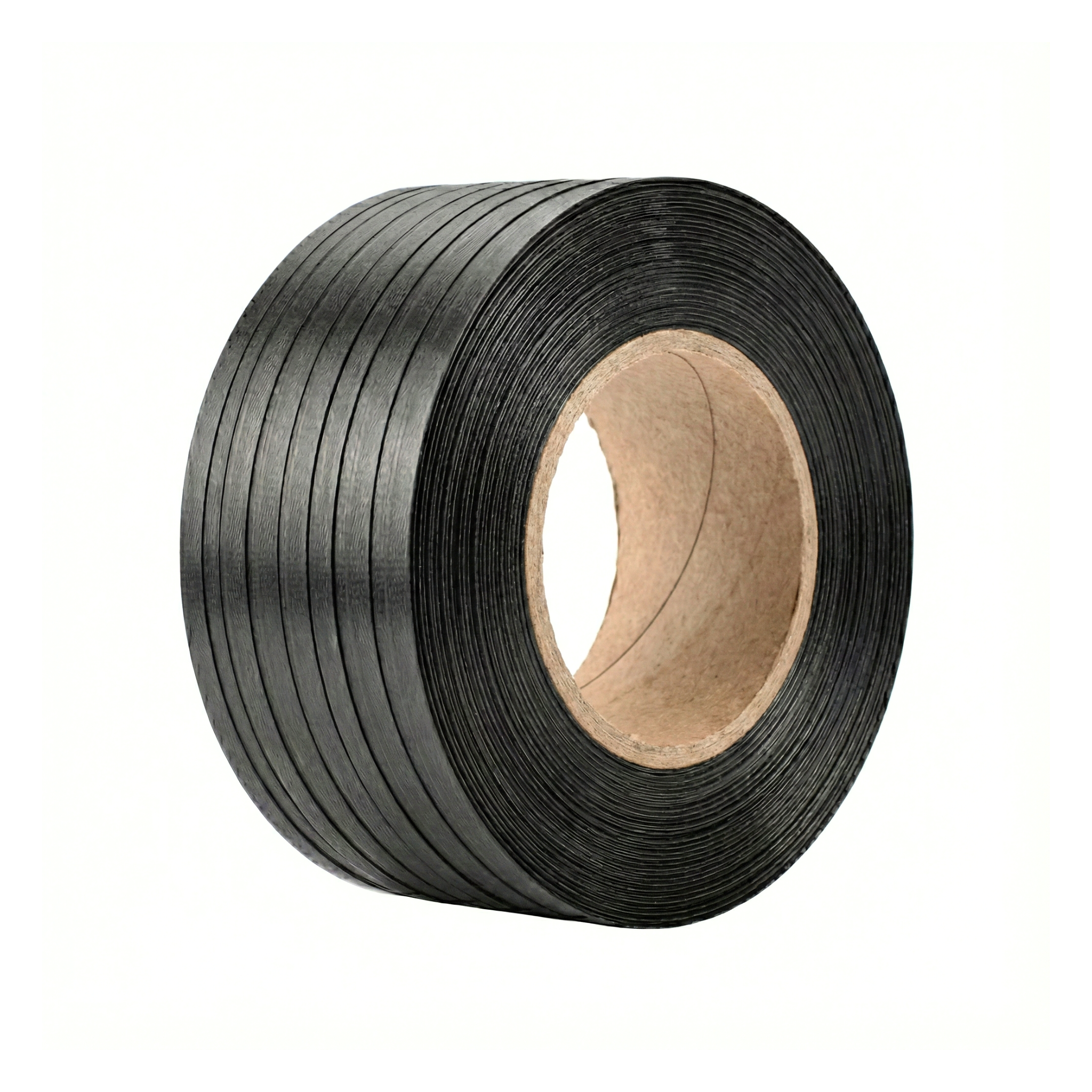
Polypropylene (PP) strapping comes in five widths — 5, 9, 12, 15 and 19 mm — covering everything from high-speed automatic strapping to heavy manual loads. All share the same virgin PP material, embossed finish, and cardboard core; what changes is the width, breaking strength, and above all whether they are designed for a machine or for a manual tool. This comparison helps you choose the right width based on your strapping method and load weight.
🎯 Choose your variant in 10 seconds
- If you strap with a high-speed automatic machine (courier, printing): go to 5 mm (> 60 kg)
- If you strap with a standard automatic or semi-automatic machine: go to 9 mm (> 100 kg)
- If you want the most versatile width (machine or manual): go to 12 mm (> 140 kg)
- If you strap pallets and medium boxes by hand: go to 15 mm (> 180 kg)
- If you strap heavy loads or dense bundles by hand: go to 19 mm (> 240 kg)
What to consider before choosing a variant
All five coils share the same material (virgin PP), embossed finish, black color, and cardboard core. The decision depends on how you strap and how much your load weighs. These are the most important criteria:
- Machine or manual: narrow widths (5 and 9 mm) are designed for automatic and arch strapping machines; wide widths (15 and 19 mm) for manual tools; 12 mm bridges both worlds.
- Weight and breaking strength: ranges from > 60 kg (5 mm) to > 240 kg (19 mm). Choose the width that comfortably covers your actual bundle or pallet weight.
- Yield per coil: at equal weight (9.5 kg net), a narrow width yields much more: 6,000 m at 5 mm vs. 1,000 m at 19 mm. In high-volume automatic lines, that means fewer coil changes.
- Strap closure: metal seal (PP strapping seal), tool-free plastic buckle, or friction weld with a machine or battery-powered strapping tool.
- Sharp edges and corners: protect with a plastic corner protector under the strap to prevent tension from cutting through the cardboard.
Variant 5 mm × 6,000 m: the narrow width for high-speed automatic machines
- 6,000 m per coil: the highest yield in the range
- Narrow width ideal for high-cadence machines
- Fewer coil changes in continuous-line operations
- Low breaking strength (> 60 kg): only for very light loads
- Designed for machines, not manual strapping
The 5 mm width is the consumable for high-speed automatic strapping machines: sealing courier boxes, magazine bundles, delivery packages, and e-commerce orders on continuous lines. It yields 6,000 m per coil — the highest in the range — reducing downtime for roll changes in high-volume operations.
Variant 9 mm × 3,000 m: the standard automatic width
- The most common machine width in the world
- 3,000 m per coil: good yield
- Breaking strength > 100 kg for light to medium loads
- For regular manual strapping, 12 or 15 mm is preferable
The 9 mm is the world's most widely used machine width: automatic and semi-automatic warehouse equipment, light product grouping, and standard box sealing. With a breaking strength of over 100 kg and 3,000 m per coil, it balances yield and resistance for medium-volume operations.
Variant 12 mm × 2,100 m: the world's best-seller (machine or manual)
- The best-selling PP width in the world
- Works equally well on semi-automatic machines and by hand
- Breaking strength > 140 kg for boxes and light pallets
- For heavier manual loads, move up to 15 or 19 mm
The 12 mm is the world's best-selling PP reference and the recommended starting point for most operations: it works on both semi-automatic machines and with a manual tensioner tool. With a breaking strength of over 140 kg, it is the width that best balances versatility, strength, and yield.
Variant 15 mm × 1,300 m: the manual width for pallets and medium loads
- Wide band: better tension distribution over cardboard
- Breaking strength > 180 kg for medium loads
- The metric equivalent of the classic 5/8 inch (16 mm)
- 1,300 m per coil: fewer meters than the narrow widths
- For automatic machines, 9 or 12 mm is preferable
The 15 mm is the workhorse of manual strapping: pallets, large boxes, and medium bundle grouping. Its wider band distributes tension better over cardboard and reduces the risk of cutting through the box. It is the metric equivalent of the classic 5/8 inch (16 mm). Pair it with a dispenser cart to reduce operator effort.
Variant 19 mm × 1,000 m: the heavy manual width
- The strongest PP: breaking strength > 240 kg
- Wide band for the most demanding bundles
- A cost-effective alternative before stepping up to PET
- 1,000 m per coil: the lowest yield in the range
- For very heavy loads or export, consider PET strapping
The 19 mm is the strongest PP width, for manual strapping of heavy loads and dense bundles where the 15 mm falls short. With a breaking strength of over 240 kg, it is the economical choice before stepping up to polyester (PET) strapping for truly heavy or export loads.
Variant comparison table
| Feature | 5 mm | 9 mm | 12 mm | 15 mm | 19 mm |
|---|---|---|---|---|---|
| Mode | Automatic | Automatic | Auto + manual | Manual | Manual |
| SKU | PP-05050 | PP-09060 | PP-12070 | PP-15080 | PP-19080 |
| Thickness | 0.5 mm | 0.6 mm | 0.7 mm | 0.8 mm | 0.8 mm |
| Breaking strength | > 60 kg | > 100 kg | > 140 kg | > 180 kg | > 240 kg |
| Length per coil | 6,000 m | 3,000 m | 2,100 m | 1,300 m | 1,000 m |
| Net coil weight | 9.5 kg | 9.5 kg | 9.5 kg | 9.5 kg | 9.5 kg |
| Core (mandrel) | Cardboard 203 × 203 mm | Cardboard 203 × 203 mm | Cardboard 203 × 203 mm | Cardboard 203 × 203 mm | Cardboard 203 × 203 mm |
Use-case matrix → recommended variant
| If your case is… | Recommended variant |
|---|---|
| High-speed automatic machine (courier, printing) | → 5 mm |
| Standard automatic or semi-automatic machine | → 9 mm |
| A single versatile width for both machine and manual use | → 12 mm |
| Manual strapping of pallets and medium boxes | → 15 mm |
| Manual strapping of heavy loads or dense bundles | → 19 mm |
If your operation combines both machine and manual strapping, the 12 mm lets you work with a single width across both workflows and simplifies inventory management. Reserve the 5 and 9 mm for pure automatic lines (where yield per coil is paramount) and the 15 and 19 mm for manual strapping stations.
Do not push PP beyond its range. Although the 19 mm exceeds 240 kg, polypropylene loses tension over time more than polyester does. For truly heavy, rigid, or export loads with several days in transit, PET strapping is the right choice; PP excels at light to medium palletizing.
Frequently asked questions
Which PP widths are for machines and which are for manual strapping?
Narrow widths (5 and 9 mm) are designed for automatic and arch-type strapping machines, where yield per coil and speed are paramount. Wide widths (15 and 19 mm) are for manual tools: tensioner, combination tool, and seal. The 12 mm bridges both: it works well on semi-automatic machines and by hand, which is why it is the world's best-selling PP width.
Why does a 5 mm coil contain 6,000 m while a 19 mm coil only has 1,000 m?
Because they all weigh the same: 9.5 kg net of polypropylene. At equal weight, the narrower and thinner the strap, the more length fits on the coil. That is why the 5 mm yields more meters (ideal for high-volume automatic lines) while the 19 mm, although it yields fewer meters, provides much greater load capacity per loop.
When should I switch from PP strapping to PET strapping?
When the load is heavy, rigid, or travels for several days (export). PP is ideal for light to medium palletizing, but it loses tension over time more than polyester does. PET maintains tension despite vibration and humidity, and achieves much higher breaking strengths. For heavy construction materials, metal, or export shipments, PET is the right choice.
