

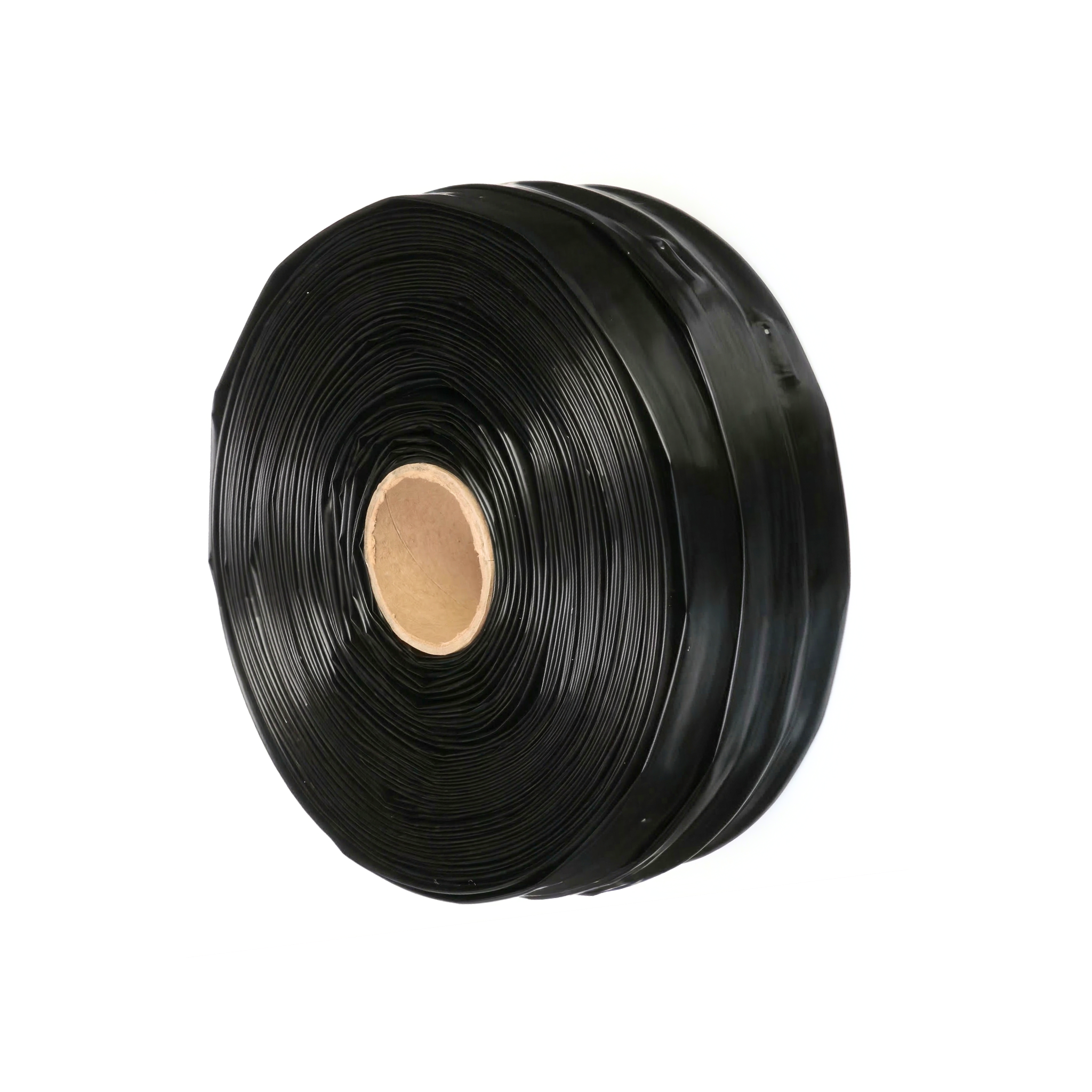
Self-compensating drip irrigation tape comes in two configurations that differ only in the spacing between emitters: 20 cm or 30 cm. Both share the same tape (16 mm diameter, gauge 240/0.6 mm thickness) and the same flow rate per emitter (1.6 L/h), delivered in a 500 m roll. "Self-compensating" means that each emitter delivers the same flow rate regardless of pressure within the working range, a decisive advantage on sloped terrain or very long lines. The choice between 20 and 30 cm depends on the planting density of your crop.
🎯 Choose the variant in 10 seconds
- If your case is dense planting: lettuce, strawberry, onion, garlic or vegetables in a narrow row: go to the 20 cm emitter spacing configuration
- If your case is spaced planting: tomato, pepper, cucumber, melon or cucurbits: go to the 30 cm emitter spacing configuration
What to consider before choosing the variant
Both configurations share tape, diameter, gauge, flow rate per emitter and roll length. The choice comes down to aligning the emitter spacing with the crop's planting layout. These are the key criteria:
- Planting layout: ideally, each plant should sit on or very close to an emitter. Crops planted every 15–20 cm (lettuce, strawberry, onion) work best with 20 cm spacing. Crops planted every 25–40 cm (tomato, pepper, cucumber) work best with 30 cm.
- Total flow per line: with 20 cm spacing there are 5 emitters/m, which gives 8 L/h per linear meter and 4,000 L/h per 500 m roll. With 30 cm spacing there are 3.33 emitters/m, which gives 5.33 L/h per linear meter and 2,667 L/h per roll. This directly affects the sizing of the water source and filters.
- Slope and line length: gauge 240 (0.6 mm thickness) and self-compensating technology allow long lines on sloped terrain without the end emitters delivering less water than those at the start. On flat, short lines (≤ 50 m), standard gauge 120 tape is already sufficient; self-compensating is the choice when there are gradients or lines longer than 100 m.
- Filtration and water: self-compensating emitters have a flexible membrane that is more demanding on water quality. Always use a mesh or disc filter of at least 120 mesh before the head unit. With well water or highly mineralized water, consider treatments against calcium precipitates.
- Expected service life: gauge 240 (0.6 mm) doubles the thickness of standard gauge 120, which translates into greater durability and resistance to breakage, especially in crops where the tape is rolled up and reused between seasons. For perennial crops on benches or in greenhouses, this robustness offsets the higher cost.
20 cm emitter spacing configuration: the dense one for vegetables and narrow planting
- 5 emitters per linear meter
- 2,500 emitters and 4,000 L/h per 500 m roll
- Uniform wetting in a continuous line
- Natural alignment with dense plantings
- Higher total flow: requires a properly sized source and filter
- Oversized for tomato or pepper
The 20 cm configuration is the natural choice for crops planted in a dense row, where each plant sits on an emitter or between two consecutive emitters. In lettuce, strawberry and onion, this emitter density creates a continuous wet band along the line, which avoids dry zones between plants and promotes uniform root development. For strawberry on plastic-mulched beds with a 20 × 25 cm layout, this tape is the industry standard.
30 cm emitter spacing configuration: the spaced one for tomato, pepper and cucurbits
- 3.33 emitters per linear meter
- 1,667 emitters and 2,667 L/h per 500 m roll
- Lower demand on source and filter
- Fits standard planting layouts
- Insufficient for very dense planting
- Possible dry zones between emitters in sandy soils
The 30 cm configuration is the standard for crops in spaced rows: greenhouse tomato planted at 30–40 cm, pepper and cucumber with similar layouts, melon and cucurbits in general. It reduces the total flow per line, which allows more sectors to be fed from the same water source and simplifies head-unit sizing. In soils with good horizontal diffusion of the wet bulb (loamy, clay soils), the 30 cm separation covers the plants well; in very sandy soils it is advisable to check diffusion and, if there are dry zones, alternate with the 20 cm tape or supplement with individual emitters.
Variant comparison table
Both configurations share tape, diameter, gauge, flow rate per emitter, self-compensating technology and roll length. The difference lies only in the spacing between emitters and, therefore, in the irrigation density per linear meter.
| Characteristic | 20 cm between emitters | 30 cm between emitters |
|---|---|---|
| Ideal use | Dense planting | Spaced planting |
| SKU | 213457 | 234512 |
| Technology | Self-compensating | Self-compensating |
| Diameter | 16 mm (5/8 in) | 16 mm (5/8 in) |
| Thickness (gauge) | 0.6 mm (Gauge 240) | 0.6 mm (Gauge 240) |
| Spacing between emitters | 20 cm (7.87 in) | 30 cm (11.81 in) |
| Flow rate per emitter | 1.6 L/h (54.1 fl oz/h) | 1.6 L/h (54.1 fl oz/h) |
| Emitters per meter | 5 | 3.33 |
| Flow rate per linear meter | 8 L/h | 5.33 L/h |
| Emitters per 500 m roll | 2,500 | 1,667 |
| Total flow per roll | 4,000 L/h (1,060 gal/h) | 2,667 L/h (704 gal/h) |
| Roll length | 500 m (1,640 ft) | 500 m (1,640 ft) |
Use case → recommended variant matrix
| If your case is… | Recommended variant |
|---|---|
| Strawberry on plastic-mulched bed | → 20 cm |
| Lettuce, spinach or chard in a row | → 20 cm |
| Onion and garlic in a compact layout | → 20 cm |
| Greenhouse or field tomato | → 30 cm |
| Pepper, cucumber or eggplant | → 30 cm |
| Melon, watermelon or cucurbits in general | → 30 cm |
Take advantage of the self-compensating benefit to extend the lines and reduce the number of valves and connections. With standard gauge 120 tape, lines are typically limited to 80–100 m to maintain flow uniformity. With self-compensating gauge 240, you can reach 200–250 m per line without significant flow loss between the start and the end, even on slopes of up to 10–12%. This simplifies hydraulic design and reduces the cost of head units and valves on large plots or rough terrain. Calculate the total flow of your sector by multiplying meters of line by L/h per linear meter and size filters and pumps for that flow.
Do not install self-compensating tape without adequate filtration. Emitters with a flexible membrane are more sensitive to particles and water quality than simple emitters. Always use a mesh or disc filter of at least 120 mesh (with well or river water, increase to 155–200 mesh) and check the filter at least once a week in peak season. A single blockage at the head unit can carry particles to several emitters and force you to replace entire sections ahead of time.
Frequently asked questions
Self-compensating or standard: when does the extra cost pay off?
Self-compensating justifies the extra cost when there is a gradient in the plot (from a 5–10% slope onward, standard emitters start to deliver very different flow rates between the start and the end of the line), when the lines are long (more than 100 m) or when the crop is high-value and needs irrigation uniformity to ensure homogeneous production. On short, flat lines with a low-value crop, the standard tape remains more economical and sufficient.
How long does self-compensating tape last?
Gauge 240 (0.6 mm thickness) doubles the thickness of standard tape, which translates into greater mechanical strength and service life. With careful handling (clean irrigation, adequate filtration, careful removal at the end of the cycle), self-compensating tape withstands several seasons in crops where it is rolled up and reused. In perennial crops on benches or in greenhouses (strawberry, vegetables in substrate), it lasts 4–6 years with good maintenance.
What working pressure does it need?
Self-compensating tape maintains a constant flow rate within a typical pressure range of 0.5–3 bar (check the roll's technical data sheet for the exact range). This means that even if the pressure varies within that range due to gradient or line length, the emitter delivers the nominal 1.6 L/h. The irrigation head unit must deliver at least the minimum pressure of the range; at pressures above the maximum, the emitters may suffer and have a reduced service life.
