

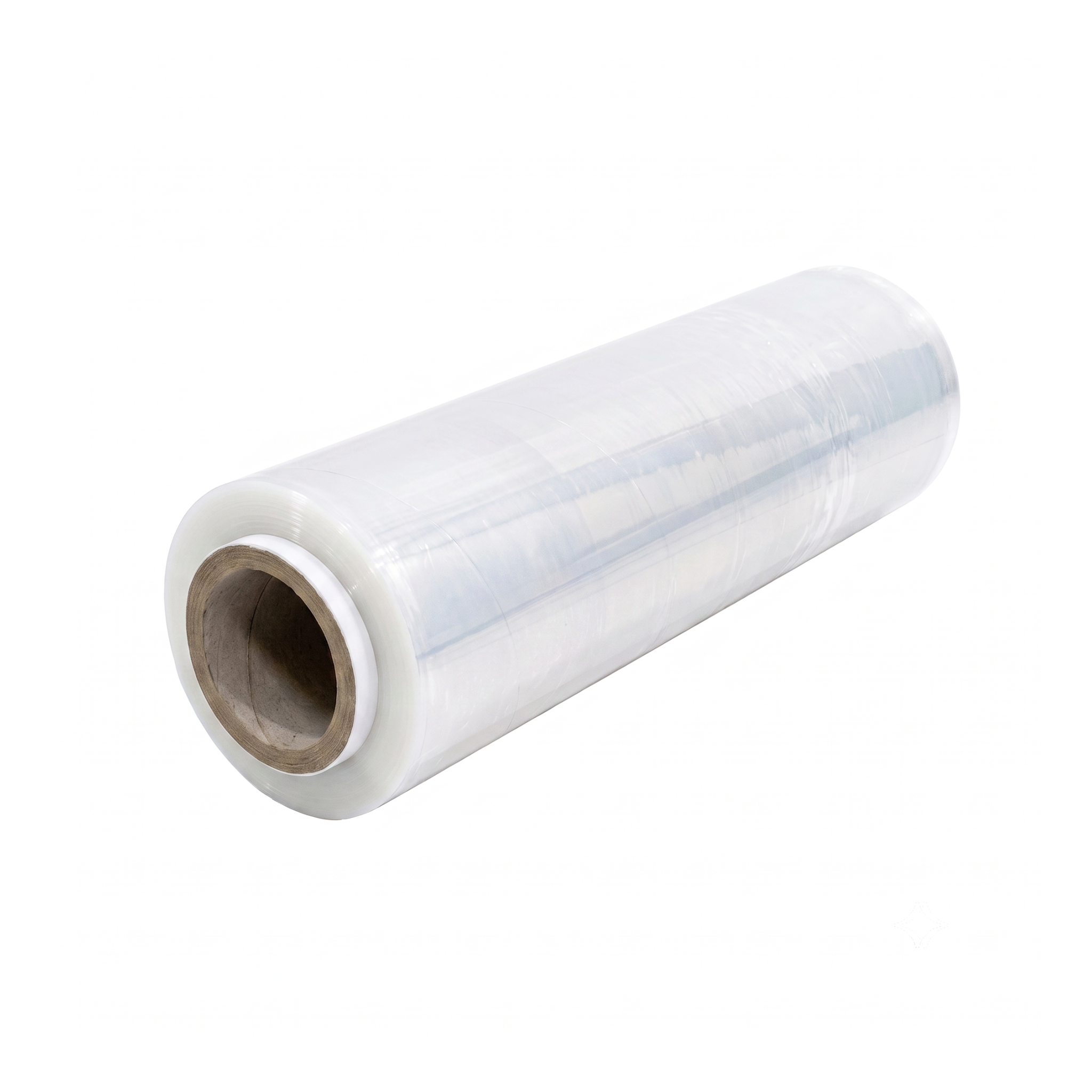
This guide covers the use of food-grade polyethylene (PE) film in the kitchen and at the counter: mounting the roll in its dispenser box, pulling and cutting with the saw, contact-sealing trays, cold storage and microwave use, and rotation of the wrapped product. Follow these steps to preserve food safely and without wasting film.
Product Specifications
The film is virgin polyethylene, free of PVC, phthalates, and BPA, with FDA 21 CFR and EU Regulation 10/2011 food contact certification, manufactured by Fortemo in two widths with 300 m per roll. The table shows the two available variants:
| Specification | 30 cm × 300 m | 45 cm × 300 m |
|---|---|---|
| SKU | 620110 | 620111 |
| Roll width | 30 cm (12 in) | 45 cm (18 in) |
| Length per roll | 300 m (984 ft) | 300 m (984 ft) |
| Thickness | 10 µm | 10 µm |
| Material | Virgin PE, PVC, phthalate, and BPA free | Virgin PE, PVC, phthalate, and BPA free |
| Certification | FDA 21 CFR and EU Regulation 10/2011 | FDA 21 CFR and EU Regulation 10/2011 |
| Suitability | Cold, freezer, and gentle microwave | Cold, freezer, and gentle microwave |
| Presentation | Box of 6 rolls, with dispenser and cutter | Box of 6 rolls, with dispenser and cutter |
| Brand | Fortemo | Fortemo |
Step-by-step guide
The workflow covers everything from mounting the roll to the wrapped and labeled product in the cold room. The technique is simple, but the order matters: a well-mounted roll and a clean cut per serving are what separates a kitchen that uses the entire roll from one that loses meters in snags and overlaps.
Mount the roll in the dispenser box
Place the roll in the box with the film exiting flat through the front slot and the serrated cutter free of obstructions. Position the box at a fixed point on the workbench, within reach of the operator: dispensing with one hand while the other holds the tray is what gives rhythm to packaging.
Pull the exact length and cut with a swift motion
Pull out enough film to cover the container plus 5 cm on each side, place the section on the cutter, and cut with a swift flick of the wrist. The clean cut of the metal cutter avoids the classic flaw of household film: the pull that stretches the film, tears it crooked, and causes the loss of the roll's start.
Wrap gently by stretching and seal by contact
Cover the tray with the film centered, gently stretch it towards the edges, and press the perimeter: PE seals by natural adherence of film to film and to the container, without adhesives. The surface should be smooth, without large air pockets, with the excess folded under the base.
Standardize the two widths per station: 30 cm at the counter and portion line, 45 cm in the cold room and for large containers. This avoids the bad habit of joining two narrow sections to close a container (double consumption and weak seal) and the opposite, wasting wide film on small containers.
For cold storage, label with date and content
Before taking the container to the cold room or freezer, label the date and content on a sticker on the film. The transparency of PE allows for quick product identification, and the film resists the freezer without becoming brittle, so the kitchen's FIFO rotation is maintained without opening wraps.
In the microwave, leave a vent
For gentle heating, lift one corner of the film as a steam vent and avoid direct contact of the film with very hot fats. PE allows microwave use at moderate power without breaking or transferring substances to the food; cooking with film, however, is not its function.
Complementary Products
PE film covers preservation in the kitchen and cold room; these complements complete the flow from the display case to the office:
Adhesive Polyvinyl Chloride (PVC) Film is the display case companion: maximum cling and shine for display trays at the counter. Manual Stretch Film secures already packed boxes when palletized for branches or customers. Transparent PP Tape seals daily dispatch boxes.
Maintenance and Care
Food-grade film requires the same conditions as any food-contact material: cleanliness, freshness, and rotation. Three rules keep it in sanitary and performance conditions:
- Cool and dry storage: Store closed boxes away from sun, stoves, and ovens. Prolonged heat degrades polyethylene, and an overheated roll tears when pulled.
- FIFO rotation: Use the oldest boxes first and keep the original packaging, which protects the roll from dust and splashes common in the kitchen.
- Clean dispenser box: Clean the slot and saw when they accumulate grease; a greasy saw loses its cutting ability and the film starts tearing, leading to loss of the roll's start.
Do not use this film as a cooking bag or in a conventional oven, and avoid microwaving at maximum power with the film in direct contact with fats: PE allows gentle heating, not cooking. Nor should it be used to palletize loads: with a thickness of 10 µm, it is a preservation film, not a securing film; for pallets, industrial stretch film is used.
Frequently Asked Questions
How many wraps does a 300 m roll yield?
As a reference, a standard tray uses 40-50 cm of film per serving: a 300 m roll yields between 600 and 700 wraps. This is a good indicator for auditing kitchen consumption; if the roll lasts much less, there are usually excessively long cuts or double overlaps from using the wrong width.
Is it suitable for vacuum sealing or with a heat sealer?
No. This film seals by contact and natural adhesion, without heat: it is designed to wrap trays, containers, and portions. Vacuum sealers and heat sealers require specific bags and films for heat sealing; using contact film in these devices does not create a seal and can melt on the heating element.
Can I wrap pots or containers that are still hot?
Let them cool first. On a very hot container, steam condenses immediately, the film bulges, and the contact seal loosens. With a tempered container, the wrap remains smooth, the seal firm, and the product goes into cold storage without trapped condensation, which shortens the food's shelf life.
