
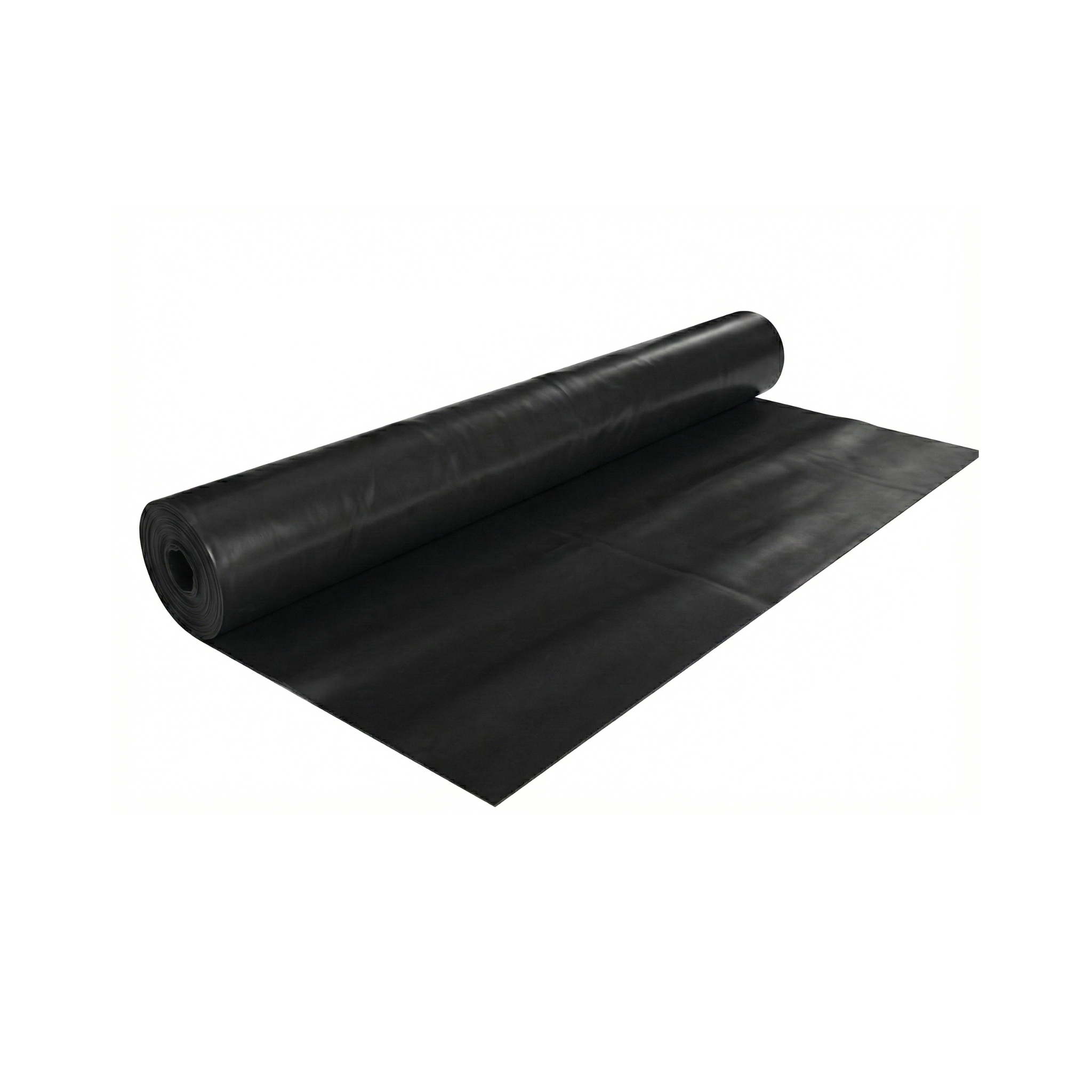
This guide covers the correct installation of HDPE geomembrane: site preparation, placement of the protective layer, unrolling the panels, joining panels together, and anchoring in a perimeter trench. Follow the recommended sequence so the liner seals without leaks and lasts for decades, with thickness-specific notes throughout.
Product specifications
HDPE geomembrane is a black impermeable liner with a smooth finish, available in six thicknesses. The two lightest gauges (0.1 mm and 0.2 mm) come in rolls of 2 m × 50 m (100 m² per roll), ideal for small projects or vapor barriers. The remaining four (0.5 mm, 1 mm, 1.5 mm, and 2 mm) are supplied as industrial rolls of 5.8 m × 100 m (580 m² per roll), designed for ponds, reservoirs, and large-scale containment.
Higher gauge means greater tear and puncture resistance, but also greater roll weight. Consult the table before installation to confirm your variant and prepare the necessary equipment.
| Specification | 0.1 mm Calibre 400 |
0.2 mm Calibre 800 |
0.5 mm Calibre 2000 |
1 mm Calibre 4000 |
1.5 mm Calibre 6000 |
2 mm Calibre 8000 |
|---|---|---|---|---|---|---|
| Parent SKU | 341532 | |||||
| Roll size | 2 m × 50 m | 2 m × 50 m | 5.8 m × 100 m | 5.8 m × 100 m | 5.8 m × 100 m | 5.8 m × 100 m |
| Coverage per roll | 100 m² | 100 m² | 580 m² | 580 m² | 580 m² | 580 m² |
| Material | High-density polyethylene (HDPE) | |||||
| Density | — | — | 0.94 g/cm³ | 0.94 g/cm³ | 0.94 g/cm³ | 0.94 g/cm³ |
| Tensile strength (yield point) | — | — | 10 N/mm | 15 N/mm | 22 N/mm | 29 N/mm |
| Tensile strength (break) | — | — | 10 N/mm | 27 N/mm | 40 N/mm | 53 N/mm |
| Elongation at break | — | — | 800 % | 800 % | 800 % | 800 % |
| Tear resistance | — | — | 69 N | 125 N | 187 N | 249 N |
| Puncture resistance | — | — | — | 320 N | 480 N | 640 N |
| UV protection | Yes (high) | |||||
| Core | Rigid plastic | |||||
| Roll weight | — | 18.8 kg | 272.6 kg | 545.2 kg | 817.8 kg | — |
Step-by-step HDPE geomembrane installation
Correct installation is the single most important factor for liner lifespan. Follow these five steps in order. Where the procedure differs by gauge, you will find a specific note immediately below the step.
Prepare the ground
Remove all stones, roots, glass, and any sharp objects from the area where the geomembrane will be placed. Level and compact the soil, eliminating irregularities greater than 2 cm. A clean, smooth surface is the first line of defense against punctures during use.
Place a protective layer
Over the leveled ground, spread a layer of fine sand (5 to 10 cm) or a protective geotextile. This cushion absorbs minor soil imperfections and prevents the geomembrane from being punctured by contact with hidden stones.
- If you have the 0.1 mm or 0.2 mm variant (Gauge 400 or 800): a thin sand layer of 3 to 5 cm is sufficient, as the film is flexible and tolerates minor irregularities well.
- If you have the 0.5 mm or 1 mm variant (Gauge 2000 or 4000): use 5 to 8 cm of compacted sand or, preferably, a lightweight geotextile.
- If you have the 1.5 mm or 2 mm variant (Gauge 6000 or 8000): given the roll weight and demanding containment application, always install a protective geotextile both below and above the liner.
Unroll the liner
Position the roll at one end of the area and unroll it along the length of the excavation. Smooth the liner as you extend it to prevent folds, air pockets, and tension. Always leave at least 30 cm of perimeter overlap for the final anchoring.
- If you have the 0.1 mm or 0.2 mm variant (2 m × 50 m roll, 18.8 kg): two people can deploy it without machinery.
- If you have the 0.5 mm variant (5.8 m × 100 m roll, 272.6 kg): you need at least 4 to 6 workers or a small forklift to unload and position it.
- If you have the 1 mm variant (5.8 m × 100 m roll, 545.2 kg): deployment requires a forklift and a handling tube inserted through the core.
- If you have the 1.5 mm (5.8 m × 100 m roll, 817.8 kg) or 2 mm variant: use a crane or excavator with a sling; do not attempt to move it manually under any circumstances.
Join the panels together
Overlap the edge of one roll over the next by a minimum of 10 cm. The permanent seam must be made along this overlap to ensure a fully watertight joint. The method depends on the gauge you are working with.
- If you have the 0.1 mm or 0.2 mm variant: you can join it with high-strength butyl tape or a hot-air gun (manual welding) at low power. Verify the seal by running your hand along the weld bead.
- If you have the 0.5 mm or 1 mm variant: professional hot-wedge or extrusion welding is the recommended method. Adhesive tape is not reliable long-term at these thicknesses.
- If you have the 1.5 mm or 2 mm variant: use exclusively hot-wedge welding equipment (double-track with test channel) operated by trained personnel. This is the only technique that guarantees a watertight seal under pressure.
Anchor the geomembrane in the perimeter trench
Excavate an anchor trench 30 cm deep × 30 cm wide around the entire perimeter. Tuck the liner overlap into the trench and backfill with compacted soil. This closure prevents wind uplift and water escape at the edges.
Install the geomembrane during the cool morning hours (before 10 a.m.) or at dusk. At midday, the Dominican sun raises the temperature of the black liner above 60 °C, causing thermal expansion that contracts upon cooling and can create permanent wrinkles in already-welded seams.
Complementary products
For a professional, long-lasting installation, the liner alone is not enough. These accessories are what make the difference between a project that lasts 5 years and one that lasts 25:
The protective geotextile is placed between the soil and the geomembrane to prevent punctures and is practically essential for the 1 mm, 1.5 mm, and 2 mm variants when the ground is not perfectly clean. Butyl tape is used for quick repairs of small punctures or as the primary joining method for the thin 0.1 and 0.2 mm variants. Fine sand is the traditional, cost-effective cushion when geotextile is not available.
Maintenance and care
HDPE geomembrane is designed to require minimal maintenance, but simple routines will significantly extend its service life. Visually inspect the liner at least once a month, paying special attention to areas near water inlets and outlets where mechanical stress concentrates. If you detect a puncture, clean it with a dry cloth, apply butyl tape over the damaged area, and seal with a hot-air gun on weldable variants.
For periodic cleaning, simply remove leaves, sediment, and floating debris with a net or soft brush. Avoid wire brushes, hard scrapers, and abrasive products: the HDPE surface scratches easily, and deep scratches reduce UV resistance. If you use the geomembrane for aquaculture, do not apply any chemical without confirming its compatibility with polyethylene.
Never walk on the geomembrane wearing hard-soled shoes, heels, spiked boots, or with sharp tools. The surface also becomes extremely slippery when wet: wear non-slip footwear throughout installation and maintenance to prevent falls.
Frequently asked questions
How do I calculate how many rolls I need for my project?
Measure the length and width of the area to cover in meters and add 10% for overlaps and perimeter anchoring. Divide that total by the coverage per roll for your variant: 100 m² for the 2 m × 50 m rolls (0.1 and 0.2 mm variants) or 580 m² for the 5.8 m × 100 m rolls (0.5, 1, 1.5, and 2 mm variants).
Can the geomembrane be installed with permanent sun exposure?
Yes. All variants include high UV protection thanks to carbon black content (2.0 to 3.0%), but the higher the gauge the longer the exposed service life. The 1 mm, 1.5 mm, and 2 mm variants are recommended when the liner will be permanently exposed to sun, such as in ponds, reservoirs, and open channels.
Can I use the same geomembrane for fish farming?
Yes. HDPE is an inert, non-toxic material, suitable for aquaculture and drinking water storage. For fish or shrimp ponds a minimum gauge of 0.5 mm (Gauge 2000) is recommended, and preferably 1 mm (Gauge 4000) if the pond exceeds 1 m in depth or requires mechanical maintenance equipment.