

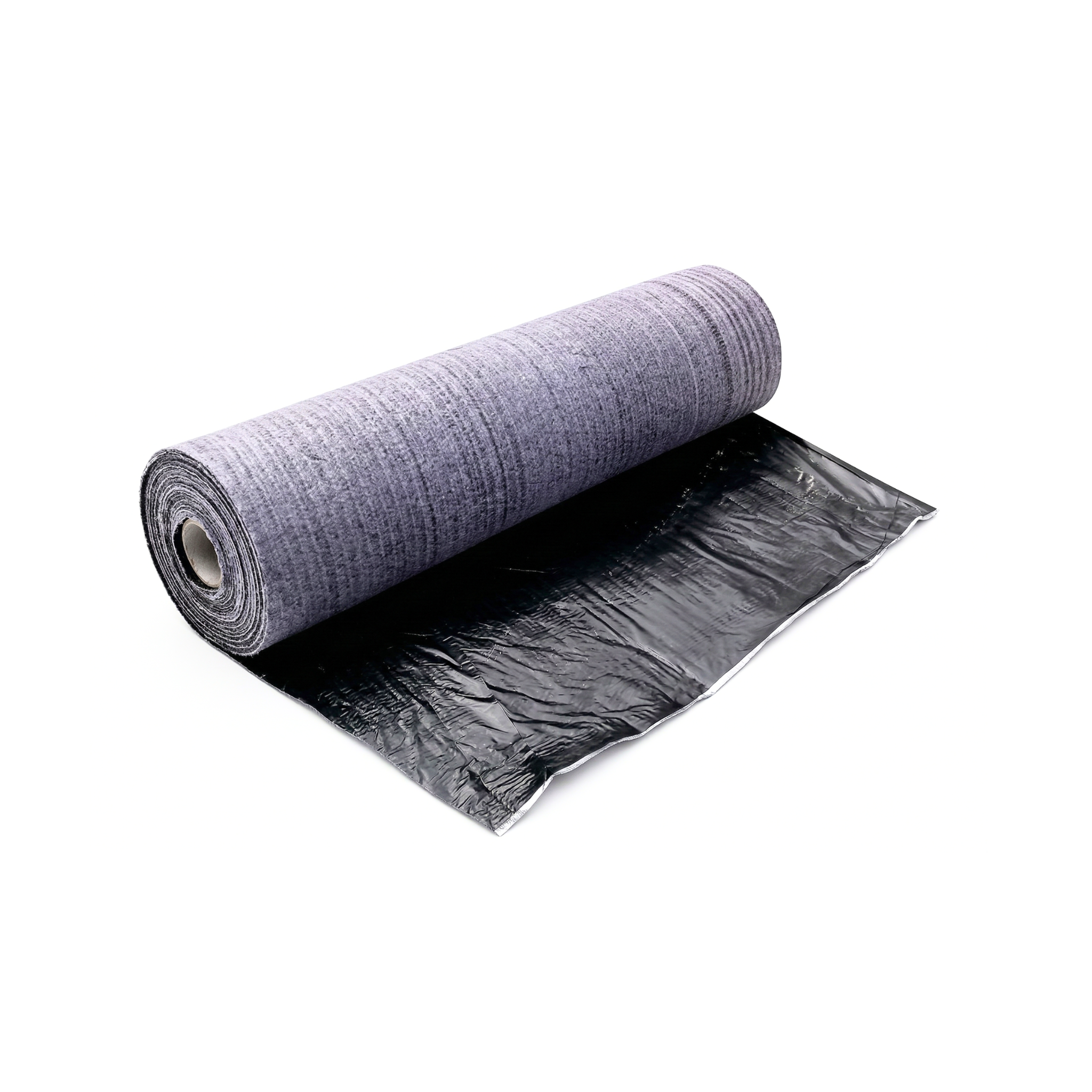
This guide covers the installation of the geosynthetic clay liner (GCL): subgrade preparation, perimeter anchor trench excavation, roll deployment, overlap execution, perimeter anchoring and covering within 24 hours. Follow these steps to seal the bottom of ponds, landfills or contaminated areas with the bentonite barrier that self-seals upon hydration.
Product specifications
The GCL is a sandwich-type system with two geotextiles that confine a layer of natural sodium bentonite in powder or granular form. Upon hydration, the bentonite swells up to 15 times its dry volume and forms a continuous impermeable seal. The Dodom range is offered in a single standard configuration sized for hydraulic works and waterproofing projects with contractual audit.
| Specification | GCL clay barrier |
|---|---|
| SKU | 537587 |
| Type | Bentonite geocomposite |
| Core | Natural sodium bentonite |
| Function | Self-sealing impermeable barrier |
| Roll width | 5.8 m (19 ft) |
| Roll length | 40 m (131 ft) |
| Coverage per roll | 232 m² (2497 ft²) |
Step by step on how to use it
The GCL is a sensitive material: the bentonite must remain dry until the exact moment it is covered and confined by its top layer. All job planning revolves around not exposing it to rain or hydrating it prematurely. Follow these steps in strict order.
Prepare the subgrade
Level and compact the surface until it is smooth, firm and free of sharp objects (stones, roots, debris). Any protruding element can puncture the GCL when placing the top layer. The surface must be dry at the time of installation.
Excavate the perimeter anchor trench
Around the perimeter of the area to be waterproofed, dig a trench 50 cm (20 in) deep by 50 cm (20 in) wide. This is the GCL's fixing point: the edge is buried inside and backfilled with compacted soil. Without that trench, the material shifts during covering.
Deploy the rolls
Roll out the sheets perpendicular to the main slope, starting from the highest elevation and working down. Handle the material carefully: the GCL is very heavy when hydrated, but when dry it is fragile under sharp folds. Use a spreader bar or mechanical equipment whenever possible.
Execute the overlaps
Overlap 30 cm (12 in) at transverse joints and 15 cm (6 in) at longitudinal joints. Spread powdered bentonite (300 g/linear m) between the two layers of the overlap before closing it. That extra bentonite is what seals the joint when everything hydrates. Without it, the overlaps are the weak point of the system.
Anchor the perimeter
Insert the edge of the GCL into the perimeter trench, backfill with soil and compact. If the works connect to concrete structures (walls, spillway, chamber), use Poly Lock or a mechanical system to seal the contact. The GCL–concrete junction is the other critical leakage point.
Cover within 24 hours
Place the top layer (HDPE geomembrane in composite systems, or cover soil at least 30 cm thick in simple systems) on the same day. The bentonite must be confined before it comes into contact with water. Once covered and confined, the natural hydration of the ground activates it progressively.
Plan the installation in sectors that you can complete and cover on the same day. If the project is large, divide the area and work one sector each day, leaving the next day's rolls protected in their original wrapping. That way you will never have exposed GCL pending cover when a rainy afternoon arrives.
Do not leave the GCL exposed to rain before covering it. If the bentonite hydrates without being confined, it swells freely, turns into a gel, loses internal structure and stops sealing. Once hydrated outside the impermeable sandwich, the material is unrecoverable: the entire affected sector must be replaced. No shortcuts.
Complementary products
For a professional installation of the GCL in audited hydraulic works, the following complementary items cover the functions of top layer, anchoring to structures and temporary fixing.
The HDPE polyethylene geomembrane is the top layer of the composite system mandatory in landfills and works with contractual audit. The Poly Lock resolves the sealing of the GCL with concrete structures (spillways, inspection chambers, perimeter walls): it is the only professional way to close the transition between geocomposite and concrete. The anchor cap is used for temporary fixing of the GCL during installation, especially on steep slopes.
Maintenance and care
A well-installed and confined GCL is a long-life system that requires no specific maintenance. Care focuses on prior storage and on avoiding subsequent punctures:
- Storage of uninstalled rolls: in a covered place, on pallets, with the original wrapping sealed. The bentonite absorbs ambient moisture: if the rolls get wet in storage they become unusable before reaching the site.
- Do not walk on the bare GCL: the weight of personnel on uncovered rolls compacts the bentonite and creates areas of reduced thickness. If you have to cross, use wooden boards as a walkway.
- Document the installation: photographically record each sector covered on the same day. On audited works, the site logbook with photos and times is what proves that the covering was done on schedule.
- Beware of nearby subsequent works: any later excavation close to the waterproofed area can compromise the system. Mark boundaries on the drawings and signpost them on site.
- Leftover bentonite: surplus powdered bentonite is not discarded: it is kept for future repairs of joints or overlaps.
Frequently asked questions
What happens if it rains on the GCL before covering it?
The wet sector becomes unusable. The bentonite swells without being confined, turns into a gel and loses structure. The affected area must be removed and replaced. There is no way to recover prematurely hydrated bentonite. That is why it is critical to plan the installation in sectors that can be covered on the same day and not have exposed stock on site.
Can I use GCL alone or do I need an HDPE geomembrane on top?
It depends on the works and the applicable regulations. Sanitary landfills and projects with environmental audit (ISO 14001) normally require a composite system GCL + HDPE geomembrane. Agricultural reservoirs, retention ponds and lower-demand works can use GCL alone with a cover soil layer. If the project has a specification or contractual audit, follow what the document states.
How much overlap between rolls must be respected?
30 cm (12 in) at transverse joints (head to head of consecutive rolls in the direction of deployment) and 15 cm (6 in) at longitudinal joints (between parallel rolls). In addition to the overlap, spread powdered bentonite inside the joint at a rate of 300 g/linear m. Without that extra bentonite the overlap is just geotextile on geotextile and does not seal.
