
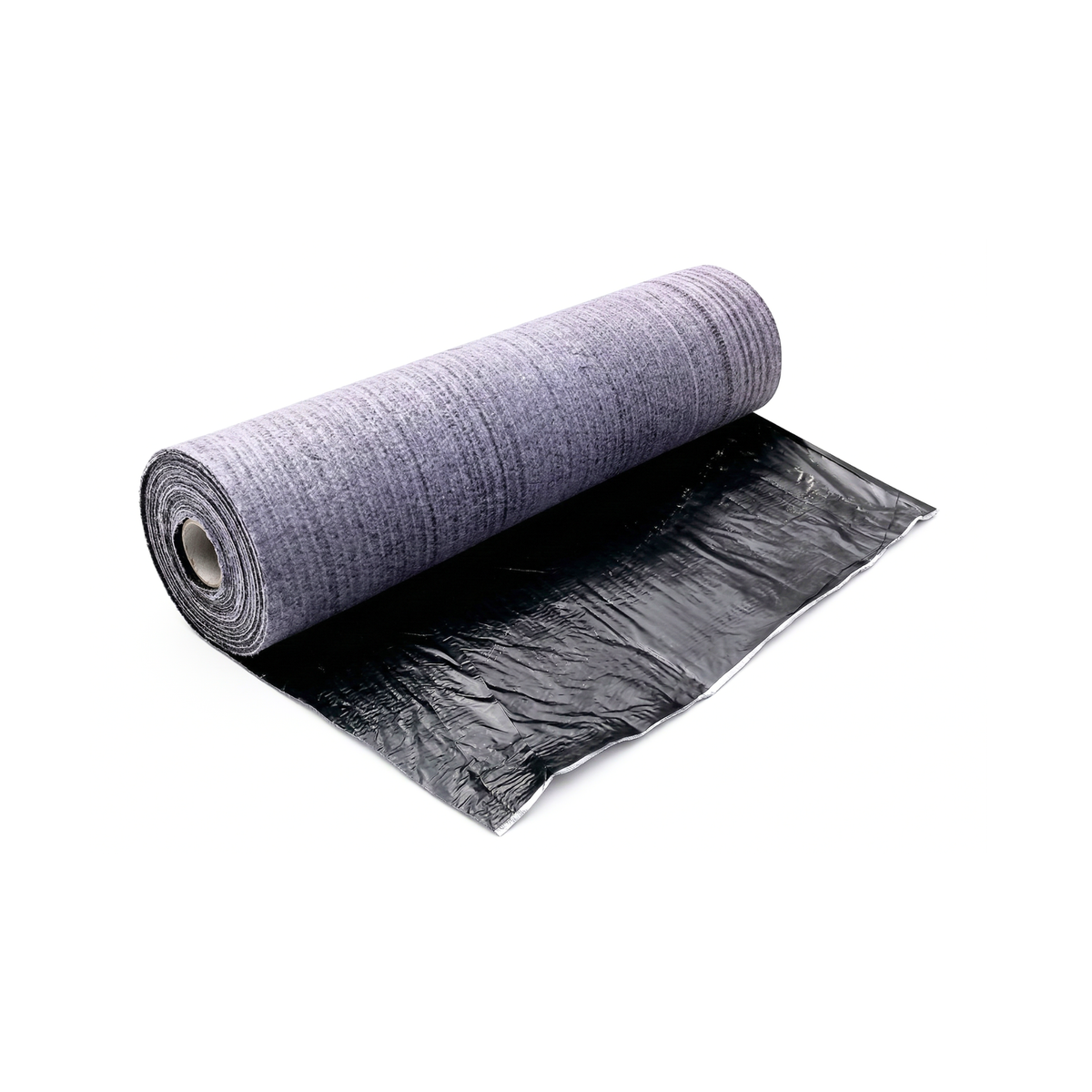
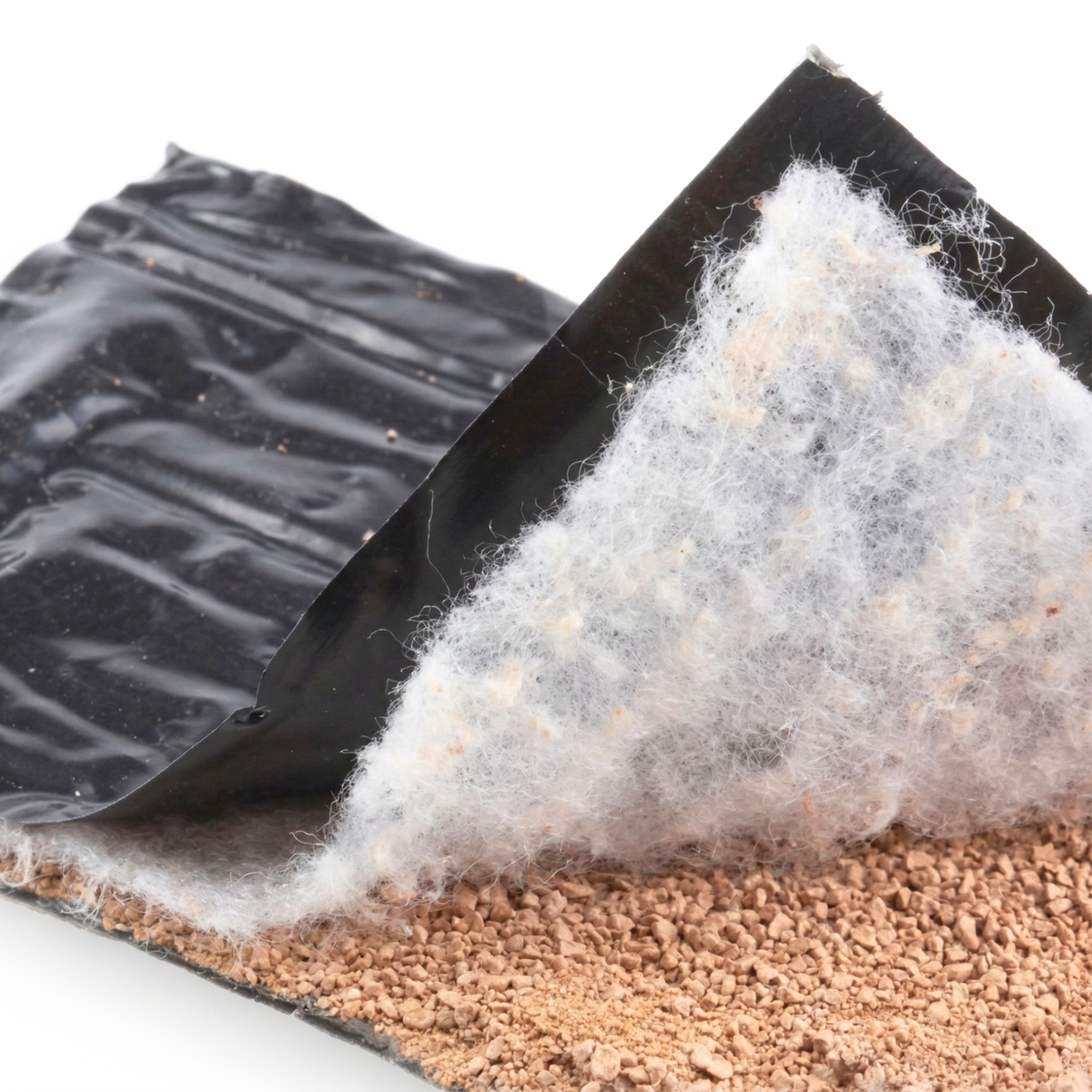


Lining sanitary landfill bases according to environmental standard ISO 14001, oxidation ponds and reservoirs with contractual auditing, where conventional HDPE geomembranes require neat welding and meter-by-meter pressure testing, demands a self-sealing sodium bentonite clay barrier geocomposite with self-protection capability. This clay barrier geocomposite (GCL) —also called geosynthetic clay liner, bentonite geomattress or bentonite GCL— is manufactured by MOLTEXO with a sodium bentonite core between two layers of needle-punched geotextile, in rolls 5.8 m wide and 40 m long, designed for landfills, mining, chemical containment, and hydraulic works with environmental criteria.
Key benefits
- Ultra-low permeability due to bentonite hydration: when moistened, sodium bentonite expands 10-15 times its dry volume, creating a monolithic layer with permeability lower than compacted site clay, a critical condition for landfills and leach pads with environmental auditing.
- Self-sealing capacity against perforations: if the barrier suffers a small perforation, the adjacent bentonite expands with the incoming water and automatically seals the breach, a differential advantage over HDPE geomembranes that require manual repair of each damage.
- Adaptation to ground irregularities: the flexible material adapts to curves, slopes, and irregular shapes without the need for cutting and welding, a differential condition compared to rigid geomembranes that require a flat prepared ground and complex welding for every change in geometry.
- Mechanical reinforcement with double geotextile: the upper and lower layers of needle-punched geotextile provide tensile and shear strength, protect the bentonite against perforation by stones, and ensure that the material withstands the thrust of the upper backfill for decades.
- Compatible with environmental criteria: sodium bentonite is a natural mineral without synthetic chemical compounds, an appropriate condition for projects with environmental auditing that require materials with low impact.
Typical applications and uses
- Lining of bases in sanitary landfills and backfill cells compliant with ISO 14001 or equivalent.
- Oxidation ponds, wastewater treatment plants, and industrial reservoirs requiring watertightness.
- Leach pads in mining and containment of chemical solutions in industrial projects.
- Artificial lakes, agricultural reservoirs, and landscaping works with water bodies requiring waterproofing.
Quality and durability
An economical GCL fails in two areas: the bentonite is calcium-based or of low mineral quality (resulting in significantly less expansion than quality sodium bentonite and much higher permeability than declared), and the confining geotextiles are sparse (leading to granule migration and areas lacking bentonite). MOLTEXO works with controlled-origin sodium bentonite and calibrated-weight geotextiles, which distinguishes an auditable environmental GCL from a generic geomattress that does not meet declared permeability.
Equivalences
Equivalent to these other-brand references:
- Roll 5.8 m (19 ft) wide and 40 m (131 ft) long
- NAUE BentofixCETCO BENTOMATBentomaxRAWMATMaccaferri MacLine GCL NMaccaferri MacLine GCL WSolmax BENTOLINER NW
Brands and references mentioned belong to their respective owners; cited only for comparison and compatibility.
How does the GCL clay barrier waterproofing actually work?
What's the function of the outer geotextile layers?
What does the GCL's self-sealing or 'self-healing' capacity mean?
Can it be installed permanently exposed to Caribbean sun?
Still have questions?
Ask us and we will gladly help you with whatever you need.
| Material and construction | |
|---|---|
| Composition | Woven geotextile + bentonite + PE film |
| Mass per unit area | ≥4000 g/m² (0.82 lb/ft²) |
| Dimensions and format | |
| Roll width | 5.8 m (19 ft) |
| Roll length | 40 m (131 ft) |
| Coverage area per roll | 232 m² (2497 ft²) |
| Estimated minimum roll weight | 928 kg (2046 lb) |
| Length and width tolerance | -1% |
| Strength and performance | |
| Tensile strength | ≥700 N/100mm (40 lb/in) |
| Elongation under maximum load | ≥10% |
| Peel resistance (PE and nonwoven) | ≥30 N/100mm (1.71 lb/in) |
| Peel resistance (woven and nonwoven) | ≥40 N/100mm (2.28 lb/in) |
| Hydrostatic resistance | 0.6 MPa, 1h, no leakage (87 psi, 1h, no leakage) |
| Hydraulics and filtration | |
| Permeability coefficient | ≤5.0 × 10⁻¹² m/s (1.64 × 10⁻¹¹ ft/s) |
| Fluid loss by filtration | ≤18 mL (0.61 fl oz) |
| Durability and protection | |
| Durability | ≥20 mL/2g |
| Physicochemical properties | |
| Methylene blue absorption capacity | ≥30 g/100g |
| Swell index | ≥24 mL/2g |
| Presentation and packaging | |
| Presentation | Roll 5.8 m (19 ft) wide × 40 m (131 ft) long |
 ASTM standards
| Roll: Width | 53.0 cm (20.87 in) |
|---|---|
| Roll: Height | 53.0 cm (20.87 in) |
| Roll: Depth | 580.0 cm (228.35 in) |
| Roll: Weight | 928.0 kg |
Official MOLTEXO warranty
What's covered
Confirmed defect: replacement or refund of the amount paid.
What's not covered
Payment & Security

