

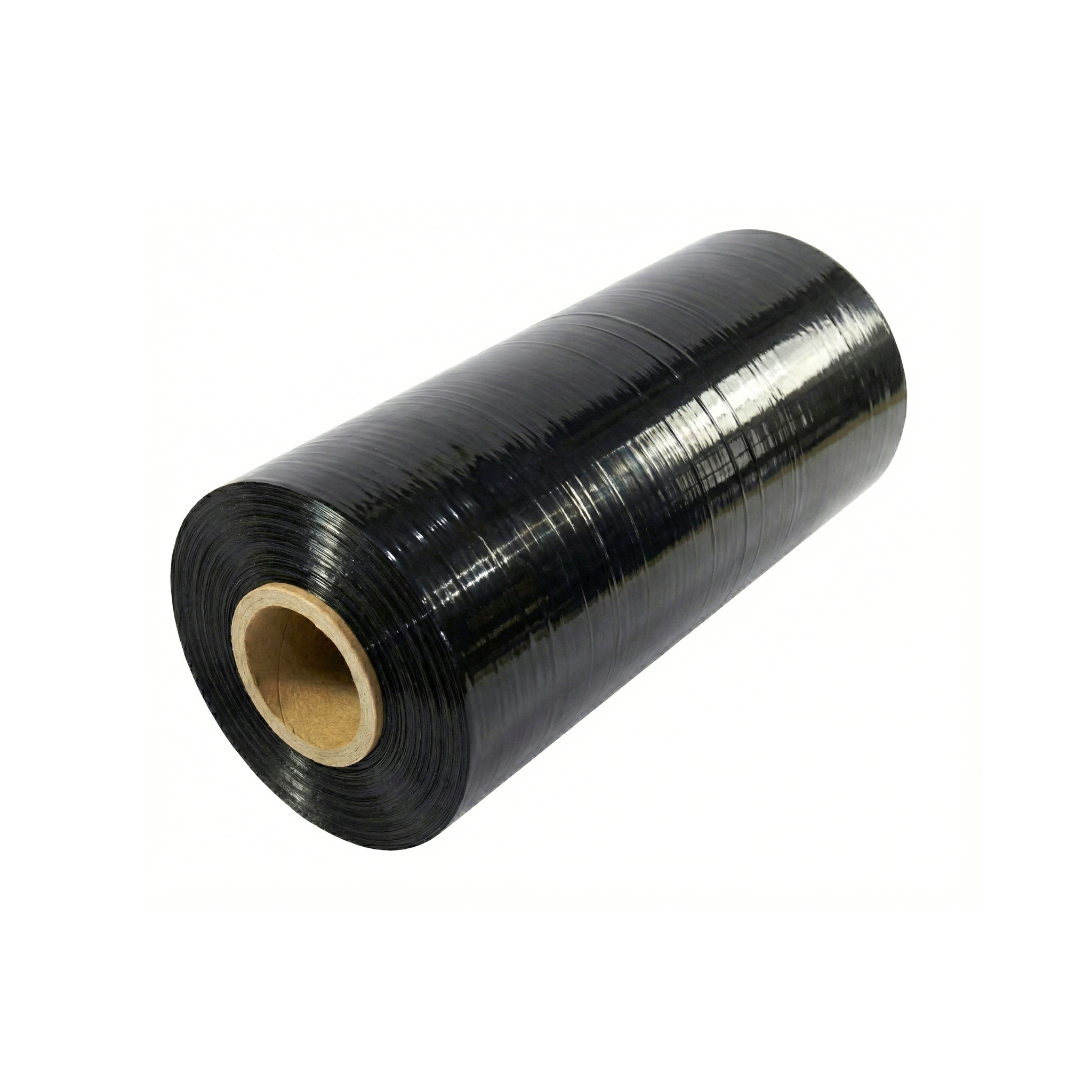
If your automated palletizing operation needs to conceal pallet contents in transit (confidential shipments, export of sensitive goods, pharmaceuticals or high-value electronics) or requires extra UV protection for pallets that sit under the Caribbean sun for several days, this Fortemo black machine stretch film is the opaque version with the same mechanical performance as the transparent one: 50 cm wide, 1500 m roll, gauge 90, multilayer coextruded LLDPE formulation with 200-300% prestretch without breakage. This guide explains how to set up the head and verify pigment quality between batches.
The mechanical application parameters are identical to those of the transparent machine film. The only real operational difference is the visual verification of the pigment between batches, which is covered in the first step. If your operation does not require opacity or UV blocking, the transparent one delivers the same mechanical closure at a lower cost.
Product specifications
The black machine stretch film is offered in a single standard presentation of 50 cm wide by 1500 m long, with UV-stable pigment integrated into the coextrusion. The following table lists the complete technical specifications of the only available variant:
| Specification | Value |
|---|---|
| SKU | 857354 |
| Material | Multilayer coextruded LLDPE + UV-stable black pigment |
| Color | Opaque black |
| Additional treatment | Integrated UV blocking |
| Width | 50 cm (20 in) |
| Length per roll | 1500 m (4920 ft) |
| Thickness | 23 µm (Gauge 90) |
| Prestretch capacity | 200-300% (on powered head) |
| Puncture resistance | High (multilayer structure) |
| Adhesion system | Calibrated differential cling |
| Compatibility | Turntable wrappers, rotary arm, mobile robots |
| Presentation | Single 1500 m roll |
The companion guide to the transparent machine stretch film applies the same setup parameters to the crystal-clear version, recommended when opacity and UV blocking are not factors and the lowest cost takes priority.
Step-by-step guide to using it
The operating procedure is identical to the transparent machine film, with one additional point: the visual verification of the pigment when loading each roll and between manufacturing batches. Each wrapper has specific parameters on its panel; the ranges indicated are for guidance and should be checked against your equipment manufacturer's manual.
Roll inspection and pigment verification
Roll inspection follows the same criteria as with the transparent one (no dents, no deformations, clean edges), with an additional step: verifying the consistency of the pigment. Unroll 1-2 meters of film and look at it against a strong light: the black should appear uniform and completely opaque. If semi-translucent areas or “mottling” appear where the pigment was poorly distributed at the factory, mark the roll as defective and report the batch to the supplier before processing it on the line —irregular pigment can go unnoticed in night-shift operation and compromise the actual confidentiality of the shipment—.
Head cleaning and mounting
Clean the head rollers with a dry cloth and isopropyl alcohol before loading the roll. In operations that alternate between transparent and black film, this cleaning is especially important: pigment residue from the previous black film can deposit on the rollers and partially “soil” the next transparent batch, in addition to affecting the prestretch. Place the roll on the roll holder with the inner (cling) side facing the pallet —the visual orientation check is harder with black, so it is advisable to mark the correct direction on the roll holder with adhesive tape as a visible reference—.
Prestretch and pattern configuration
The prestretch parameters are identical to the transparent film: 200-300% depending on the type of load. Stable loads 250-300%, mixed loads 200-250%, fragile loads 150-200%. The mechanical performance of the black is equivalent to the transparent —it requires no special adjustments due to opacity—. Configure the number of wraps at the base, body and top according to the operation.
For operations shipping valuable goods abroad with a real risk of theft in transit, consider alternating two colors: 80% of the pallet with black film (closure plus opacity) and a central ring with two wraps of transparent film of the same gauge. The transparent band acts as a visual inspection seal: if it arrives cut or replaced at the destination, there is immediate evidence of tampering during the journey. It is a passive security layer that adds no significant cost and provides visual traceability.
Cycle start and uniformity verification
Start the cycle and observe the first three wrapped pallets. The texture should be uniform and the color of the applied film completely opaque. If you notice areas that reveal the pallet contents at certain angles, it is a sign of irregular pigment in the loaded roll (not in the head configuration). Change the roll and check the entire batch. For operational auditing, record the manufacturing batch of each loaded roll to correlate incidents with production quality.
Maintenance between changes and batch traceability
The mechanical maintenance between changes is the same as with the transparent one (roller cleaning, axle verification). Additional for operations with black film: keep a simple record of which rolls were used in which shift and which pallets they covered. If a customer reports a pallet with irregular pigment at the destination, this record makes it possible to identify the responsible manufacturing batch and prevent the rest of the batch from reaching other customers.
Do not mix rolls from different manufacturing batches in the same night-shift operation without verifying uniform pigment between them. Even if the formulation is identical in spec, different batches may have minor visual color variation (more matte, more glossy, slightly darker) that becomes noticeable when pallets from the same shipment arrive at the customer with an uneven appearance. For critical shipments where appearance matters (premium export, retail), use rolls from the same batch or segment the operation by roll.
Complementary products
To complement the black machine film in industrial palletizing operations with opacity or UV protection requirements, the following products cover the most common adjacent needs:
The transparent machine stretch film is the crystal-clear version with the same mechanical performance, recommended when opacity and UV protection are not factors and the lowest cost per pallet takes priority. The polypropylene (PP) strapping complements the black film in heavy export operations: two turns of strapping over the film close the pallet with additional fastening for long road transits. The open-mouth big bag palletized and wrapped with black machine film plus strapping is the usual combination in the export of aggregates sensitive to visual inspection of the batch. The plastic edge protectors protect the four corners of the pallet from strapping cuts, especially when film plus strapping is combined over loads with sharp edges.
Maintenance and care
The black machine film rolls require the same storage care as the transparent ones: vertical position, cool interior, on a flat surface, away from direct sunlight. Direct UV radiation on the stored roll does not degrade the applied film (which is protected by its own UV additive) but it does degrade the cling of the inner side and may marginally affect the consistency of the pigment in the exposed area. In a warehouse with a metal roof exposed to the Caribbean sun, it is advisable to store the rolls in a specific area protected from direct radiation.
For operations that keep batch records (recommended for export shipments), keep the manufacturing sticker of each roll together with the date of use. This traceability makes it possible to identify which pallets correspond to which supplier batch in the event of an incident with pigment quality or mechanical performance. The practice adds 30 seconds per roll change and provides audit capability that, in critical operations, pays for itself with the first incident.
Frequently asked questions (FAQ)
Does it have the same mechanical performance as the transparent one?
Yes. The multilayer coextruded LLDPE formulation is identical in structure and properties: the UV-stable black pigment is integrated into the coextrusion without affecting elongation, puncture resistance or prestretch capacity. The head configuration parameters (200-300% prestretch, wraps at base/body/top) are the same. The only difference perceptible in operation is the visual verification of the pigment between batches, not the mechanical operation itself.
Is it compatible with all wrappers that use transparent film?
Yes, with no known exceptions on standard wrappers (turntable, rotary arm, mobile robots). If your operation alternates between transparent and black, it is advisable to clean the head rollers between changes to avoid residual pigment carryover to the next transparent batch. Wrappers with optical sensors for detecting the start or end of the roll may require a sensitivity adjustment for the opaque film; consult your equipment manual.
When is the extra cost of black vs transparent really worth it?
The practical rule is: if fewer than 30% of your pallets have a specific opacity or UV protection requirement, it is inefficient to wrap everything in black by default. Identify the SKUs or destinations that justify the black (confidential products, export to destinations with questionable handling, photosensitive goods, pallets with prolonged outdoor storage) and reserve the black line for those. For the rest, the transparent covers the mechanical closure at the same level at a lower cost.
