

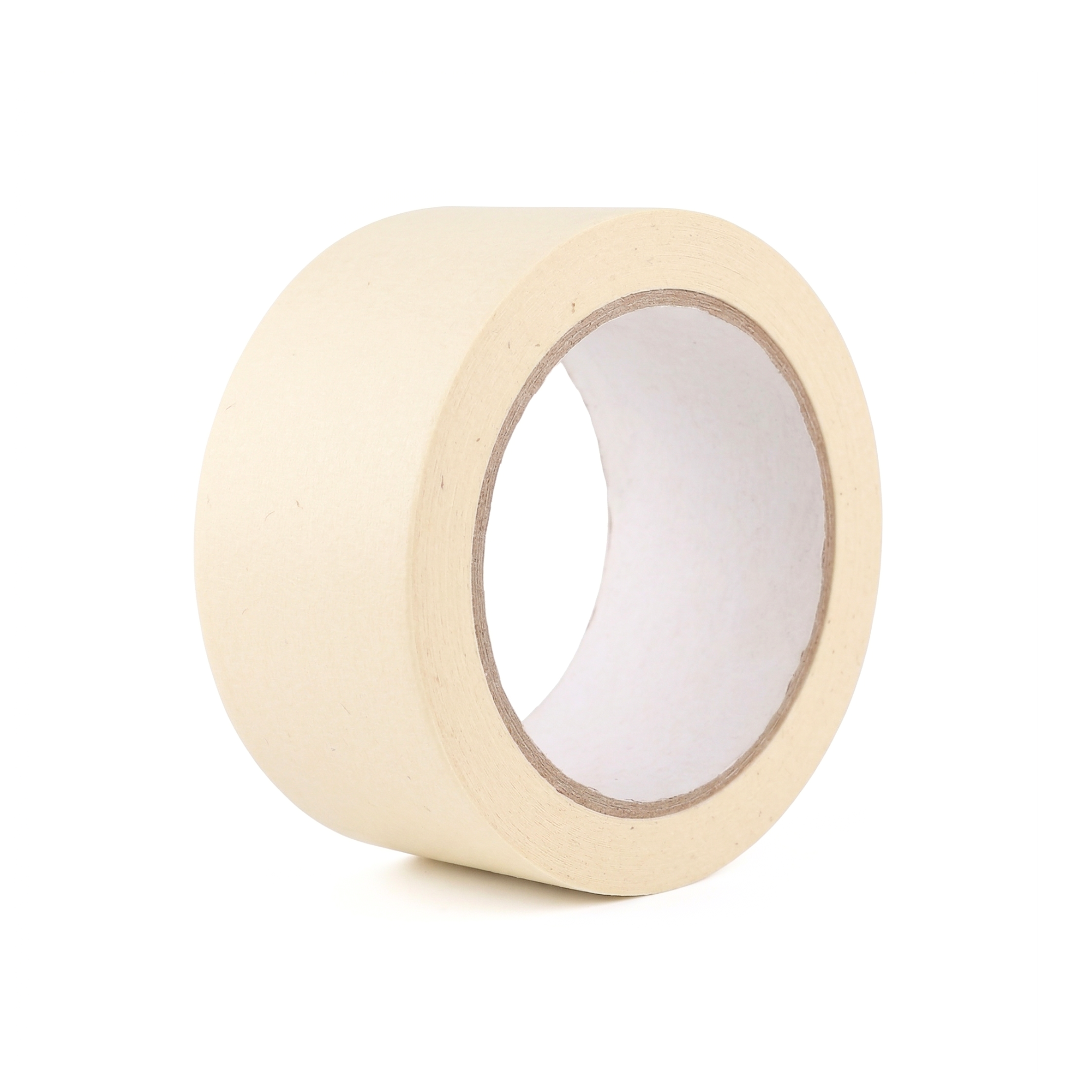
This guide covers the correct application of paper masking tape: choosing the width, cleaning the surface, applying along the exact line, sealing the edge and removing at the right time. Follow these steps to get clean edge masking: straight lines, no paint bleed and no residue on removal.
Product specifications
The tape is cream crepe paper with a rubber adhesive calibrated for clean removal within 24-48 hours of application. The difference between the three variants is the width, which is chosen according to the line to be masked and the size of the job. Find your variant by SKU below.
| Specification | 25 mm / Box of 18 | 50 mm / Box of 9 | 72 mm / Box of 6 |
|---|---|---|---|
| SKU | 643243 | 256213 | 945632 |
| Tape width | 25 mm (1 in) | 50 mm (2 in) | 72 mm (3 in) |
| Length per roll | 55 m (60 yd) | 55 m (60 yd) | 55 m (60 yd) |
| Material | Crepe paper | Crepe paper | Crepe paper |
| Adhesive | Rubber | Rubber | Rubber |
| Color | Cream | Cream | Cream |
| Rolls per box | 18 rolls | 9 rolls | 6 rolls |
| Recommended use | Fine lines, detail masking | General painting use | Wide edges, large-area protection |
| Brand | Fortemo | Fortemo | Fortemo |
Step-by-step usage
Professional masking follows three principles: application on a clean, dry surface, firm pressure on the edge to be protected, and removal within a reasonable time (ideally when the paint is dry to the touch but not fully cured).
Choose the width based on the line to be masked
The tape width should match the level of detail of the job. Tape that is too narrow lifts at the edges; tape that is too wide is hard to apply along curved lines.
- If you have the 25 mm variant (SKU 643243): ideal for masking slim window frames, fine moldings, joints between parts and curved lines in detail projects.
- If you have the 50 mm variant (SKU 256213): the standard format for general interior wall painting. It covers baseboards, door frames and color transition lines.
- If you have the 72 mm variant (SKU 945632): for protecting large areas in a single pass or holding protective plastic sheeting over furniture and floors while painting.
Clean the surface before applying
Dust, grease and moisture reduce the rubber adhesive's initial tack. Wipe moldings, frames and baseboards with a dry cloth before applying the tape. If the surface has construction dust, remove it with a dry brush. Existing paint must be fully cured (at least 7 days); never apply over fresh paint or a recently applied satin finish.
Apply the tape along the exact line
Peel off 30-40 cm and apply by hand along the line to be protected, without stretching the tape. Stretching crepe paper deforms it, and as it recovers its tension it peels off on its own. Work in short sections and smooth with your finger, especially along the edge that will meet the new paint.
Seal the edge with a fingernail or spatula
Run your fingernail, a plastic spatula or the edge of a card firmly along the tape edge facing the area to be painted. This seal is what keeps the new paint from seeping underneath and leaving a ragged line at the edge.
To get perfect lines at color transitions, apply a first thin coat of the base color (the wall's existing color) over the tape edge before painting the new color. That coat seals the microscopic bleed paths under the crepe, so by the time you apply the new color, any possible gaps have already been filled with the original color. The result is a perfectly straight line with no extra touch-up work.
Paint and remove at the right time
Paint as usual. Remove the tape when the paint is "dry to the touch" but not yet fully cured (1 to 4 hours depending on paint type and room temperature). Pull the tape back on itself at a 45° angle, slowly and steadily. Never leave it on for more than 48 hours: the adhesive turns aggressive and can tear off the existing paint on removal.
Complementary products
Masking tape is often combined with tapes made of other materials for tasks crepe paper does not cover: permanently securing protective plastic, sealing in hot or damp areas, and labeling boxes after the painting job.
The Clear manual PP tape is used when you need to hold protective plastic sheeting over furniture or floors for more than 48 hours, where masking tape turns aggressive, or to close and label boxes of materials and tools at the end of the day. The Aluminum tape is for masking in hot areas (near hot pipes, ducts or outdoors under prolonged sun), where crepe paper dries out and stops working.
Maintenance and care
Crepe paper is sensitive to moisture and heat. Stored properly, the rolls keep performing for months; stored poorly, they harden or lose tack within a few weeks.
- Indoor storage, away from moisture: keep the rolls in their original box in a dry area, away from bathrooms, laundry areas and spots with condensation. Moisture softens the paper, which then tears as you pull it during application.
- Away from heat sources: sustained heat hardens the rubber adhesive. A roll left in the sun in the work van for weeks loses its clean-removal property and tears off paint when peeled.
- Tab the end of the roll: after each use, fold the free end back on itself about 2 cm so it does not stick to the roll and is easy to peel next time. It is a small detail that saves minutes at the start of every workday.
Do not leave masking tape on for more than 48 hours, especially over existing paint. The rubber adhesive is calibrated for clean removal within 24-48 hours; beyond that, the adhesive turns aggressive and pulling off the tape rips away the paint underneath, leaving "bald spots" that force you to repaint the entire wall. If for some reason it must stay on longer, remove it and reapply fresh tape every 48 hours.
Frequently asked questions
Can I use masking tape to ship packages instead of packing tape?
It is not recommended. Masking tape's rubber adhesive is calibrated for clean removal, not for a permanent seal: with transport vibration and handling, boxes sealed with masking tape come open. For carton sealing use clear manual PP tape, which has an acrylic adhesive sized for transit.
Does it work on a damp or freshly painted surface?
No. The rubber adhesive needs a completely dry surface and cured paint (at least 7 days) to bond properly. Applied over moisture, the tape lifts on its own; applied over fresh paint, removing it tears the new paint away along with the masking tape. If you are masking for a second coat of paint, wait until the first is dry to the touch and apply with moderate pressure.
What is the difference between 25, 50 and 72 mm masking tape?
Only the width. The material, adhesive and roll length are identical across the three variants. The 25 mm is for fine detail and curved lines; the 50 mm is the standard format for general painting; the 72 mm is for protecting large areas in a single pass or holding protective plastic sheeting. Many professional painters carry all three sizes in the van and choose by task.
